

Key takeaways
- Input prices for GPT-4-class capability fell about 200-fold in 42 months, yet OpenAI's newest flagship lists at $10 per million input tokens: the floor collapsed while the ceiling held.
- Cheaper tokens expand usage: agentic tasks can consume about 1,000 times more tokens, and McKinsey finds 44% of organisations scaling AI but only 6% booking material profit from it.
- Main risks: AI capex outpacing hyperscaler cash flow, revenue figures that labs define differently, and easy workload portability eroding any single provider's pricing power.
On 10 September 2026, DeepSeek made its V4.1 Flash model generally available at $0.15 per million input tokens off-peak. Twelve days later, Anthropic released Claude Opus 5.5 at $4 per million input tokens, 20% below its predecessor, and OpenAI cut prices on its mid and low tiers. Yet OpenAI's newest flagship, GPT-6 Astra, lists at $10 per million input tokens, five times its own GPT-6.1 Sol. AI inference pricing has split in two: the floor is collapsing while the ceiling holds. For investors in model developers, cloud providers and the companies building on them, the question is no longer whether intelligence gets cheaper, but who keeps the margin as it does.
How fast AI inference pricing is falling
When GPT-4 launched in March 2023, OpenAI charged $30 per million input tokens and $60 per million output tokens. In September 2026, DeepSeek V4.1 Flash, a model that exceeds GPT-4 on standard benchmarks, costs $0.15 off-peak and $0.30 at peak for the same million input tokens. On our calculation, that is a fall of roughly 200 times off-peak, and 100 times at peak, in about 42 months. The trend is not new: data from Stanford's AI Index, cited by McKinsey, shows the cost of GPT-3.5-level capability falling from $20 to $0.07 per million tokens by late 2024.
The mechanism is largely architectural. Sparse mixture-of-experts models activate only a fraction of their parameters for each token, so serving cost scales with active parameters while capability scales with the whole model. DeepSeek's V4.1 Flash, for example, activates 8 billion parameters on input and 16 billion on output from a 552-billion-parameter backbone.
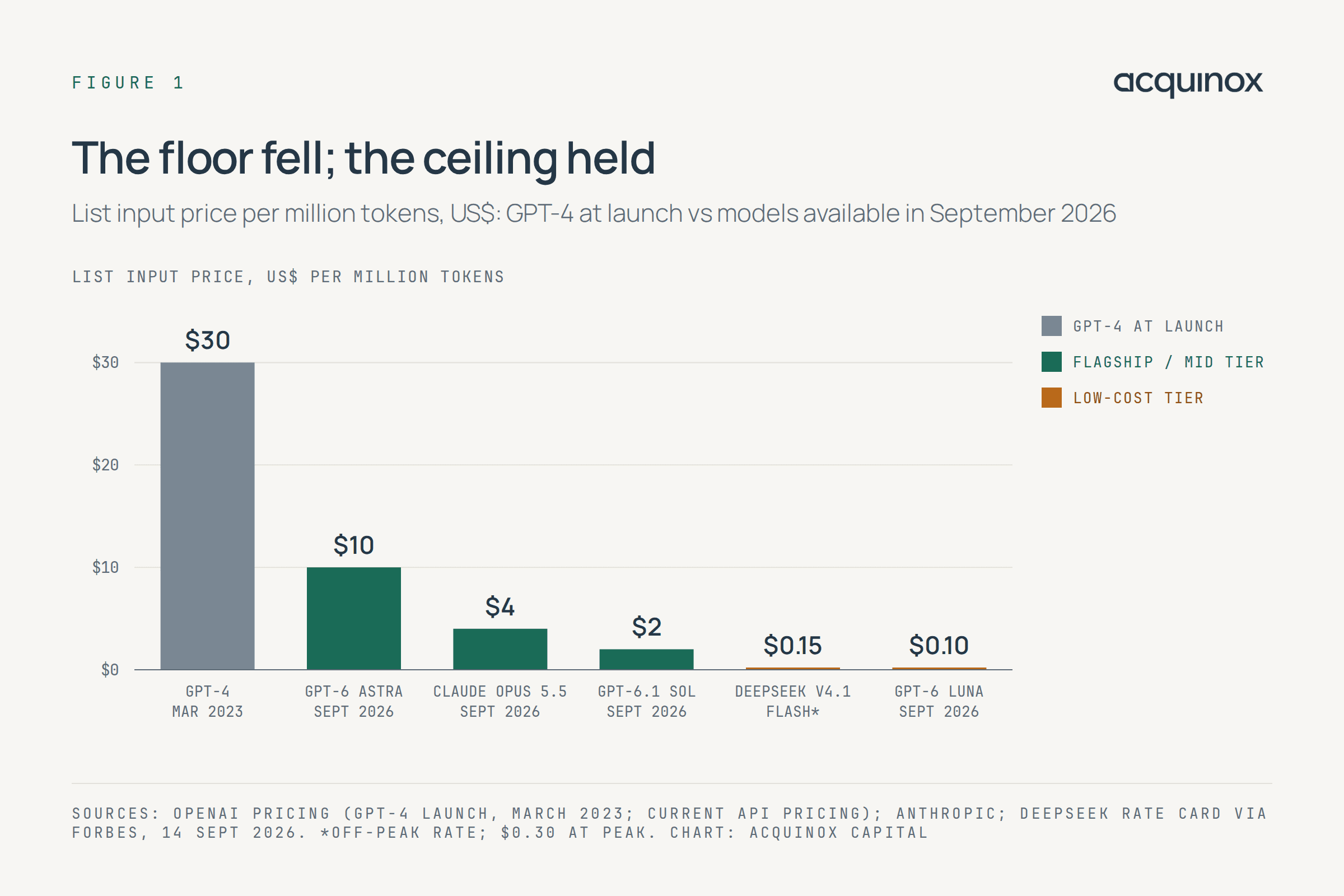
Figure 1. List input prices per million tokens: GPT-4 at launch in March 2023 against models available in September 2026. DeepSeek V4.1 Flash shown at its off-peak rate ($0.30 at peak).
The top of the market has moved differently. OpenAI prices GPT-6 Astra at $10 input and $50 output per million tokens, Anthropic prices Claude Opus 5.5 at $4 and $20, and both sell far cheaper tiers alongside. Providers are segmenting rather than simply cutting: commodity pricing for high-volume work, premium pricing for the most capable models.
Cheaper inference does not necessarily mean less infrastructure spending. Goldman Sachs Research estimates global AI investment at about $1 trillion in 2026, including $581 billion in the US. A separate Goldman Sachs Global Institute scenario, which it stresses is not a forecast, puts annual AI capex at $765 billion in 2026 rising to $1.6 trillion in 2031, and argues that if demand is elastic, cheaper compute reshapes who earns the margin rather than how much is spent.
Cheaper tokens, bigger bills
Price compression and demand expansion are happening together. McKinsey reports that agentic tasks can consume roughly 1,000 times more tokens than a single chat interaction, and that its own internal use had reached about five trillion tokens a month by May 2026. The same work notes that AI operating costs already constrain use for about one in five organisations: lower unit prices have not prevented total bills from rising.
Adoption is now broad, but profit is narrow. In McKinsey's State of AI 2026 survey of 1,719 respondents, 44% said their organisations are scaling AI across the enterprise, up from 38% a year earlier, but only 37% attribute any EBIT impact to AI, and just 6% qualify as high performers that attribute at least 5% of EBIT to it.
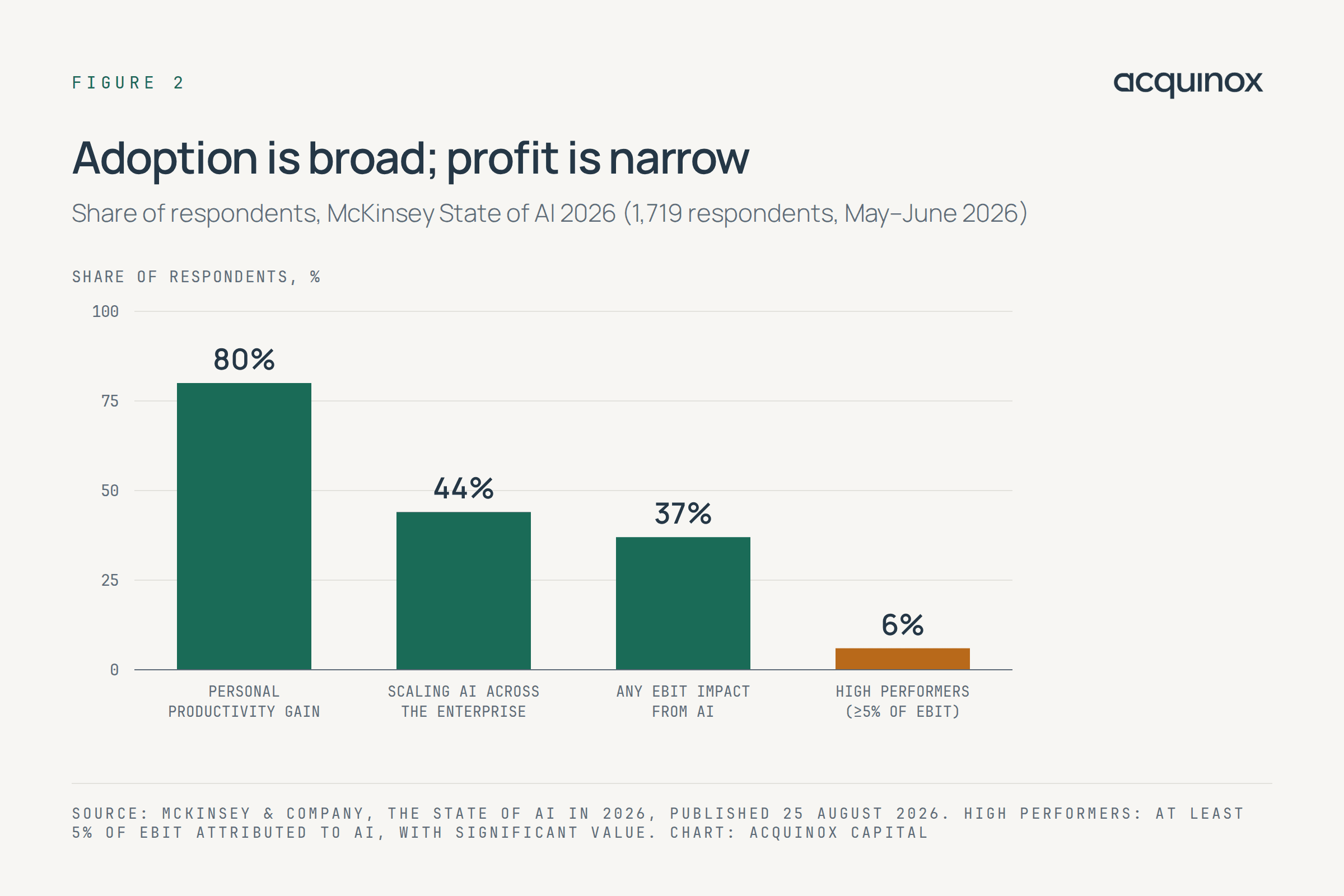
Figure 2. McKinsey State of AI 2026: share of respondents reporting personal productivity gains, enterprise-wide scaling, any EBIT impact, and high-performer status.
Capital has concentrated regardless. According to J.P. Morgan, 89% of venture capital went to AI start-ups in the first half of 2026, up from 65% in 2025, in a sector where falling prices are compressing unit economics at the bottom of the market.
The revenue test for frontier labs
The two largest model developers show both sides of the paradox. Anthropic's annualised revenue run rate passed $65 billion at the end of July, and its preliminary second-quarter revenue of more than $11.5 billion was over 14 times the prior year, according to documents reported by Bloomberg. OpenAI told investors its annualised revenue was approaching $50 billion as of 30 September, about $20 billion below the figure that had circulated among investors, a gap attributed to gross revenue from partnerships.
The two figures are not directly comparable. The companies calculate annualised revenue differently: Anthropic counts sales made through its cloud partners, while OpenAI does not. That accounting choice is itself a value-capture question, because it shows how much of the end customer's spend passes through hyperscalers that also supply the compute.
Both labs are approaching public markets. Anthropic is reported to be preparing a listing in November and to be sharing third-quarter figures with large investors this month; OpenAI's listing is expected in 2027. The first public pricing of a frontier lab will test whether growth, retention and margins can hold as prices fall, the question we examined in our analysis of pacing and frontier-lab economics and the 2026 IPO pipeline.
Where value accrues as intelligence gets cheaper
| Layer | Price direction | Potential source of pricing power | Main pressure |
|---|---|---|---|
| Compute and data centres | Rising capital cost: $15–20 million per MW for next-generation AI facilities versus about $10 million for traditional cloud | Scale, power access, long-term contracts | Capex outpacing cash flow; overbuild if returns disappoint |
| Frontier model labs | Flagship prices holding; lower tiers cut by 20% to 50% in September 2026 | Enterprise workflows, trust and safety record, distribution | Workload portability; revenue that depends on partners |
| Low-cost and open-weight models | Floor at about $0.10–0.15 per million input tokens | Volume, cost leadership | Thin margins; constant price competition |
| Applications and distribution | Input costs falling | Customer interface, embedded workflows, proprietary context | Competition passing savings to customers |
Source: Goldman Sachs Global Institute (data centre costs, May 2026); company pricing pages (September–October 2026); Acquinox analysis.
In our view, returns in this phase are likely to accrue to the stickiest customer relationship rather than the fastest model. Enterprises increasingly place workloads by volume, sensitivity and quality threshold: flagship APIs for expert reasoning, cheaper or open models for high-volume tasks, and private deployments for regulated work. The easier it is to move workloads between those tiers, the weaker any single provider's pricing power. Labs and applications that become embedded in customer workflows, with the governance that regulated industries require, should hold more defensible revenue than those competing on benchmarks alone. Regulation reinforces this: the EU AI Act has applied obligations to general-purpose AI model providers since August 2025, raising the value of a credible compliance record. We first examined this dynamic in our analysis of inference economics and of AI revenue models.
The risks that matter
Capex is outpacing cash flow
The Bank for International Settlements' 2026 Annual Economic Report notes that the five largest hyperscalers are set to spend more than $1 trillion on AI-related capex across 2025 and 2026, commitments that outpace their earnings and free cash flow and have led some to issue debt. It warns that disappointing returns could turn the boom into a protracted investment bust.
Opaque financing links
The BIS also describes hyperscalers, chip makers and AI labs as linked through a complex web of private arrangements. When the same companies are investors, suppliers and customers of one another, revenue and demand signals become harder to read.
Revenue quality and comparability
Annualised run rates extrapolate short periods, and the two leading labs define them differently. Until filings standardise the measures, headline revenue comparisons can overstate how much value the model layer captures.
Commoditisation reaching the top tier
Flagship pricing holds today because the most capable models still command a premium. If cheaper and open-weight models close the gap on the tasks enterprises value most, the ceiling will come under the same pressure as the floor.
A slow productivity payoff
The OECD's modelling suggests AI could add 0.4 to 1.3 percentage points a year to labour productivity growth in high-exposure G7 economies over a decade. That is a real but gradual payoff, against an investment cycle priced for speed.
What to monitor next
Five indicators will show where value settles: the gap between flagship and floor prices per token; net revenue retention and gross margin per token disclosed in the labs' registration statements; whether revenue definitions are standardised in those filings; hyperscaler capex relative to operating cash flow; and the share of companies reporting EBIT impact from AI in next year's surveys.
Intelligence is getting cheaper at a pace few technologies have matched, and usage is rising to meet it. The AI investment cycle is entering a phase in which returns depend less on producing the most capable model and more on owning the workflow, the customer relationship and the trust that keep demand in place when a cheaper alternative is a configuration change away.
This article is for informational purposes only and does not constitute investment advice or an offer to buy or sell any security. It reflects publicly available information and estimates as of the publication date, which may change. Private market investments involve substantial risks, including illiquidity and potential loss of capital. Readers should conduct their own due diligence and consult qualified advisors before making investment decisions.