

Key takeaways
- Research firms estimate 19,000 to 25,000 humanoids shipped in H1 2026, almost all from Chinese vendors, while the US now bars new foreign-made robot models unless the Department of War approves them.
- US measures are narrower than headlines suggest: existing models stay legal, the rule covers all foreign producers including allies, and the Section 232 action has imposed no tariffs yet.
- Main risks: dependence on Chinese-processed rare-earth magnets, US valuations ahead of volumes, shipments that are not yet productive work, and policy that may change within months.
Two industrial models for robotics are hardening at once. In China, humanoid makers are scaling: three research firms estimate that 19,000 to 25,000 humanoids shipped in the first half of 2026, almost all from Chinese vendors. In the US, policy is building walls: since 28 July, new foreign-produced robot models cannot obtain FCC authorisation without approval from the Department of War, and on 28 October a Section 232 proclamation declared robotics imports a threat to national security. On 5 November, Agility Robotics began trading on Nasdaq as the only US-listed pure-play humanoid company. For investors, the question is where value will sit in a robotics supply chain that is splitting along political lines.
China is winning on volume, not yet on productive work
Estimates of humanoid shipments differ, but they agree on direction and on who leads. Counterpoint Research counts more than 22,000 units in H1 2026, up nearly 300% year on year, with the top five vendors, all Chinese, accounting for 86%. Smart Analytics Global counts 19,100 units, and IDC almost 25,000, with Chinese vendors building more than 95% of them. AgiBot leads in all three datasets, shipping about 9,700 units in Counterpoint's count, ahead of Unitree with more than 7,000.
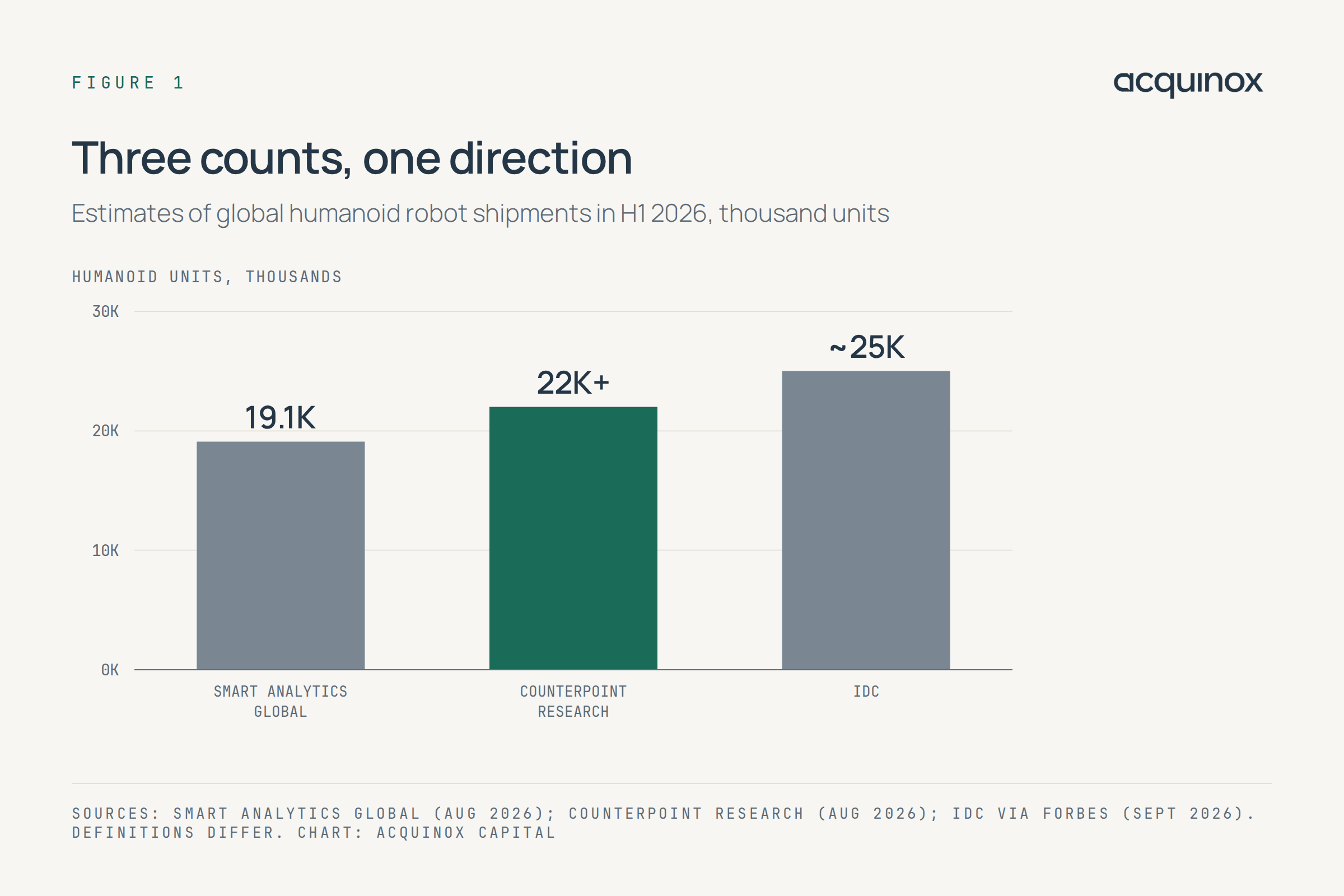
Figure 1. Three estimates of global humanoid shipments in H1 2026, all led by Chinese vendors: Smart Analytics Global 19,100; Counterpoint more than 22,000; IDC about 25,000.
Volume is not yet the same as work. Counterpoint finds that entertainment, performance, data production and research still took more than 60% of first-half shipments, against about 13% for manufacturing and 5% for warehousing and logistics. These estimates also count far more units than the IFR's tally of about 7,000 full-size humanoids sold in 2025, which covers only industrial and professional machines taller than 140cm, as we set out in our analysis of humanoid deployment.
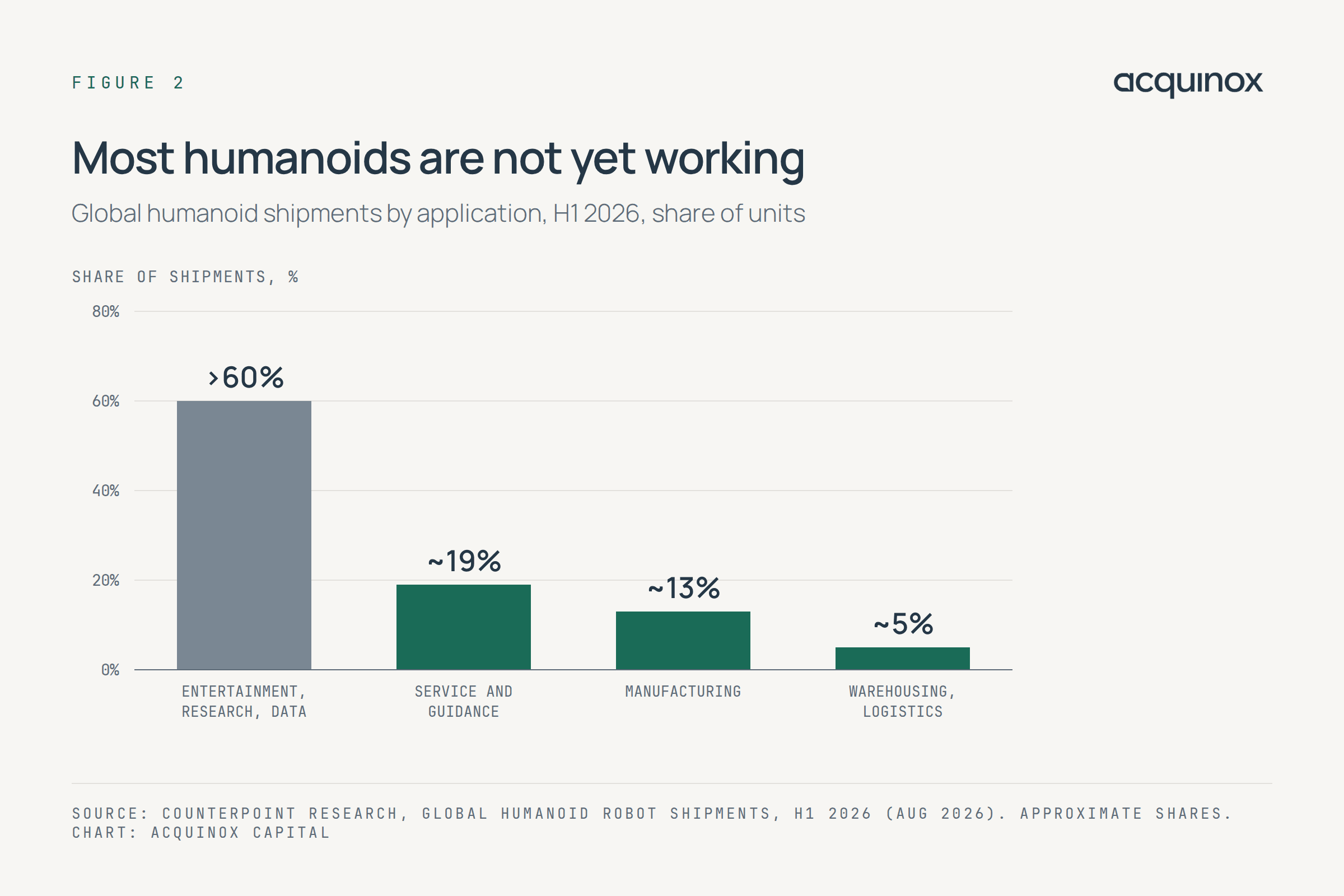
Figure 2. Humanoid shipments by application in H1 2026: more than 60% went to entertainment, research and data production, against about 13% for manufacturing and 5% for logistics (Counterpoint).
Public markets are already testing the volume story. Unitree priced its Shanghai IPO at a valuation of about $9 billion in August, rose more than fivefold on its debut and later fell about 55% from its peak. Its first results as a listed company showed third-quarter revenue up 70% but net profit down 17.4%, around half the analyst forecast, as research spending rose 250% and inventory nearly tripled to 1.02 billion yuan.
Washington's restrictions are narrower than the headlines
On 28 July, the FCC added "foreign-produced advanced robotic devices", including humanoids, quadrupeds and autonomous mobile robots, to its Covered List. New models on the list cannot receive the equipment authorisation needed to import or sell them in the US. The rule is narrower than it sounds. Models authorised before 28 July remain legal, robots that qualify as domestic end products are not covered at all, and producers can seek a Conditional Approval from the Department of War, which alone decides for robotics. Approvals have been granted since September, mainly for industrial and service robots rather than humanoids.
The rule also applies whatever the producer's nationality. A robot made in Japan, Korea or Germany needs the same approval as one made in China, which complicates the assumption that allied supply will simply replace Chinese supply.
Trade policy has moved more slowly. The Section 232 proclamation of 28 October covers robotics, industrial machinery and components from all countries, but imposes no tariffs. It directs the Commerce Department and the US Trade Representative to negotiate with trading partners and report within 180 days, by around 26 April 2027, with tariffs, quotas, fees or domestic investment incentives available as later remedies.
The result is the beginning of a two-tier market: an approved, trusted-supply tier for defence, critical infrastructure and government buyers, and an open commercial tier exposed to Chinese cost competition. The pattern is familiar from defence technology, where autonomous systems are already bought on trust as much as price. The US is already paying for trusted supply in adjacent categories: its Drone Dominance programme plans to spend about $1 billion buying more than 200,000 small drones by 2027 from a domestic industrial base.
Actuators, not algorithms
Investors often treat robotics as an AI story, but the bill of materials points elsewhere. McKinsey estimates that actuators, the motor-and-gearbox assemblies that move each joint, account for 40% to 60% of a humanoid's hardware cost.
| Layer | Share of bill of materials | Supply-chain readiness |
|---|---|---|
| Actuators | 40–60% | Least developed supplier base; dependent on rare-earth magnets |
| Sensing and perception | 10–20% | Force and tactile sensing still immature |
| Compute and control | 10–15% | Most mature layer; integration and certification are the constraints |
| Structure and battery | 10–20% combined | Largely commoditised |
Source: McKinsey & Company, Turning humanoid supply chain constraints into billion-dollar wins (April 2026).
The deeper dependence sits upstream. High-torque actuators rely on rare-earth permanent magnets, and China accounts for about 69% of rare-earth mining and about 90% of magnet processing and refining, according to McKinsey. Chinese suppliers also benefit from their overlap with the electric-vehicle supply chain, which shares motors, power electronics and magnets with humanoids. Assembling robots in the US without addressing magnet supply shifts the exposure rather than removing it.
Allied hubs: positioning, not proof
Korea's state-backed K-Humanoid Alliance and Japan's strength in precision components make both countries candidates for "China plus one" sourcing. But no robotics-specific framework yet rewards allied supply: the FCC rule treats allied producers like any other foreign producer, and the Section 232 negotiations have only just begun. Investors betting heavily on allied regionalisation are anticipating policy rather than following it.
Model leadership versus deployment scale
The US still leads in frontier AI, but by less than it did. Stanford's 2026 AI Index finds the US produced 50 notable AI models in 2025 against China's 30, while the performance gap between the best US and Chinese models had narrowed to 2.7% by March 2026. China installed about 59% of the world's 603,000 new industrial robots in 2025, according to the IFR. Whether that deployment scale becomes a durable data advantage for robots that learn on the job is not yet proven. We examined the wider contest in our analysis of the US–China robotics race.
Private marks meet public pricing
US humanoid valuations reflect expectations of AI leadership and a trusted-supply premium more than current shipments.
| Company | Status | Latest valuation | Note |
|---|---|---|---|
| Figure AI | Private | $39B post-money (September 2025) | Highest primary valuation in the sector; no primary round since |
| Unitree | Listed, Shanghai | ~$9B at IPO pricing (August 2026) | Shares rose more than fivefold on debut, then fell ~55% from the peak |
| Apptronik | Private | ~$5.3B (February 2026) | Partners include Google DeepMind and Mercedes-Benz |
| Agility Robotics | Listed, Nasdaq (via SPAC, 5 November 2026) | $2.5B pre-money (announced) | Gross proceeds ~$465M, down from >$620M at announcement; closed its first session at $11.51 |
Sources: Figure AI; CNBC; TechCrunch; Agility Robotics and Churchill Capital Corp XI filings (October 2026).
Agility's listing is the first public test of a US humanoid valuation. Its merger with Churchill Capital Corp XI was announced with more than $620 million of expected gross proceeds, including about $424 million in the SPAC's trust. After the redemption deadline, the trust contribution fell to about $164 million, implying that roughly 61% of trust capital was redeemed on our calculation. Its shares closed their first session at $11.51, above the $10 SPAC reference price, after trading as low as $8.40 on a day the Nasdaq Composite fell about 5.5%. The company cites $300 million of committed multi-year orders, subject to contractual milestones; our earlier Agility Robotics investor insights set out its model.
In our view, the robotics split rewards control of the hard parts of the supply chain more than final assembly. Value is most likely to accrue to companies that secure precision actuators and magnet supply, qualify for trusted-supply procurement, and pair compliant hardware with capable AI. Fortress America may create a premium tier for approved suppliers, while factory China currently owns the cost curve. The open question is which business models can compound under that divergence, and private-market valuations should be tested against shipments, firm orders and supply-chain access rather than against the most ambitious forecasts.
The risks that matter
Magnet dependence
Most rare-earth magnet processing remains in China, and export licensing has already been used as leverage. Any US or allied humanoid programme depends on that supply until alternatives scale.
Policy that can change quickly
The Section 232 negotiations may end in tariffs, quotas or incentives, and Conditional Approvals depend on a single department's assessment. Business plans built on today's rules may need revising within months.
Valuations ahead of volume
US private valuations sit far above current shipments and revenue. The Agility listing and any later humanoid IPOs will show how public investors price that gap.
Volume that is not yet work
Most humanoids shipped today go to entertainment, research and data collection. Shipment growth alone does not prove demand for productive deployment.
Approval risk
Foreign suppliers, including allied ones, need Department of War approval for new models, with applications due by 1 January 2028. Delays or refusals could disrupt supply for US integrators and customers.
What to monitor next
Five indicators will show how the split develops: the outcome of the Section 232 negotiations due by April 2027; which robots, and from which countries, receive Conditional Approval; the share of humanoid shipments going to manufacturing and logistics; magnet supply arrangements outside China; and how Agility trades in its first months as a listed company.
The robotics supply chain is dividing into a trusted tier priced for security and an open tier priced on cost. Neither tier guarantees returns. The companies that compound will be those that control the scarce inputs, qualify for the protected market without depending on it entirely, and turn shipments into paid, productive work.
This article is for informational purposes only and does not constitute investment advice or an offer to buy or sell any security. It reflects publicly available information and estimates as of the publication date, which may change. Private market investments involve substantial risks, including illiquidity and potential loss of capital. Readers should conduct their own due diligence and consult qualified advisors before making investment decisions.