

Key takeaways
- The four largest hyperscalers now guide to more than $700 billion of 2026 capex, and much of it flows through a handful of firms that each control one step of the AI chip supply chain.
- Margins follow bottlenecks: firms with no real substitute, such as Nvidia, TSMC and ASML, keep half to three-quarters of sales, while the companies that assemble servers and racks keep 6% to 20%.
- Main risks: customers designing their own chips, a five-year asset bought at railway scale, supplier financing that blurs demand, and concentration of production in Taiwan.
In 2023, Amazon, Microsoft, Alphabet and Meta spent $141 billion between them on buildings and equipment. For 2026, they have told investors to expect more than $700 billion, most of it for AI data centres. Roughly 60 cents of every dollar goes on chips and the computers around them. Yet the money does not spread evenly along the AI chip supply chain. It collects at a few narrow points where only one or two companies can do the work: Nvidia's software, TSMC's factories, ASML's lithography machines and a small number of memory makers. This article sets out where those gates sit, why they keep their margins, and what the pattern means for investors in late-stage private companies.
The toll is collected where there is only one gate
Making an AI chip passes through a series of steps, and at most of them the choice of supplier is very small. Three companies supply most of the software used to design chips. One, ASML, makes the extreme-ultraviolet machines that print the finest layers. TSMC manufactures nearly all advanced chips for other companies, and took a record 72.5% of global foundry revenue in the second quarter of 2026, against 5.9% for Samsung and 5.4% for China's SMIC. A Japanese company, Ajinomoto, supplies nearly all the insulating film beneath advanced chips. SK Hynix makes about half of the high-bandwidth memory that AI chips need, and TSMC has been the main provider of the advanced packaging that joins chip and memory together.
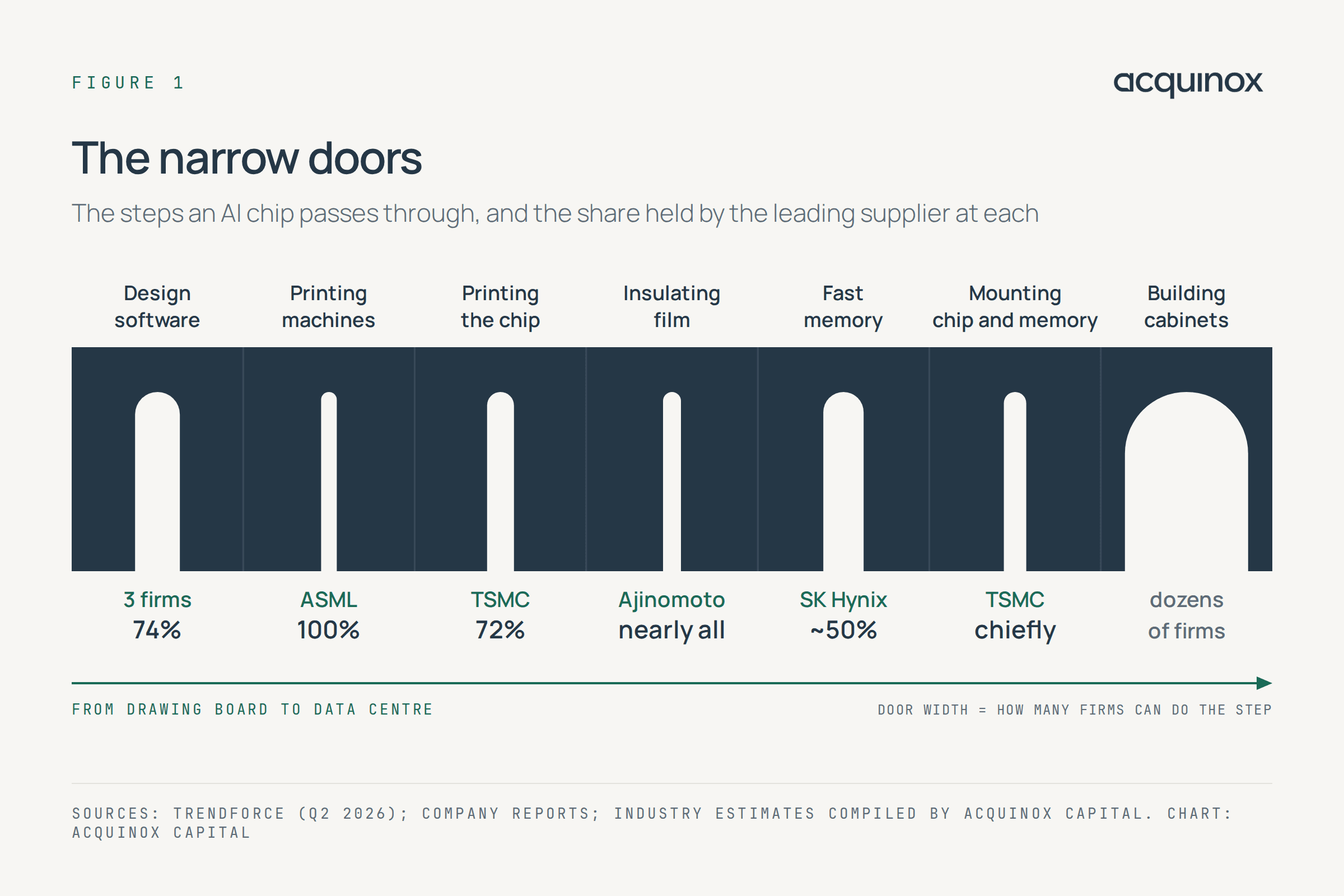
Figure 1. The seven steps an AI chip passes through, from design software to cabinet building. Door width shows how many firms can do each step; the figures show the leading supplier’s share.
The margins follow the number of competitors almost exactly.
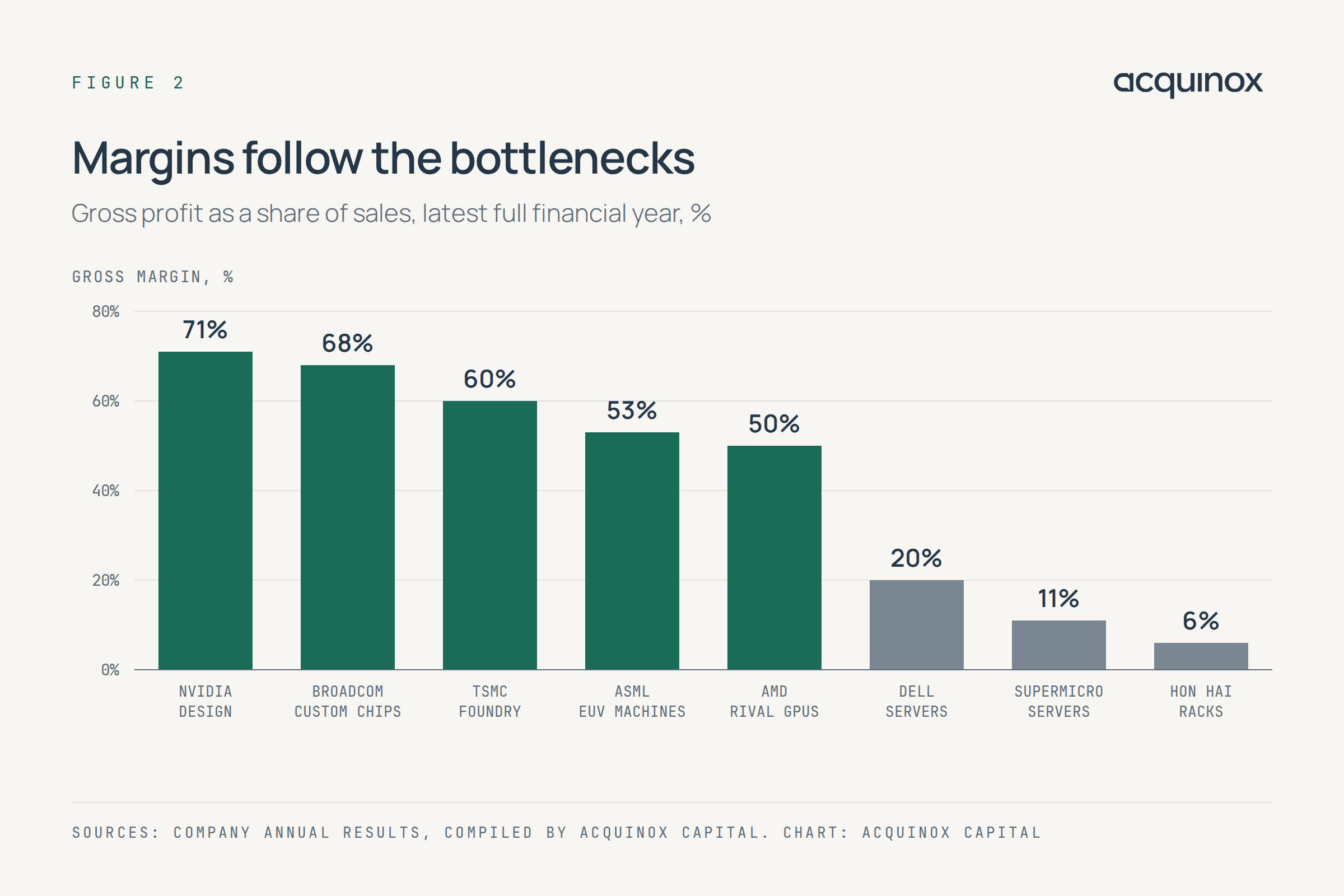
Figure 2. Gross margin in each firm’s latest full financial year. Firms with few or no substitutes keep half to three-quarters of sales; server and rack assemblers keep 6% to 20%.
Where one firm stands in the doorway, it keeps half to three-quarters of its sales as gross profit. Where many firms compete, as among the companies that build servers and assemble racks, they keep between 6% and 20%. The question to ask of any company in this chain is therefore simple: how many others can do what it does?
Nvidia's moat is software, not silicon
Nvidia reported $215.9 billion of revenue in its financial year to January 2026, with a 71.1% gross margin, and in the quarter to October its data-centre revenue reached $107.6 billion at a gross margin of 74.8%. Its advantage is only partly the chips. Since 2007 it has built CUDA, the software layer that lets developers program its processors, into every chip it sells, and by 2026 it counted more than 7.5 million developers using it. Part of the advantage sits low in the software stack. CUDA's libraries are tuned so closely to Nvidia's chip architecture that together they multiply very large matrices exceptionally fast, which matters most at the "prefill" stage, when a model processes a user's prompt before it starts to generate an answer. A rival can build a fast chip, as our earlier breakdown of specialised AI chips described; persuading millions of programmers to rewrite their software and change their habits is far harder.
The economics show the effect. Analysts at Raymond James estimated that Nvidia's Hopper-generation H100, the scarce chip of 2023, cost about $3,300 to manufacture and sold for $25,000 to $30,000. Its successor, Blackwell, is estimated by Epoch AI to cost about $6,400 to make and sells for $30,000 to $40,000. The gap is not all profit, since design and software are not free, but it explains the margin.
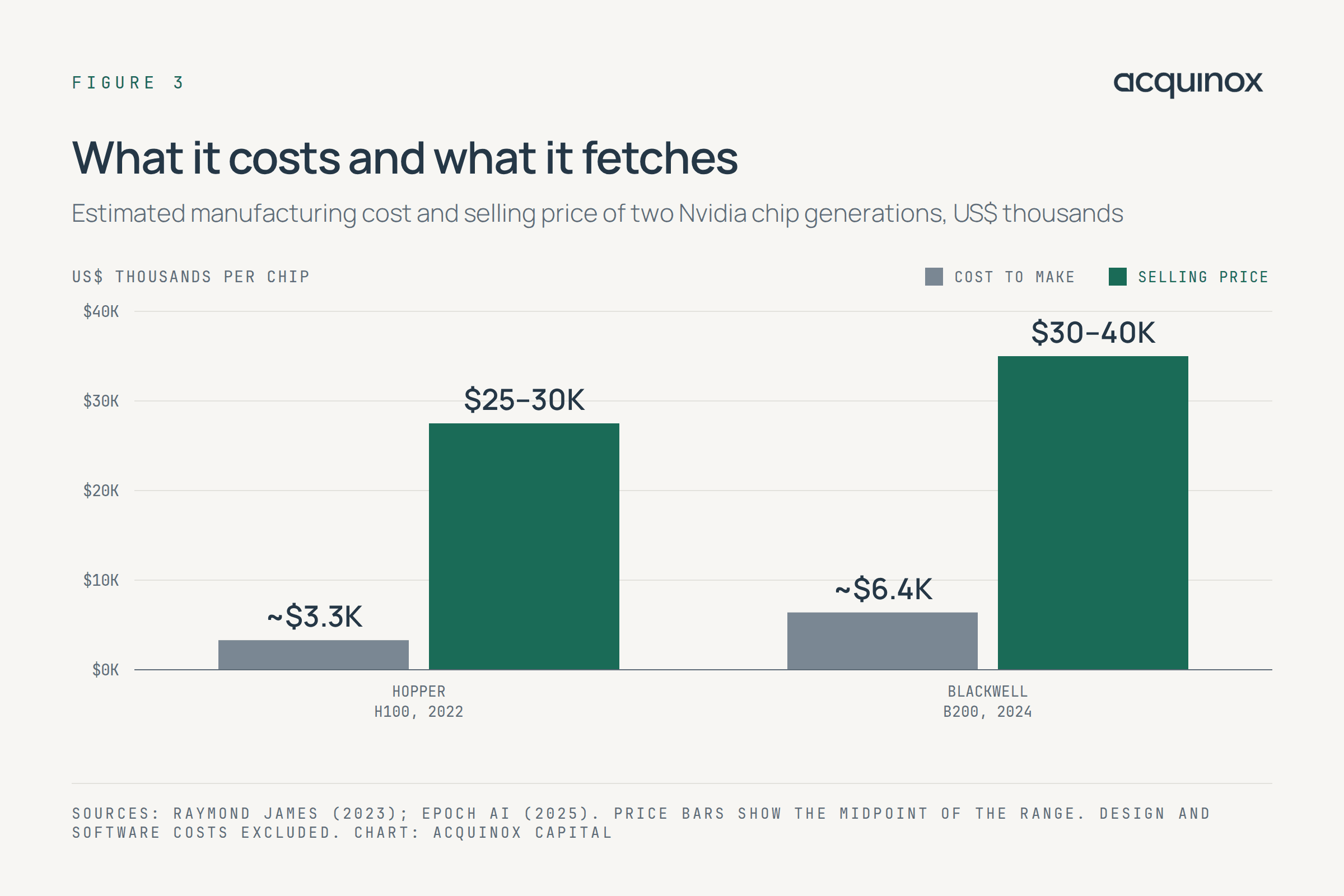
Figure 3. Analysts’ estimates of what two Nvidia chip generations cost to make against what they sell for: Hopper (H100) and Blackwell (B200). Price bars show the midpoint of the range; design and software costs are excluded.
Nvidia now increasingly sells whole racks: 72 chips in a 1.36-tonne cabinet drawing about 120 kilowatts and costing about $3 million each.
Everybody's factory: TSMC, ASML and the memory makers
Nvidia has never owned a chip factory. Its designs, and those of AMD, Apple, Google, Amazon and Microsoft, are manufactured by TSMC, which kept a gross margin of about 68% in the middle of 2026, unusually high for a business built on the most expensive factories in the world. Behind TSMC stands ASML, the only company able to build extreme-ultraviolet lithography machines. Each costs more than $200 million and ships in about forty freight containers; ASML sold 44 of them in 2024, none to China.
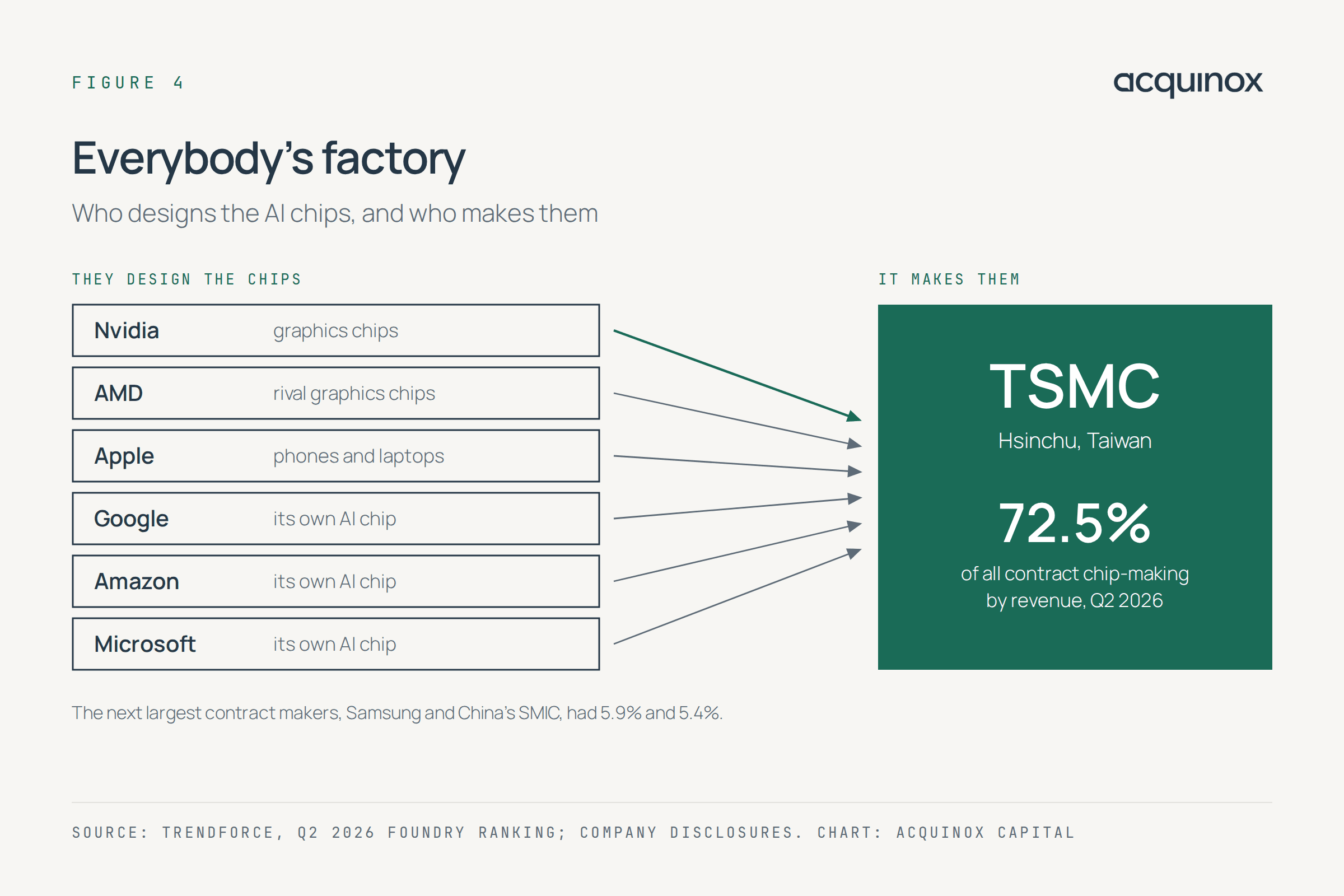
Figure 4. Nvidia, AMD, Apple, Google, Amazon and Microsoft design their own chips, but TSMC makes them. It held 72.5% of contract chip-making revenue in Q2 2026; Samsung and SMIC, the next largest, had 5.9% and 5.4%.
Memory has become the newest bottleneck. SK Hynix said late in 2025 that its 2026 production was already sold out, and by mid-2026 it was keeping about three-quarters of its sales as operating profit. The pattern is the same at every gate: scarcity of capability, not scale of output, decides who keeps the money.
The customers are trying to become the shop
A 75% gross margin invites competition, and the most capable challengers are Nvidia's own customers. Google has run its own AI chips since 2015 and agreed in 2025 to supply up to a million of them to Anthropic. Amazon's in-house chips were generating revenue at a rate of more than $25 billion a year by mid-2026, and Microsoft and Meta have their own designs, several built with Broadcom, whose AI revenue reached $16.7 billion in a single quarter of 2026. AMD remains the most direct merchant rival, with $8.5 billion of data-centre sales in the third quarter of 2026 against Nvidia's $107.6 billion.
The most unexpected challenge has come from the desk rather than the data centre. Apple designs its own chips, has TSMC make them, and places the memory in the same package as the processor, so a single Mac Studio with its new M5 Ultra chip holds up to 512GB of memory that its graphics cores read at about 1.2TB a second. For running large AI models on one machine, that changes the arithmetic. Nvidia's desktop AI system, the DGX Spark, carries 128GB of memory read at about 273GB a second, so matching one 512GB Mac takes four of them, at a broadly similar total price and with each box reading memory at less than a quarter of the Mac's speed. Nvidia still wins on raw speed for models that fit in its graphics cards: in MacStories' tests, an RTX 5090 read a long prompt almost twice as fast as the M5 Ultra. But for the largest models, which only fit in large pools of memory, Apple now offers more capacity and faster text generation per dollar than Nvidia's own desktop hardware. It is a reminder that Nvidia's moat is narrowest where memory, not arithmetic, is the constraint.
Two points matter for investors. Nvidia's customer base is concentrated: two customers accounted for 36% of its sales in its last financial year, and they are exactly the companies with the money and motive to replace it. And nearly every rival chip is made by TSMC on ASML machines. Whoever wins the contest over chip design, the factory and the machine maker are paid either way. The deeper in the chain a company sits, the less it matters who wins above it.
A five-year asset bought with railway enthusiasm
The four largest buyers spent $360 billion on capital expenditure in 2025 and, after their third-quarter results, guide to more than $700 billion for 2026, Forbes reported. A gigawatt of AI data centre costs something like $40 billion to $50 billion, most of it for silicon, the shift we traced in how data infrastructure became investable.
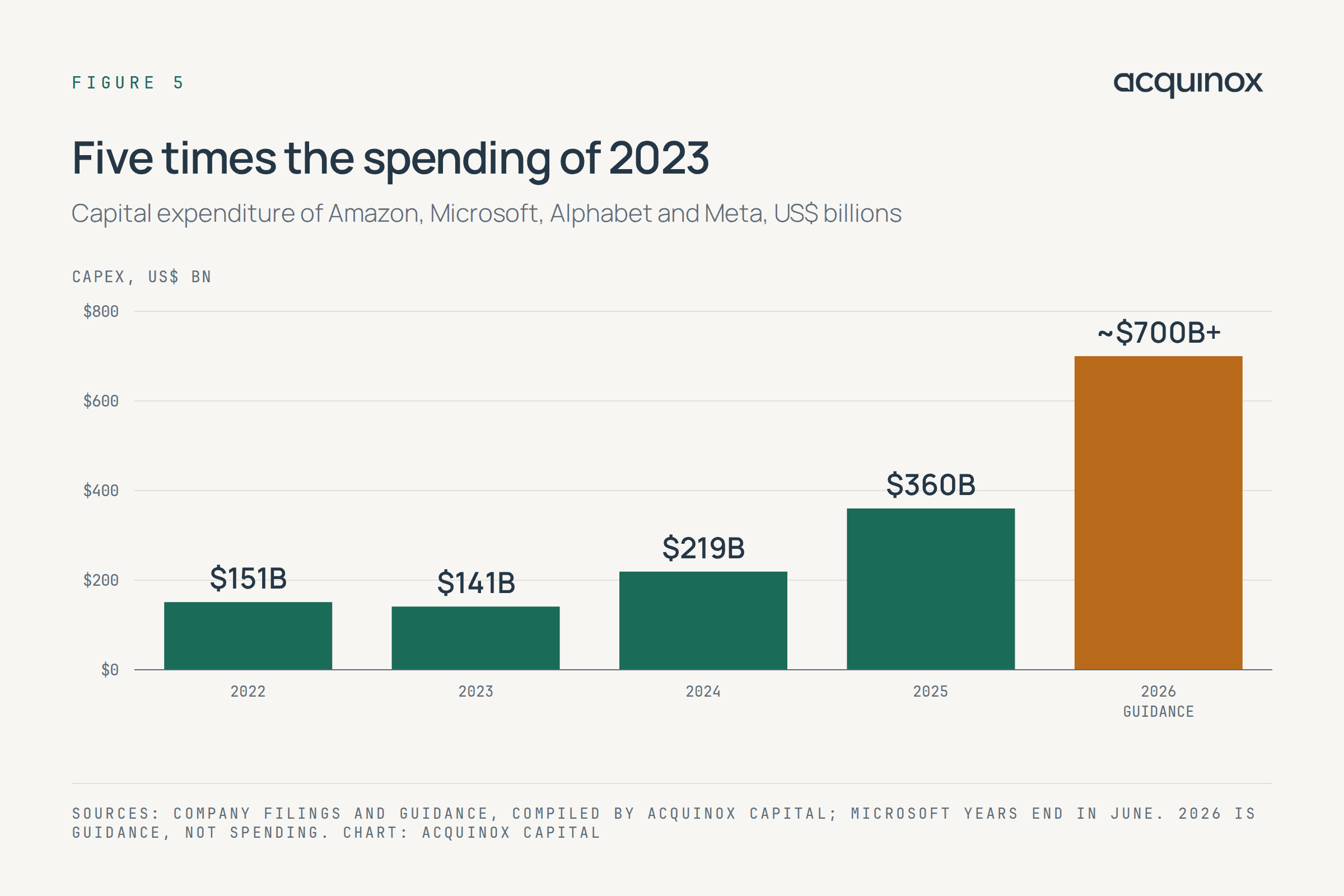
Figure 5. Capital expenditure by Amazon, Microsoft, Alphabet and Meta as each reports it (Microsoft years end in June). 2026 is guidance; after third-quarter results, trackers put it at $720–740 billion on a calendar basis.
Chips are not like the other assets companies spend at this scale. Railways last a century and buildings decades; the buyers' accounts assume a server lasts five or six years, while Nvidia now releases a better chip every year. On our calculation, every $100 billion spent on chips becomes roughly $18 billion of depreciation a year for five and a half years, whether or not the revenue arrives. The evidence on useful life is mixed: the rental price of an H100, the chip of 2022, fell from more than $8 an hour in 2023 to about $2 in late 2024, but recovered to $2.81 in October 2026 as older chips found work running models rather than training them.
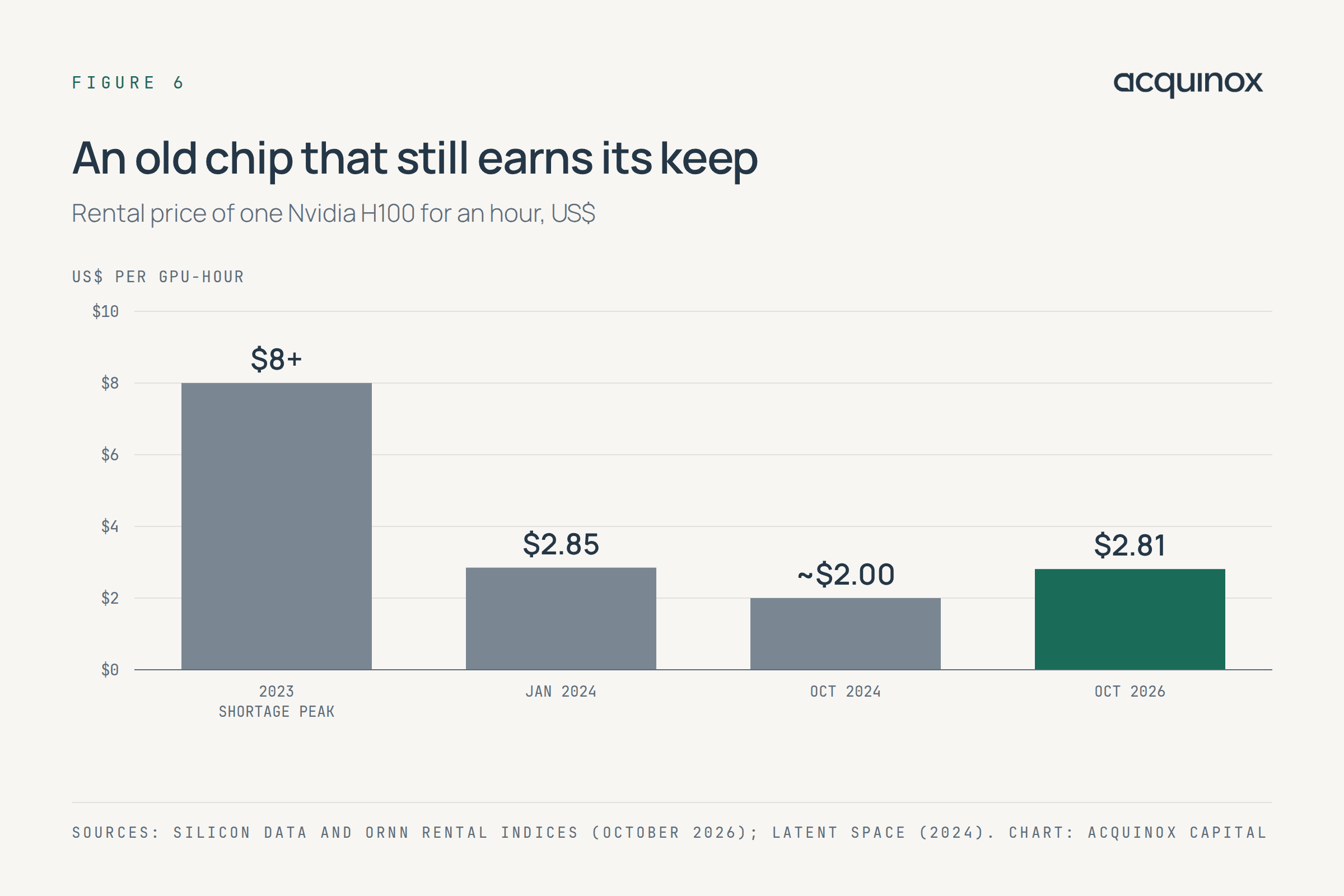
Figure 6. Hourly rental price of an Nvidia H100, the chip of 2022: above $8 in the 2023 shortage, about $2 in October 2024, and $2.81 in October 2026.
The financing has also become circular in places. Nvidia's holdings of non-marketable securities, mostly stakes in private companies, rose to $51.2 billion by July 2026 from $3.8 billion a year earlier, and reached $65.5 billion by October. It invested $30 billion in OpenAI's February round, has committed up to $10 billion to Anthropic, and in August guaranteed up to $105 billion of an OpenAI-linked data-centre lease in Ohio. Supplier financing can be perfectly sound, but it makes demand harder to read when the seller is also funding the buyers.
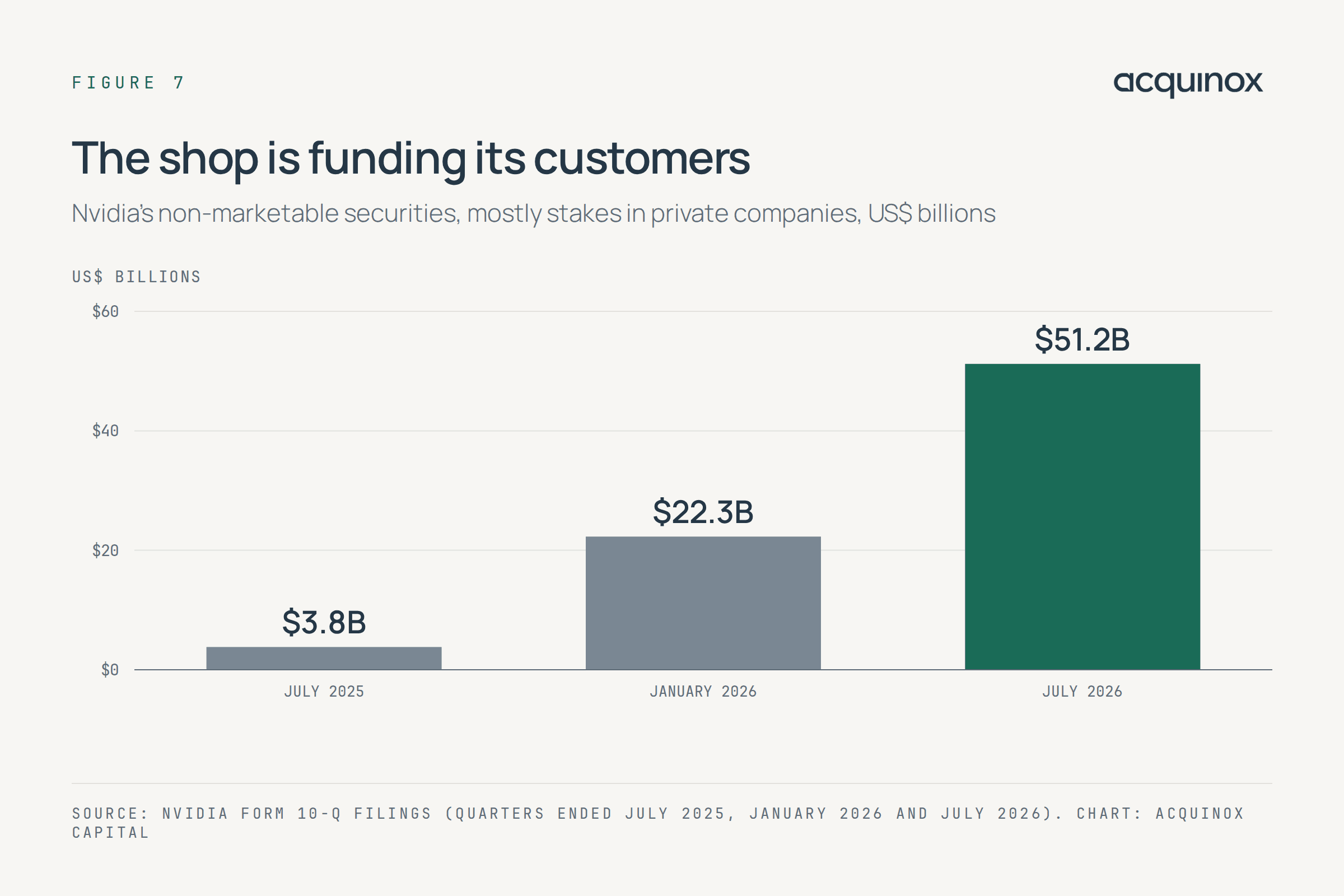
Figure 7. Nvidia’s non-marketable securities, mostly stakes in private companies, rose from $3.8 billion in July 2025 to $51.2 billion in July 2026.
What the gate test means for late-stage private companies
Most late-stage private companies in AI infrastructure sit on the paying side of the gates. The most highly valued private AI companies, the frontier model developers, are among the largest buyers of chips, so a large share of their capital flows to the gatekeepers. Independent cloud providers, which we examined in our analysis of neocloud financing, buy chips at full price, borrow against them and carry the depreciation risk. Private chip designers face both the CUDA habit and the same queue at TSMC, the memory makers and the packaging lines.
That does not make these companies poor investments, but it changes what to underwrite. A private company's valuation should reflect where it stands relative to the gates, not simply its exposure to AI demand.
| Question | A company behind a narrow gate | A company in a crowded room |
|---|---|---|
| How many others can do what it does? | None or one; switching is slow and costly | Several or many; customers can switch |
| Who sets the price? | The company | Its suppliers or its customers |
| What is its main asset? | Know-how, software, installed habits | Hardware bought from the gatekeepers |
| How long does that asset earn? | As long as the advantage lasts | As long as the chips stay economically useful |
| Who finances its customers? | The customers themselves | Increasingly, the suppliers |
Source: Acquinox analysis.
In our view, the AI build-out pays its toll at the single gates, and the margins of ASML, TSMC, Nvidia and the leading memory makers show it. Nvidia's moat is a software habit, which the largest customers have the money and motive to break; the factory and the machine maker are protected whoever wins above them. And because chips are a short-lived asset bought at railway scale, the rental price of an old chip and the useful life accountants assign to a new one are dull numbers that will decide who was right. For private investors, the opportunity lies in companies that own a genuinely scarce step, in packaging, memory, interconnect or power, rather than in those that simply buy access to someone else's.
Private companies on the horizon
A growing group of late-stage private companies is trying to open new doors or widen existing ones. Most fall into three groups: chips built only for running models, designs that get around the memory bottleneck, and links that move data between chips with light.
| Company | Approach | Latest financing | What to watch |
|---|---|---|---|
| Etched | Inference chip hard-wired for transformer models | $700M at a $21B valuation, August 2026 | Deliveries beyond its first customer, Jane Street, against more than $1B of contracts |
| SambaNova | Dataflow processors sold as complete inference systems | $1B Series F first close, reported at an $11B valuation, July 2026 | Enterprise and sovereign customers after acquisition talks with Intel fell through |
| Tenstorrent | RISC-V AI processors, plus chip designs licensed to Samsung and LG | $1.5B Series E at a $6.2B valuation, October 2026 | Whether licensing creates a toll of its own |
| Positron | Inference systems built on commodity memory rather than scarce HBM | $875M at a $5B valuation, September 2026 | The tape-out of its next chip and scaling beyond its Oracle Cloud deployment |
| MatX | Chips designed for large language models | $500M Series B led by Jane Street, February 2026; valuation not disclosed | First production silicon |
| d-Matrix | Digital in-memory computing for inference | $275M Series C at a $2B valuation, November 2025 | Volume shipments of its Corsair accelerator |
| EnCharge AI | Analog in-memory computing for laptops and edge devices | Series B of more than $100M, February 2025; a 2026 Series C is reported but unconfirmed | Adoption by device makers |
| Ayar Labs, Lightmatter | Optical links that move data between chips with light | Late-stage private rounds in 2025–26 | Whether moving data becomes the next narrow door |
Sources: company announcements (Positron, Tenstorrent, EnCharge AI); TechCrunch (Etched); Semiconductor Engineering (SambaNova); Bloomberg Law (MatX); company reports (d-Matrix).
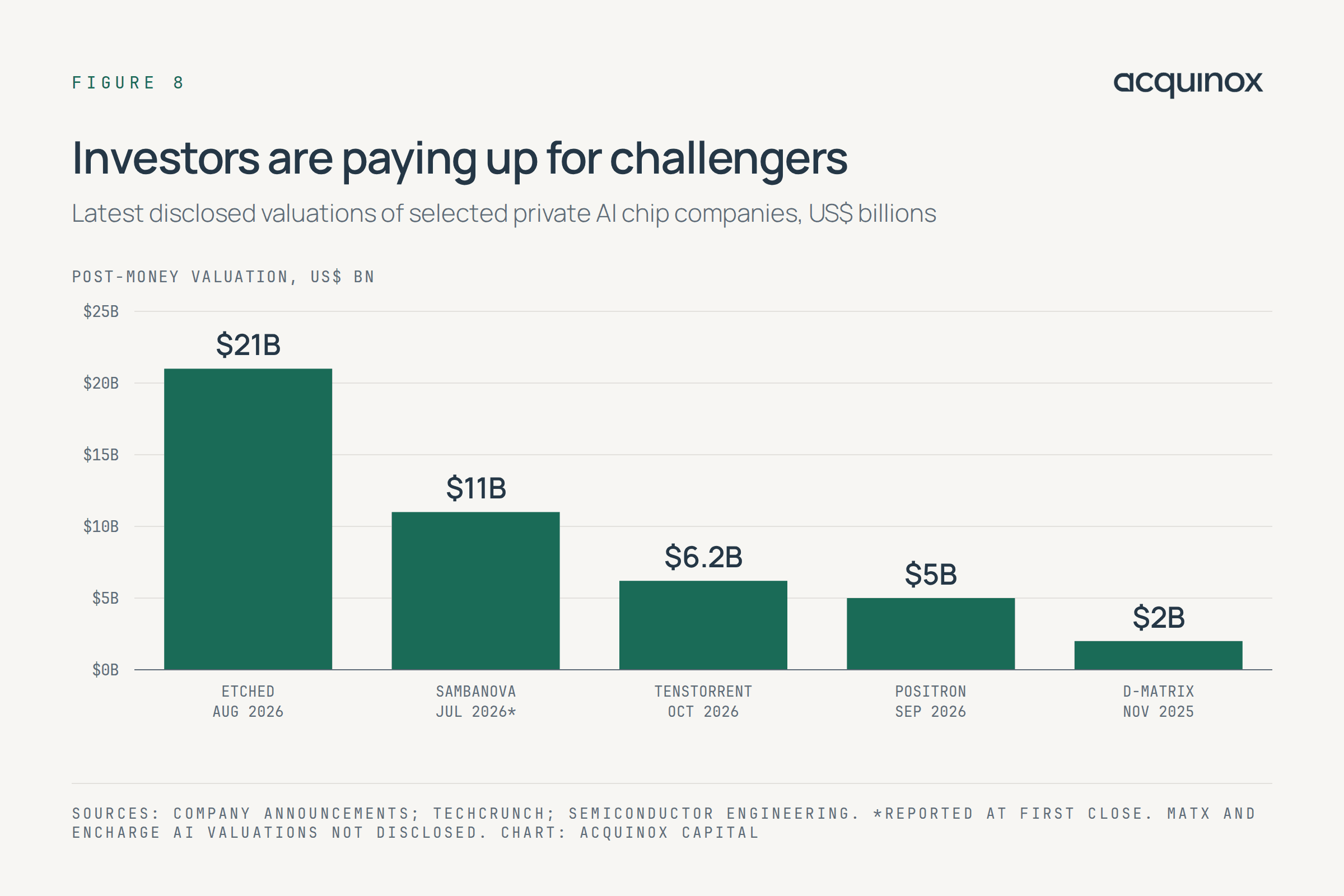
Figure 8. Latest disclosed valuations of selected private AI chip companies. SambaNova’s is reported at the first close of its Series F; MatX and EnCharge AI have not disclosed theirs.
The pace of revaluation is striking. Etched was valued at $5 billion in December 2025 and $21 billion eight months later, after Jane Street put its first rack into production and then led the round. Positron's valuation rose about fivefold in seven months, and SambaNova's reached $11 billion within a year of reported acquisition talks with Intel at a fraction of that. Tenstorrent chose fresh funding over takeover interest from Intel and Qualcomm, according to Bloomberg. The exits so far point the same way: Groq licensed its technology to Nvidia in a deal worth about $20 billion in December 2025, and Cerebras listed on Nasdaq in May 2026.
The gate test applies to all of them. New chip designers still queue for the same advanced manufacturing and memory, and must win developers away from CUDA, so for many the most valuable outcome may be to be bought or licensed by a gatekeeper rather than to replace one. The more interesting group may be the companies working on memory and data movement, from Positron's commodity-memory systems to in-memory computing and optical links. Moving data already consumes far more energy than the arithmetic itself, and, as Apple's Macs show, the memory constraint is where Nvidia's position is weakest.
The risks that matter
Customers building their own chips
Custom chips from Google, Amazon, Microsoft and Meta reduce dependence on Nvidia. The shift threatens margins at the design layer, though not at the factory or the lithography machine.
Depreciation of a short-lived asset
If chips lose economic value faster than accounts assume, buyers' earnings and the collateral behind GPU-backed loans both weaken. Rental prices are the earliest signal.
Circular financing
When suppliers invest in or guarantee their customers, reported demand partly reflects the supplier's own balance sheet. A slowdown would hit sales, investments and guarantees at the same time.
Concentration in Taiwan
In 2019, 92% of the world's most advanced chip-making capacity was in Taiwan. Governments are paying to diversify, including through TSMC's commitment to spend $265 billion in Arizona, but the shift takes years.
Export controls
US restrictions have cut Nvidia's China business to Hopper shipments of $2.4 billion in the quarter to October, about 2% of data-centre revenue, and its outlook assumes no data-centre compute revenue from China. Policy can change quickly in either direction, for chips and for the machines that make them.
What to monitor next
Five indicators will show whether the gates hold: the share of AI servers using customers' own chips; rental prices for older chips and the useful lives in buyers' accounts; supplier investments in and guarantees for customers; high-bandwidth memory and packaging capacity; and progress on advanced chip production outside Taiwan.
The AI build-out is the largest capital programme in the technology industry's history, and its returns are already unevenly distributed. They collect where there is only one gate. For late-stage investors, the most useful question about any private AI infrastructure company is not how much AI demand it serves, but how many others could serve it instead.
This article is for informational purposes only and does not constitute investment advice or an offer to buy or sell any security. It reflects publicly available information and estimates as of the publication date, which may change. Private market investments involve substantial risks, including illiquidity and potential loss of capital. Readers should conduct their own due diligence and consult qualified advisors before making investment decisions.