

Key takeaways
- Amodei's 12 September call to pace frontier AI drew support from the heads of OpenAI, xAI and Google DeepMind; markets responded with a rotation from chip stocks into software.
- On 22 September two labs cut prices by 20% to 50%; with slower capability gains, the valuation case rests more on enterprise adoption, pricing and margin per token.
- Main risks: antitrust exposure from coordination, a voluntary regime that may change little, price cuts compressing margins, and uncertain effects on training-compute demand.
On 12 September 2026, Anthropic chief executive Dario Amodei published an essay, We Must Pace the Frontier, calling on frontier AI companies to deliberately slow the rate at which they improve model capabilities. OpenAI's Sam Altman committed to match its first step the same day, and Elon Musk and Google DeepMind's Demis Hassabis voiced support. Within three weeks, chip stocks had sold off, OpenAI and Anthropic had cut model prices, a proposed class action had accused the leading labs of an unlawful agreement, and the White House had settled on a voluntary accord. For investors in the two largest private AI companies, valued at $965 billion and $852 billion ahead of planned listings, the question is what pacing does to frontier-lab economics.
What pacing the frontier actually proposes
Amodei's plan has three steps. The first is embedded evaluators: each frontier company gives a team of third-party evaluators ongoing, employee-like access to verify safety practices and report incidents. Anthropic committed to this unilaterally, and Altman said OpenAI would do the same. The second is coordination among frontier companies in democratic countries to establish common safety standards "as well as limits on the rate of unchecked AI progress", which Amodei acknowledges will need government support, including a narrow antitrust waiver. The third is global coordination, including with China.
Two details matter for investors. The essay states that pacing does not mean halting model training. And among the ways it suggests pacing could work, it lists limits on the "ingredients" of frontier models, including training compute. That is the most direct link between the proposal and demand for AI infrastructure.
Markets priced a rotation, not a retreat
On Monday 14 September, the first trading session after the essay, the iShares Semiconductor ETF (SOXX) fell about 5% while the iShares Expanded Tech-Software Sector ETF (IGV) rose about 5% and the Nasdaq Composite slipped 0.2%, according to CNBC. The move was a rotation within the AI trade: investors marked down companies whose revenue depends on ever-larger training runs and marked up those that build on capabilities that already exist.
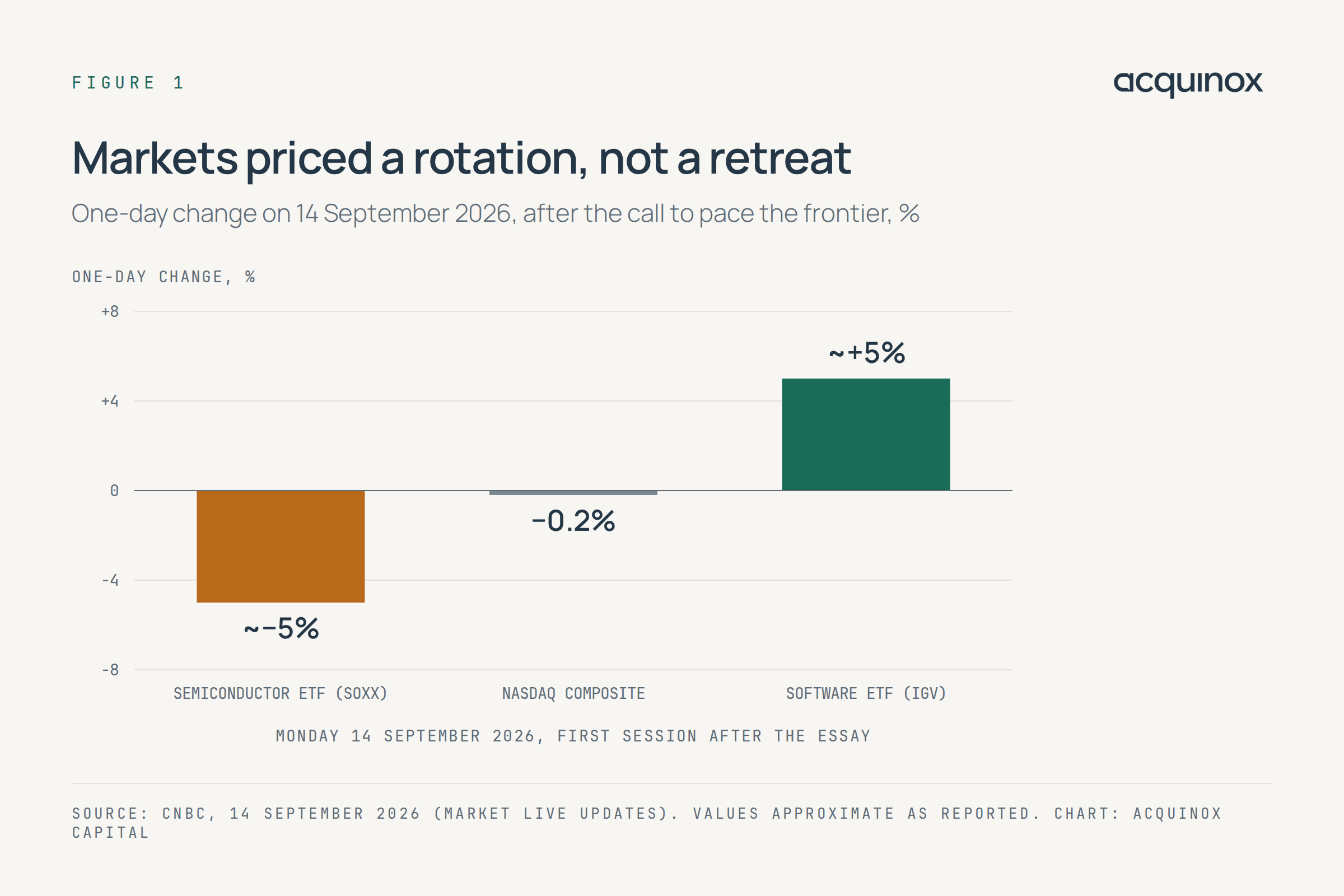
Figure 1. On 14 September 2026, the first session after the essay, semiconductor stocks fell while software stocks rose.
| Segment | What pacing could change | Market signal so far |
|---|---|---|
| Semiconductors and training infrastructure | Training-compute limits are an explicit pacing option; the cadence of the largest training orders could slow | SOXX down about 5% on 14 September |
| Cloud and inference capacity | Demand shifts towards serving existing models rather than training new ones; total spend depends on adoption | Not yet visible in reported data |
| Frontier labs | Evaluation gates and coordination add cost and can delay launches; growth must come from adoption | Private; the first public mark will come from listings |
| Application software | A longer window to build on current capabilities before they are superseded | IGV up about 5% on 14 September |
Source: CNBC (13–14 September 2026); Dario Amodei, We Must Pace the Frontier (September 2026); Acquinox analysis.
The reaction suggests markets expect value to move from producing new capability towards deploying existing capability. One trading session is a thin basis for conclusions, but the direction was consistent across chipmakers in the US, Europe and Asia.
Price, not capability, is becoming the competitive arena
Ten days later, on 22 September, both labs cut prices. Anthropic released Claude Opus 5.5 at $4 per million input tokens and $20 per million output tokens, 20% below Opus 5, and estimates it costs about 40% less to run for typical workloads because it also uses fewer tokens per task. OpenAI released GPT-6 Sol and GPT-6 Luna at $2/$10 and $0.10/$0.50, which it describes as 50% below the promotional pricing of their GPT-5.6 predecessors. Leading open-weight models are priced near OpenAI's cheapest tier rather than the flagships: on 12 October, OpenRouter listed DeepSeek's V4 Pro from $0.21 per million input tokens and $0.63 per million output tokens, about a thirtieth of Opus 5.5's output price.
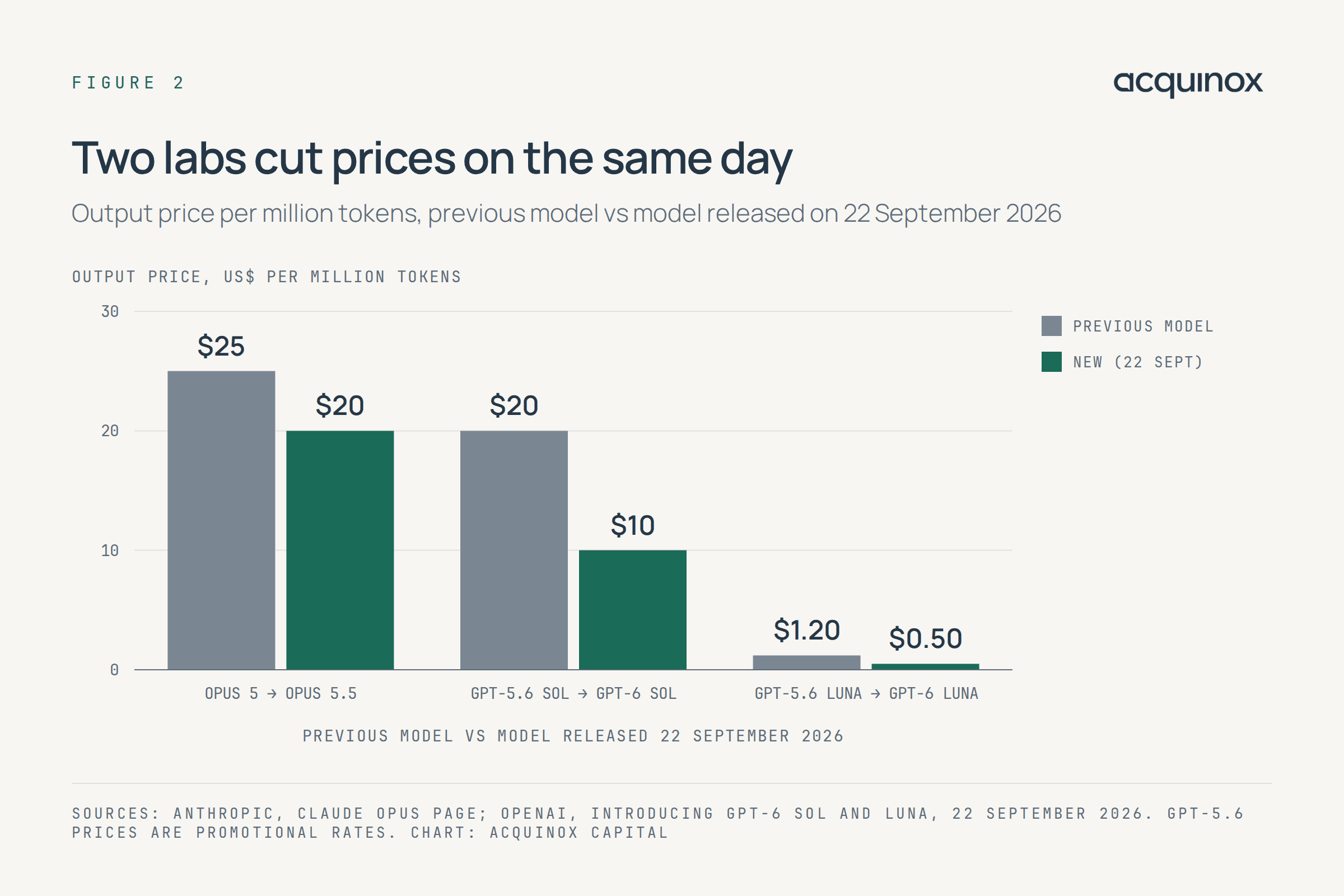
Figure 2. Output prices per million tokens before and after the 22 September 2026 launches. GPT-5.6 prices are OpenAI’s promotional rates.
Neither company links its price cuts to pacing; both credit efficiency gains in serving models. The timing still illustrates the competitive logic. If capability gains slow by agreement, labs compete less on benchmark leads and more on cost per useful token, reliability and enterprise trust. That price gap is the outside pressure on the coordination debate, a dynamic we examined in our analysis of open-weight AI policy. For investors, AI revenue models that rest on a capability premium become harder to defend than those built on enterprise adoption and margin per token.
What pacing means for frontier-lab valuations and IPO timing
Both companies are approaching public markets. Anthropic raised $65 billion at a $965 billion post-money valuation in its May Series H and confidentially submitted a draft registration statement on 1 June. OpenAI's $122 billion round in March valued it at $852 billion, and it filed confidentially in June. OpenAI chief financial officer Sarah Friar told employees in August that the company will be public in 2027 or sooner. Anthropic has been reported to be targeting a Nasdaq listing in the fourth quarter, with investors discussing a valuation of up to $2 trillion.
Valuations at this level assume rapid revenue growth continues. Pacing adds a new underwriting variable: evaluation gates, longer red-teaming and delayed launches raise near-term costs and can push the next capability jump beyond an IPO window, just as public investors look for clean growth.
In our view, the durable support for these valuations is adoption-driven growth: enterprise contract expansion, usage volume and improving margin per token. The question shifts from who builds the most capable model to who captures and retains the most enterprise workloads at profitable margins. Pacing cuts both ways. Bulls see a responsible steward that may earn a safety premium; bears see a pre-IPO effort to raise rivals' compliance costs while locking in incumbent advantage. The first public pricing of a frontier lab will show which reading investors weight more, and that valuation will anchor the listings that follow, as our view of the 2026 IPO pipeline anticipated.
Coordination meets antitrust law, and Washington stays voluntary
Step two is the legally exposed part of the plan. On 15 September, Senator Josh Hawley, supported by Senator Ted Cruz, blocked a national-security antitrust exemption in the National Defense Authorization Act, closing the most direct route to the waiver Amodei described. On 18 September, four paying subscribers filed a proposed class action in the Northern District of California against Anthropic, OpenAI, Google and SpaceXAI. It alleges that executives' public support for the essay amounted to an agreement to slow development in breach of Section 1 of the Sherman Act, characterising it as "an agreement to restrict output". No class has been certified, and the plaintiffs seek an injunction and damages that antitrust law allows to be tripled. Legal analysis from Holland & Knight and the Congressional Research Service notes that a stand-alone agreement to slow development risks being treated as a naked restraint on competition.
Washington chose a voluntary path. On 29 September, six AI and chip companies, including Anthropic, OpenAI and Google, signed the White House Accord on Super Intelligence, committing to internal controls, monitoring, independent external assessments and board-level oversight, and to meet regularly to establish standards. The accord has no enforcement mechanism, and law firm Crowell & Moring notes that the commitment to meet regularly may itself raise antitrust concerns. A separate executive order the same day directed federal agencies to use "Super Intelligence" in place of "artificial intelligence". The result is voluntary oversight, no mandated pacing and no antitrust shield.
The risks that matter for frontier-lab investors
Binding pacing would add cost and delay
If pacing became mandatory, through legislation or enforceable standards, evaluation gates and coordinated release limits would raise costs across the industry and lengthen the time between capability gains, the main driver of current revenue growth.
Voluntary pacing may change little
A voluntary regime without enforcement may matter mainly for reputation. If the competitive race continues regardless, pacing becomes a disclosure and governance issue rather than an economic one, and the safety premium some investors expect may not materialise.
Antitrust exposure
The class action is at an early stage, but any coordination on development pace now carries litigation risk, and the Senate has shown no appetite for an exemption. Remedies could constrain how labs cooperate on safety standards.
Margin pressure from price cuts
The 22 September launches cut list prices by 20% to 50%. Unless usage grows faster than prices fall, gross margins come under pressure just as the labs prepare to disclose them in their filings.
Compute demand mix
Training-compute limits are one of the pacing options the essay names. Inference demand may offset slower training growth, but the mix and timing are uncertain, and the market reaction on 14 September shows how quickly that uncertainty reaches chip valuations.
What to monitor next
Five indicators will show how pacing shapes frontier-lab economics: whether any pacing commitment becomes binding through legislation or an antitrust safe harbour; the first published findings from embedded evaluators; usage volume, enterprise retention and gross margin per token disclosed in the labs' registration statements; how the court handles the class action, starting with any motion to dismiss; and the first public valuation of a frontier lab.
Pacing has moved the valuation case for frontier labs from capability towards adoption and governance. Until pacing becomes either binding or clearly irrelevant, the labs that can show revenue growth from deployment, rather than from the next capability jump, are best placed to sustain current multiples, and the first frontier-lab IPO will put a public price on that distinction.
This article is for informational purposes only and does not constitute investment advice or an offer to buy or sell any security. It reflects publicly available information and estimates as of the publication date, which may change. Private market investments involve substantial risks, including illiquidity and potential loss of capital. Readers should conduct their own due diligence and consult qualified advisors before making investment decisions.