
Key takeaways
- SpaceX increasingly fills its own rockets: Starlink took about 79% of Falcon 9 missions in 2026, and customers report Falcon 9 booked into 2028–29, opening room for second-source providers.
- Capital is arriving before flight data: Stoke, The Exploration Company and Impulse raised about $1.8 billion in September and Blue Origin $10 billion, while most of their new vehicles have yet to fly.
- Main risks: schedule slips, unproven full reuse, dependence on government anchor contracts, and SpaceX's own capacity expanding as Starship enters service.
In eleven days in September 2026, Germany's Isar Aerospace reached orbit for the first time, Stoke Space closed a $1 billion Series E, The Exploration Company raised $450 million and Impulse Space added $308 million to its Series D. Later that month, Blue Origin was reported to have raised $10 billion in its first outside funding round. The common thread is not a bet that any of these companies will beat SpaceX on price. It is a bet that SpaceX's dominance, and its growing use of its own rockets, has created demand for a second source of access to orbit: from governments that want sovereign capability, and from operators that cannot wait for a slot.
Why SpaceX's success creates room for rivals
SpaceX proved the economics of reusable launch, and its own constellation is now its largest customer. Starlink's share of Falcon 9 missions rose from 54% in 2020 to about 79% so far in 2026, according to a Reuters analysis of launch data. At least seven spacecraft companies have been told that Falcon 9 is fully booked until 2028 or 2029, and its list price has risen from about $54 million in 2013 to about $74 million.
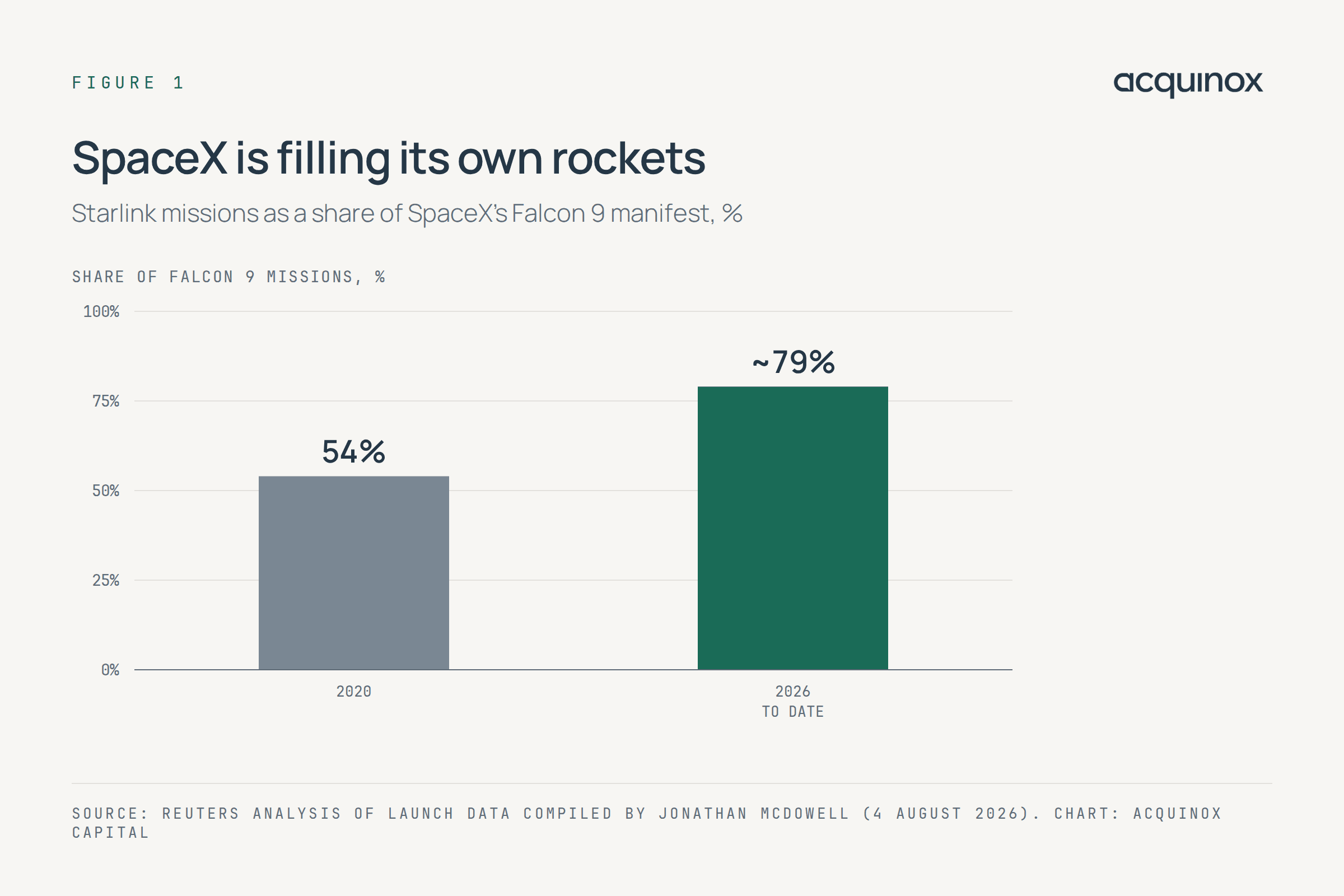
Figure 1. Starlink missions rose from 54% of Falcon 9 launches in 2020 to about 79% so far in 2026 (Reuters analysis of launch data).
For operators, availability is starting to matter as much as price. A launch that is cheaper per kilogram but unavailable for two years has limited value to a constellation operator with a deployment schedule, or to a government that wants assured access. SpaceX plans to ease the constraint with Starship, targeting its first orbital mission in late 2026, but much of that capacity is also earmarked for Starlink and NASA commitments.
Capital is arriving before flight data
Investors are funding the alternatives at record pace. Space and satellite start-ups raised a record $20.3 billion of seed-to-growth funding by late August 2026, according to Crunchbase, a total that includes Anduril's $5 billion round. Seraphim counted a record $20.8 billion in the third quarter alone, including Blue Origin's $10 billion financing.
Company | Round | Amount | Valuation | Flight status |
|---|---|---|---|---|
| Blue Origin | First outside round (September 2026) | $10B | ~$140B (reported) | New Glenn flown three times; vehicle lost in May 2026 pad explosion; return to flight targeted by end-2026 |
| Stoke Space | Series E (8 September 2026) | $1.0B | Not disclosed | Nova Pathfinder first orbital flight targeted for early 2027 |
| The Exploration Company | Series C (8 September 2026) | $450M | Not disclosed | Nyx demonstration to the ISS planned for 2028 |
| Impulse Space | Series D extension (16 September 2026) | $308M ($808M round) | ~$5.4B (reported) | Mira vehicles flown; Helios upper stage first flight planned for 2027 |
| Isar Aerospace | Series D (June 2026) | €270M | >€2B (reported, not company-confirmed) | Spectrum reached orbit on its second flight, 5 September 2026 |
Sources: company announcements; The Wall Street Journal via CNBC; Reuters; Payload. Acquinox analysis.
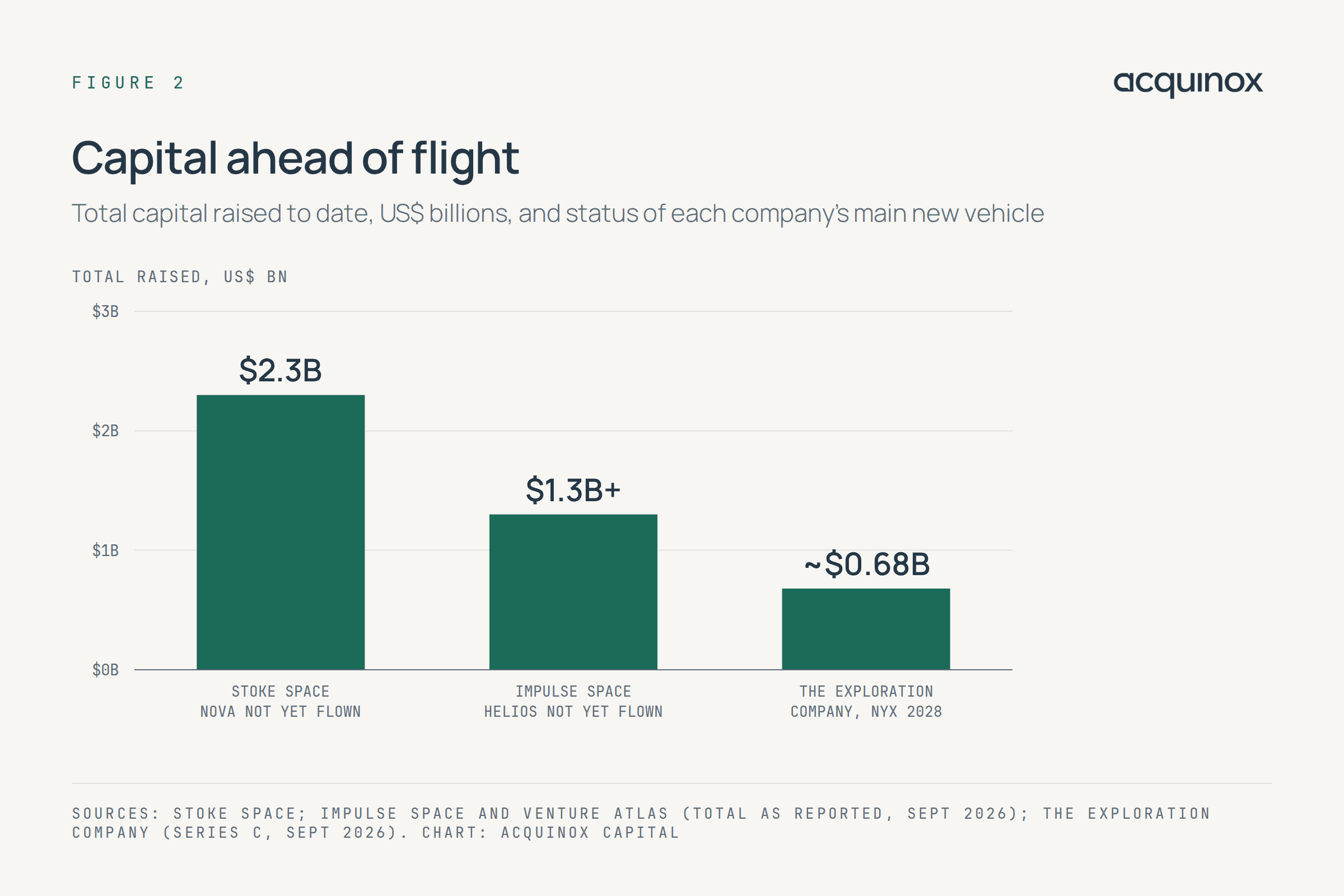
Figure 2. Total capital raised by three second-source companies whose main new vehicles have yet to fly: Stoke Space $2.3B, Impulse Space more than $1.3B, The Exploration Company about $0.68B.
The pattern is unusual for capital-intensive hardware: investors are paying for production capacity and second-generation vehicles before the first one has flown. Stoke's own sequence illustrates it. Its first rocket, Nova Pathfinder, has yet to reach orbit, yet the Series E also funds Nova Block 2, a larger fully reusable vehicle designed to carry 15 metric tons to low Earth orbit from 2029. The bet is that demand will outgrow SpaceX's standalone capacity and that customers will pay for an alternative, as we examined in our analysis of rocket reusability and launch costs.
Europe: sovereignty becomes a purchasing decision
Europe has long warned against depending on foreign launchers, and it is now paying to avoid it. On 5 September, Isar's Spectrum rocket reached orbit from Andøya in Norway, the first orbital launch from continental Europe, 524 days after its first flight ended about 30 seconds after lift-off. "Europe now has sovereign access to space," chief executive Daniel Metzler said. The flight also completed Isar's first milestone under ESA's European Launcher Challenge, which funds commercial launchers as sovereign capability.
The Exploration Company is building the next layer. Its Series C, the largest by a European space company, brings total funding to about $680 million, and its investor Atomico reports 10 Nyx missions booked and more than $2 billion of contracts and commitments. Nyx, a reusable cargo capsule, is due to fly a demonstration mission to the International Space Station in 2028 on Ariane 6 under a €760 million ESA contract, while most of the new funding goes to Storm, a methane engine intended to power a future reusable European heavy launcher.
Heavy and medium launch: the US challengers
Blue Origin is the best-capitalised second source. Its first outside funding round raised $10 billion at a valuation of about $140 billion, CNBC reported, citing The Wall Street Journal. New Glenn has flown three times, but a vehicle exploded during a test in May 2026 and damaged its only operational launch pad; the company is targeting a return to flight before the end of the year and plans a $330 million expansion in Florida to support multiple launches a week by the end of the decade.
In medium launch, Stoke's Nova Pathfinder is designed to be fully reusable, including its upper stage, and is targeting a first flight in early 2027. Rocket Lab's Neutron, the other leading medium-lift challenger, has slipped to 2027 after defects were found in a carbon-composite tank dome, its third postponement. Our earlier analysis of which space companies could follow SpaceX to market covers the listed and pre-IPO field.
The orbital logistics layer
Launch is only the first leg of the journey. Impulse Space builds vehicles that move payloads once in orbit: its Mira transfer vehicle has flown, and its larger Helios upper stage is due to fly in 2027. In July, Helios was selected for the Space Force's National Security Space Launch Phase 3 Lane 1 programme, the first upper stage to win prime status, although the initial task order was worth only $5 million. Impulse says its first Helios rideshare missions are sold out for 2028. Defence customers in particular want the ability to move and reposition satellites, a capability that sits outside SpaceX's core focus and fits the wider shift we described in defence technology investing.
Underwriting the second source
Layer | Incumbent | Second-source entrants | Status (November 2026) | What drives demand |
|---|---|---|---|---|
| Heavy launch | SpaceX Falcon Heavy, Starship | Blue Origin New Glenn | Return to flight targeted by end-2026 | Capacity, national security redundancy |
| Medium launch | SpaceX Falcon 9 | Stoke Nova, Rocket Lab Neutron | Both targeting first flights in 2027 | Availability, dedicated missions |
| Small launch (Europe) | SpaceX rideshare | Isar Spectrum | In orbit since September 2026 | Sovereign access, schedule control |
| Orbital logistics | SpaceX (limited) | Impulse Mira and Helios | Mira flown; Helios 2027 | Mission-specific orbits, defence manoeuvres |
| Cargo capsules | SpaceX Dragon | The Exploration Company Nyx | ISS demonstration 2028 | European autonomy |
Source: company announcements; Reuters. Acquinox analysis.
In our view, returns in this sector are unlikely to come from displacing SpaceX. They are more likely to come from serving customers that require sovereign access, dedicated capacity or capabilities SpaceX does not prioritise, and that will pay a premium for it. That makes the quality of anchor contracts, particularly government ones, central to valuation: second-source providers are selling assurance as much as lift, and the price of that assurance depends on how long governments are willing to pay for it.
The risks that matter
Schedules slip
Isar needed 524 days between its first and second flights; Stoke's first orbital flight has moved from 2025 to 2027; Neutron has slipped three times. Valuations built on near-term flight dates are exposed to every delay.
Full reuse is unproven
Stoke's fully reusable architecture, including its reusable upper stage, has not flown. The economics depend on rapid turnaround that no company other than SpaceX has demonstrated at scale.
Dependence on governments
Sovereign demand is real but political. ESA programmes, national security contracts and European procurement preferences anchor many of these businesses, and budgets can change.
SpaceX's own capacity
If Starship enters service on schedule and SpaceX releases more Falcon 9 capacity to outside customers, the scarcity that supports second-source pricing could ease.
Capital intensity
Every company here needs further funding before reaching steady-state operations. A weaker market for private space funding would test business plans that assume continued access to capital.
What to monitor next
Five indicators will show whether the second-source thesis holds: New Glenn's return to flight and launch cadence in 2027; the first flights of Nova Pathfinder, Neutron and Helios; whether Isar can turn its first orbital success into a regular manifest; Starship's progress and any change in Falcon 9 availability for outside customers; and the size of European and US government contracts for alternative providers.
SpaceX's dominance has proven the market and, by filling its own rockets, created demand for alternatives. The second-source companies that compound value will be those that fly reliably, convert government interest into long-term contracts, and serve customers who value control over their access to orbit more than the lowest price per kilogram.
This article is for informational purposes only and does not constitute investment advice or an offer to buy or sell any security. It reflects publicly available information and estimates as of the publication date, which may change. Private market investments involve substantial risks, including illiquidity and potential loss of capital. Readers should conduct their own due diligence and consult qualified advisors before making investment decisions.