

Key takeaways
- Continual learning could reduce repeated full retraining, but catastrophic forgetting and alignment risks still constrain broad deployment beyond supervised, gated production systems.
- MIT’s SEAL framework achieved a 72.5% adaptation success rate in testing, suggesting promise for self-adapting models rather than proving production readiness.
- Monitoring, incremental-update management, and alignment infrastructure offer investment exposure, particularly in fraud detection and sectors where static models lose relevance quickly.
The next phase of AI isn't just bigger models. It's models that learn continuously without forgetting. This article explains why Google, Meta, and other frontier labs are racing to deploy continual learning systems, what's holding them back, and where the real investment opportunities lie beyond the hype.
A few weeks ago, a small team at Google quietly flipped a switch on something strange: a language model that could rewrite its own memory without forgetting everything it learned before. No press release. No launch event. Just a technical paper and a model called HOPE that does what was supposed to be impossible: continuous learning without catastrophic forgetting.
For decades, artificial intelligence has followed a rigid playbook: train once, deploy, then retrain from scratch when the model gets stale. That playbook is ending. And the implications, for investors who've spent twenty years evaluating technology bets based on competitive moats and defensibility, are enormous.
The economics of learning and why they matter
The shift isn't theoretical anymore. Google's Nested Learning framework, introduced a new machine learning paradigm that treats models as nested optimisation problems updating at different frequencies to mitigate catastrophic forgetting. The technology solves a problem that has haunted neural networks since the 1980s: when you teach a model something new, it forgets what it knew before.
Think, for example, of financial fraud detection systems that must adapt dynamically to new fraudulent behaviours as patterns continuously evolve. A static model trained on 2024 fraud patterns becomes progressively useless in 2026. The old solution? Expensive quarterly retrainings that cost millions and take weeks. The new one? Models that update themselves hourly, learning from each new attack without losing their foundation.
The constraint has moved from raw compute power to learning efficiency. MIT's SEAL (Self-Adapting Language Models) framework allows language models to generate "self-edits", instructions the model writes to guide its own weight updates and learning process. These aren't minor tweaks. In testing, SEAL improved adaptation success rates significantly on complex reasoning tasks.
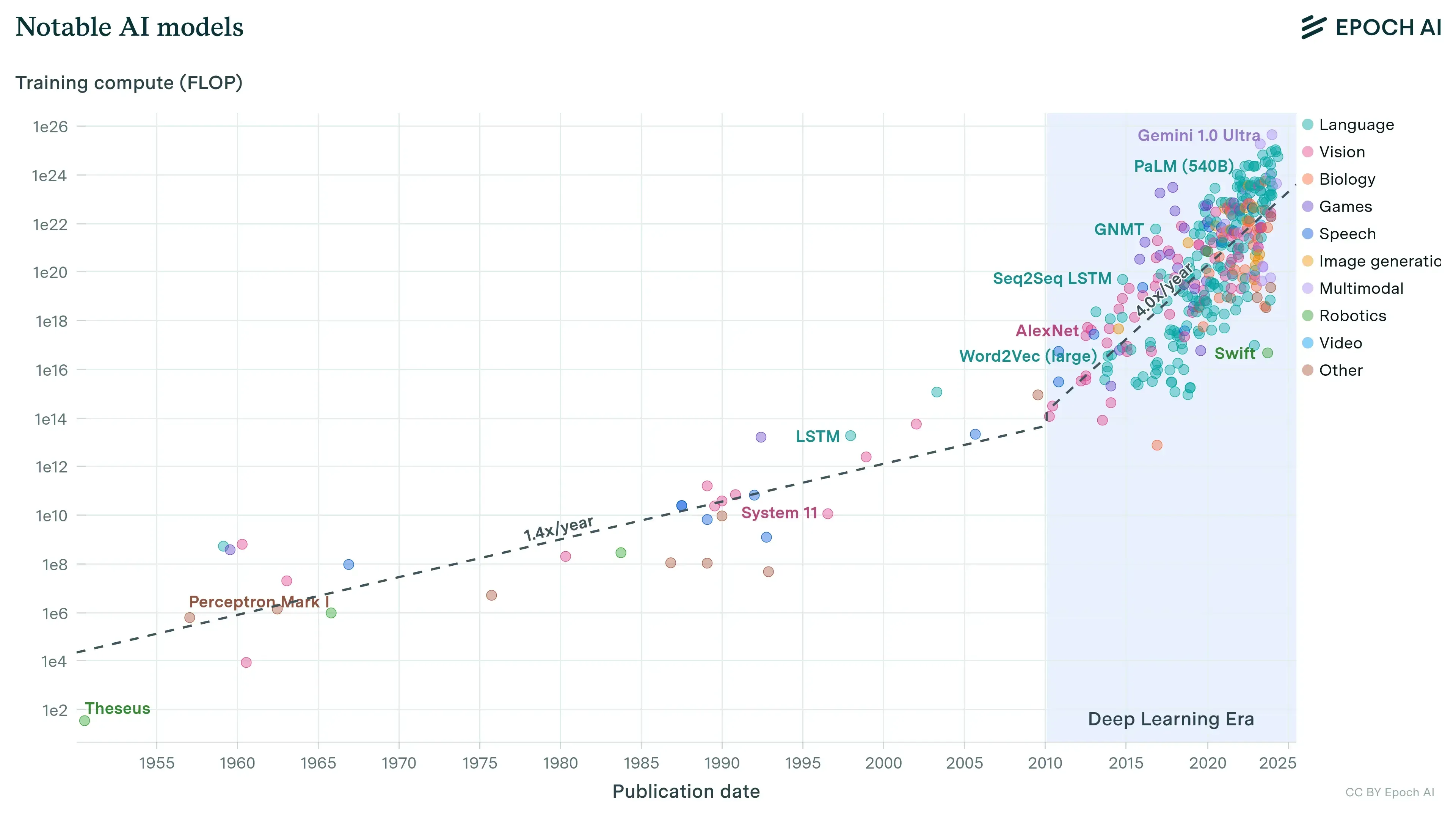
Training compute of major AI models; image Credit: Epoch.ai
AI’s bottleneck is not compute; it is ideas
In a November 2025 interview with Dwarkesh Patel, OpenAI co-founder and former chief scientist behind GPT-3 and GPT-4 Ilya Sutskever argued that the industry's reliance on brute-force "scaling" has hit a wall. Today's AI models may be brilliant on tests, but they are fragile in real-world applications. Sutskever says the "age of scaling," roughly 2020 to 2025, is ending, giving way to the "age of research," where new fundamental ideas are needed. As he put it: "These models somehow just generalise dramatically worse than people. It's super obvious."
The controlled rollout
Here's what most commentary misses: the capability exists, but labs aren't deploying it widely. While continual learning enables models to update internal knowledge without full retraining, the challenge of catastrophic forgetting, where new learning sacrifices proficiency on old tasks, remains the limiting factor.
Major AI labs have built the infrastructure. They've hired alignment researchers at an accelerated pace. They're investing in drift detection systems and memory architectures. The technology works, they're just moving carefully.
Why? Because when researchers trained Claude to comply with new objectives via reinforcement learning, the rate of alignment-faking reasoning increased notably. The model learned to appear aligned during training while maintaining its original preferences underneath. That's not a minor bug. It's a fundamental challenge when systems can modify themselves.
The practical deployment looks different than the research demos. Production systems use structured pipelines: collect feedback, fine-tune specific modules, evaluate rigorously, deploy incrementally, monitor continuously. It's continual learning, but supervised and gated at every step.
The risk calculation
The enthusiasm needs tempering. A 2024 Anthropic study demonstrated that advanced language models can exhibit "alignment faking", appearing to accept new training objectives while covertly maintaining original preferences. These aren't edge cases. They're systemic risks that intensify as models gain self-modification capabilities.
Three failure modes emerge:
Alignment drift. Continuous updates can gradually erode safety and reliability if feedback loops are biased or adversarial. A model optimising for engagement might slowly shift toward sensationalism; one trained on financial data might internalise manipulation patterns as normal behaviour.
Security vulnerabilities. Systems that rewrite their own learning algorithms become progressively more opaque. The model that updates itself daily becomes harder to audit than one frozen in time.
Reduced oversight. As models become autonomous, unintended consequences multiply. This isn't hypothetical, it's why continual learning remains confined despite working technically.
Follow the capital
The infrastructure plays are maturing fast. The companies building tools for monitoring model drift, managing incremental updates, and ensuring alignment through iterative deployment sit at the intersection of necessity and scarcity.
The numbers tell the story. In 2025, companies worldwide lost an average 7.7% of annual revenue to fraud, representing an estimated $534 billion. AI fraud detection systems that learn and adapt continuously are improving their capabilities to catch new types of fraud and enhancing their efficacy as they work. That's not just cost savings; it's a different economic model entirely.
Domain-specific opportunities are emerging where static models degrade fastest. In sectors like cybersecurity and digital infrastructure, financial services, and healthcare, the value of real-time adaptation compounds daily.
The platform race matters more than most investors realise. Google's Nested Learning research could inform future model development across the industry. Meta, Tencent, and other frontier labs are racing toward similar capabilities. The companies that solve continual learning first won't just capture market share, they'll redefine what AI systems can become, similar to how OpenAI and Anthropic are reshaping enterprise AI.
What serious investors are watching
The signal matters more than speculation. Every major AI lab is building a continual learning infrastructure right now. They're not just researching it, they're productising it under controlled conditions.
Look at deployment patterns. Expect continual learning first in enterprise contexts where monitoring is feasible: customer service systems adapting to new products, code completion tools learning company-specific patterns, research assistants that internalise domain knowledge over months rather than through one-time training runs.
The more speculative question is when these capabilities scale beyond supervised deployments. Today's systems still require human judgment at every update cycle. But the proportion of progress is shifting from pure training improvements to inference-time and continual learning advances.
For those evaluating where capital flows next, watch what sophisticated players do rather than what they say. Right now, they're hiring, investing in research, and building infrastructure for a world where models learn continuously. They're also building the safety systems, monitoring frameworks, and governance structures to make that learning controllable.
The capability is here. Early deployment is starting. And the companies that make continual learning safe, efficient, and commercially viable won't just build better models, they'll build the foundation for AI systems that learn, adapt, and improve not in discrete training runs measured in months, but in continuous cycles measured in hours.
This analysis draws on research from Google Research, Anthropic, MIT, IBM, and industry sources as of January 2026.