

Key takeaways
- The investment case favours proven space hardware, credible government customers and firm contract backlogs over valuation headlines or speculative IPO timing.
- The global space economy reached $613 billion in 2024, with commercial activity accounting for 78%, while public-market exposure remained limited.
- The article presents SpaceX’s 2026 listing as speculative; none of the other profiled companies had announced IPOs, and execution and liquidity risks remain.
A Falcon 9 lifts off from Vandenberg, frost cascading down its flanks. In a Houston conference room, three institutional investors watch the webcast about the satellite deployment. But they are also here because the space companies IPO market is about to transform.
SpaceX is targeting an initial public offering reportedly rumoured at some point in 2026, and the speculatively targeted $1.75 trillion valuation numbers have rewritten assumptions about what "space infrastructure" means to a portfolio.
This is what commercial space has been building towards for two decades. The global space economy reached an unprecedented $613 billion in 2024, reflecting strong 7.8% year-over-year growth. The commercial sector accounted for 78% of the global space economy. Yet public market exposure remains thin.
Behind SpaceX, a cohort of private space companies is lining up with multi-billion-dollar government contracts, working hardware, and revenue growth that mirrors early cloud infrastructure adoption.
Why SpaceX's IPO rewrites the playbook
For institutional investors, SpaceX's public offering may solve a decade-old problem: the absence of pure-play space infrastructure exposure. The existing public universe consists largely of legacy aerospace primes where space represents a division rather than the core business. SpaceX changes the equation.
The ripple effects extend beyond a single listing. Private space companies have historically struggled with valuation opacity. A SpaceX IPO establishes real-time pricing for launch cadence, reusability economics and government contract backlog.
Three structural shifts are converging. NASA's transition from the International Space Station to commercial platforms represents approximately $1 billion in annual recurring contracts shifting to private operators by 2030. Reusability has collapsed the cost per kilogramme to orbit from approximately $54,500 in the Space Shuttle era to around $2,700 on Falcon 9, according to NASA data. And US defence space spending keeps climbing.
Private space companies that may IPO in the future
None of the following companies have announced an IPO yet, however, it may be possible that after the SpaceX IPO there may be some movement in the sector. These are a section of private companies with interesting space technology:
1. Axiom Space: the space station first-mover
Valuation: Approximately $2.5 billion Latest funding: $350 million
Axiom Space, which is valued at more than $2.5 billion, represents the most direct bet on NASA's post-ISS transition. The company's first commercial module is scheduled for launch in 2028, followed by additional habitat modules slated for 2029.
The strategy is straightforward: attach to ISS for validation, then detach to become the first free-flying commercial station. Axiom holds the only NASA contract for ISS-attached commercial modules and has already executed private astronaut missions, demonstrating end-to-end capability.
Houston-based Axiom Space raised $350 million, with Qatar's sovereign wealth fund and 1789 Capital, where Donald Trump Jr. is a partner, as investors in the round. The revenue model monetises through private astronaut missions (approximately $55 million per seat), research services and future station capacity leasing.
Risks: Module launch delays directly impact revenue timing. The ISS deorbit schedule creates hard deadline pressure.
2. Stoke Space: full reusability's next frontier
Valuation: Approximately $2 billion Total funding: Approximately $1.34 billion
Stoke Space Technologies announced an extension of its Series D financing, bringing the total raised in the round to $860 million, with $1.34 billion raised to date. Stoke targets the last major cost reduction in launch: upper-stage reusability.
While SpaceX's Falcon 9 recovers the first stage, the second stage remains expendable. Stoke's Nova vehicle aims for full reusability through an actively cooled metallic heat shield. If it works, the economics change dramatically, targeting approximately $500 per kilogramme to low Earth orbit.
The investor base includes the US Space Force, Defence Innovation Unit, NASA and the National Science Foundation. That's validation from potential customers, not just financial sponsors. Nova's medium-lift capacity slots between small launchers and heavy-lift vehicles, targeting frequent, responsive launch for national security missions.
Risks: Stoke's Nova has not yet achieved full orbital, 100% reusable flight. Full reusability requires both stages to work flawlessly.
3. Sierra Space: the pivot to defence
Valuation: Approximately $8 billion Total funding: Approximately $2 billion since 2021
Sierra Space announced a $550 million equity investment led by LuminArx Capital Management, with the financing valuing the company at $8 billion post-money. Sierra operates two distinct businesses: Dream Chaser spaceplane for cargo and crew transport, and satellite infrastructure for national security missions.
The company completed Critical Design Review for two major national security satellite programmes in 2025 and completed all manufacturing and assembly milestones for Dream Chaser, with a demonstration flight planned in late 2026.
But the defence business is driving the valuation now. Sierra delivered satellite structures ahead of schedule, positioning it for follow-on awards as the Pentagon accelerates commercial space integration. The company's multi-billion-dollar contract backlog provides revenue visibility that most space companies lack.
Risks: Dream Chaser's spaceplane delays raise questions about execution risk. The programme's capital intensity is another point to watch.
4. Relativity Space & Vast Space: 3D printing and billionaire backing
Relativity Space: $4.2 billion valuation, over $1.2 billion funding (2021, Techncrunch) Vast Space: Reportedly $30bn valuation, over $1 billion funding (Datacenterdynamics, Vastspace)
Relativity's investment thesis centres on manufacturing transformation. The company's Stargate 3D printing system can produce rocket structures. Former Google CEO Eric Schmidt became CEO in March 2025, bringing significant personal investment.
Vast Space stands out through execution speed. Founded by cryptocurrency entrepreneur Jed McCaleb, Vast flew its Haven Demo mission in November 2025, becoming the first company to successfully operate its own commercial space station platform in orbit. Haven-1, planned for 2027, aims to become the world's first commercial free-flying space station.
What to watch
The SpaceX IPO is possibly the catalyst, not the endpoint. When SpaceX goes public, it validates the sector for institutional investors and creates pricing benchmarks. But the real opportunity lies in identifying which companies benefit from expanded capital availability without facing direct comparison to SpaceX's superior execution.
Contract backlog quality beats valuation headlines. A company with $3 billion in firm contracts at 15% margins provides more visibility than one with $5 billion in launch service agreements that may never execute. Dig into contract type, customer credit quality and milestone payment structure.
Government as anchor customer reduces commercialisation risk. Every successful space company has material government contracts. NASA, the Space Force or the Defence Innovation Unit provide non-dilutive development funding and serve as reference customers for commercial sales.
Defence convergence drives valuations. The fastest-growing segment is national security applications. Companies that successfully pivot to defence customers command premium valuations due to higher margins, longer contract durations and strategic relationships. Pure commercial plays face tougher unit economics.
Technology validation gates matter. A company that has flown hardware and proven core technologies de-risks more through one successful test than through raising a Series D. Focus on technical milestones over funding round alphabets.
The countdown has started
The $613 billion space economy in 2024 is projected to reach $1.8 trillion by 2035, according to World Economic Forum analysis, but very little of that growth is accessible through public equities today. SpaceX's IPO will need to test the waters first.
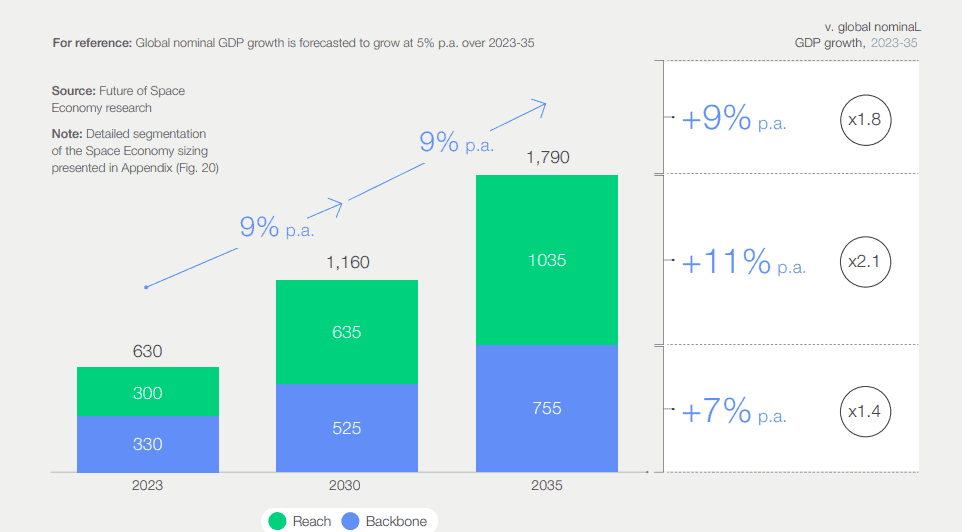
Source: WEForum
For sophisticated investors evaluating the sector, a key consideration is identifying which companies have built the technical moats, customer relationships, and operational fundamentals to navigate the transition. The launch window is opening through pre-IPO opportunities at private market valuations, though pre-IPO investments carry inherent liquidity and execution risks.