

Key takeaways
- The IFR counted about 7,000 full-size humanoids sold in 2025, mostly for research and AI data collection, while bank forecasts for 2026 range from 50,000 in China to 90,000 worldwide.
- Reliability, not demonstrations, now decides value: Figure's 56% success rate in unseen homes shows real progress, but deployment economics depend on productive hours, safety and firm orders.
- Main risks: forecasts built on different definitions, revenue from state-backed data-collection projects in China, unproven unit economics and a cooling IPO window.
On 17 September 2026, Figure showed its Helix 2.5 model completing household chores in 30 homes it had never seen, succeeding in 56% of trials. A week later, the International Federation of Robotics (IFR) published its first count of humanoid sales: about 7,000 full-size units in 2025, most bought for research and AI training rather than productive work. In China, regulators have slowed a rush of humanoid IPOs after Unitree's shares fell 55% from their post-debut peak. Together these mark a change in how the sector will be judged: from what humanoids can demonstrate to whether they can be deployed reliably and profitably. This article sets out the evidence investors can use to tell the difference.
Humanoids are still a small, early market
The IFR's count covers full-size humanoids, taller than 140cm, sold for industrial and professional service use. Its secretary general, Susanne Bieller, told Reuters that many were bought by research institutions or by companies collecting data to train AI models. For comparison, the IFR counted about 603,000 conventional industrial robots installed in 2025, and almost 250,000 professional service robots sold.
The IFR's own assessment is blunt. Its World Robotics 2026 presentation describes humanoids as "still on the verge of making the leap from laboratories to pilots – let alone real deployments", and lists safety and functional reliability, a lack of training data and the lack of an economically viable business case as the main challenges. It has identified 174 humanoid manufacturers worldwide, so the market is already crowded relative to its size.
Generalisation is improving; reliability is the test
Figure's Helix 2.5 is the clearest recent evidence of progress. Its Figure 03 robot made beds, folded towels and tidied toys in 30 Bay Area homes where no training data had been collected, completing 237 of 420 trials (56%), with credit only for fully completed tasks. An otherwise identical model trained without Figure's Index pretraining data succeeded 9% of the time. Figure is careful about the claim: "zero-shot" applies to the homes and objects, and the company says general-purpose humanoid robotics is not solved.
The result started a public argument about what counts as useful work. Tony Zhao, chief executive of Sunday Robotics, responded that "failing half the time is not 'doing real useful work'". Sunday reports 99.1% success for garment folding on its own wheeled robot, but on a single task, so the numbers are not directly comparable. Both sides make the same underlying point: commercial deployment needs generalisation and reliability together.
Small trial counts make reliability hard to judge. On our calculation, 237 successes in 420 independent trials implies a 95% confidence interval of roughly 52% to 61%. A recent preprint, not yet peer-reviewed, notes that robot policies are typically evaluated on few hardware trials without statistical assurances. Investors should ask for success rates with confidence intervals, intervention counts and results over thousands of cycles, not single demonstrations.
Forecasts diverge by an order of magnitude
| Institution | Near term | 2030 | Long term | Published |
|---|---|---|---|---|
| Bank of America | ~20,000 shipped in 2025 (its estimate); 90,000 in 2026 | 1.2 million shipments | 10 million shipments in 2035 | March 2026 |
| Goldman Sachs | 75,000 in 2026 | 890,000 shipments | 6.5 million shipments in 2035 (~$138B market) | September 2026 |
| Morgan Stanley | 50,000 in China in 2026 (external sales) | — | More than 1 billion in use and a $5T market by 2050 | May 2025; June 2026 |
Sources: Bank of America Institute, Transformation: Physical AI, part 2 (12 March 2026); Goldman Sachs Physical AI report as reported by 24/7 Wall St. and Yahoo Finance (September 2026); Morgan Stanley Research (May 2025); CNBC (24 June 2026). Definitions differ between forecasters and from the IFR's count.
The spread reflects definitions as much as views. Bank of America estimates 2025 shipments at about 20,000, nearly three times the IFR's 7,000, because it counts a broader range of machines. Measured against its own baseline, its 2026 forecast implies roughly 4.5 times growth, not the 13 times that a comparison with the IFR figure suggests. Morgan Stanley expects adoption to stay relatively slow until the mid-2030s before accelerating. 2026 is the first year in which these forecasts can be tested against an independent count.
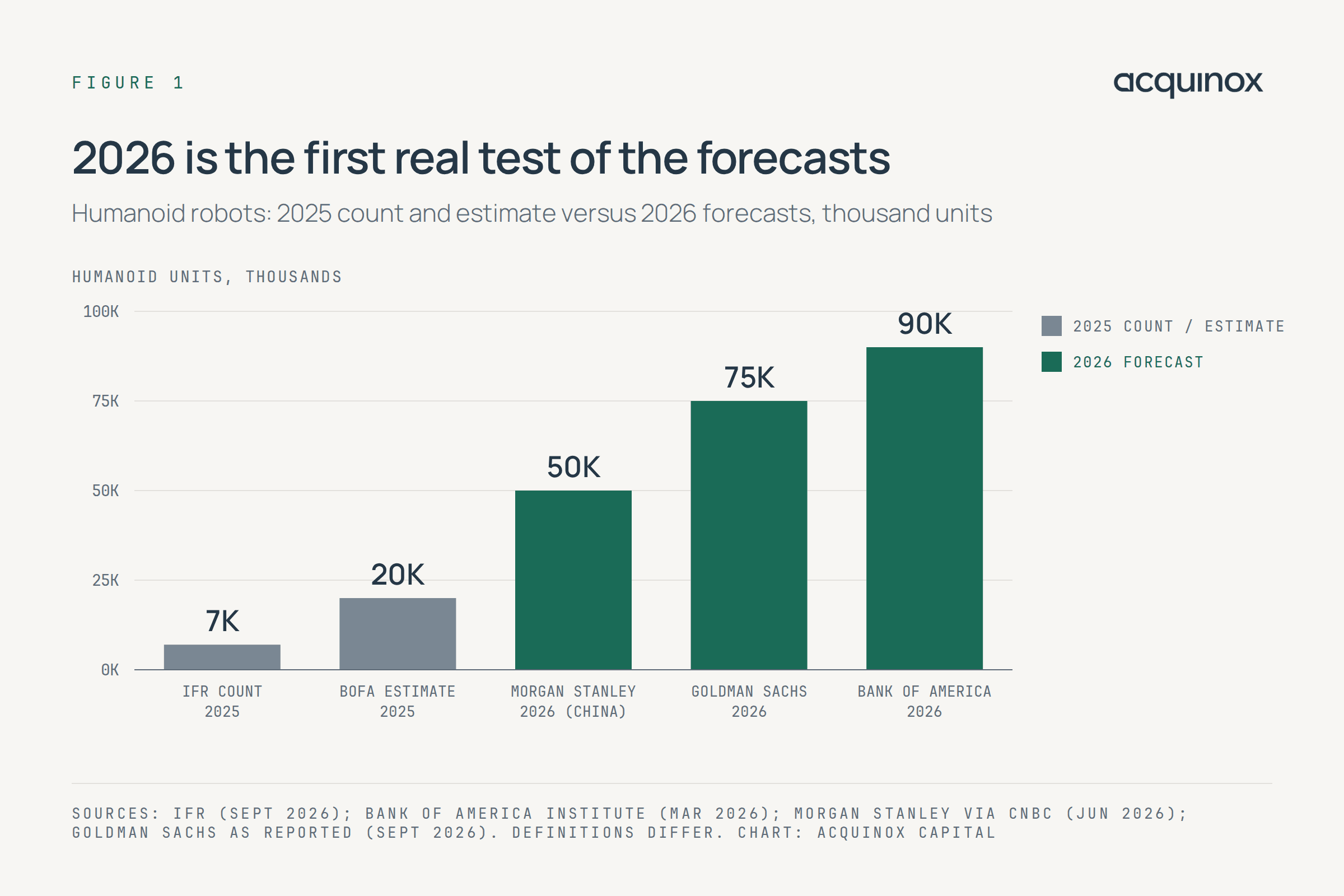
Figure 1. The IFR counted about 7,000 full-size humanoids sold in 2025 (Bank of America estimates about 20,000 on a broader definition); 2026 forecasts range from 50,000 in China to 90,000 worldwide.
The economics: hours, not hardware
Component costs are falling quickly. Bank of America puts the bill of materials for a China-built humanoid at about $35,000 in 2025, falling below $17,000 by 2030, against $90,000 to $100,000 for Western pilot-stage units. Morgan Stanley estimates a humanoid cost about $200,000 in high-income countries in 2024, falling to about $150,000 by 2028. Bill of materials is parts cost, not selling price, and excludes integration, maintenance and support.
The return depends less on the purchase price than on how many productive hours the robot delivers. The US Bureau of Labor Statistics puts the median wage for hand labourers and material movers at $38,220 in May 2025. As an illustration, take a $50,000 robot replacing that wage, excluding benefits. If it delivers a full shift of productive work, it pays back in about 1.3 years. If charging, faults and supervision limit it to half a shift, payback stretches to about 2.6 years; at a quarter of a shift, to more than five years, before maintenance, integration and supervision costs.
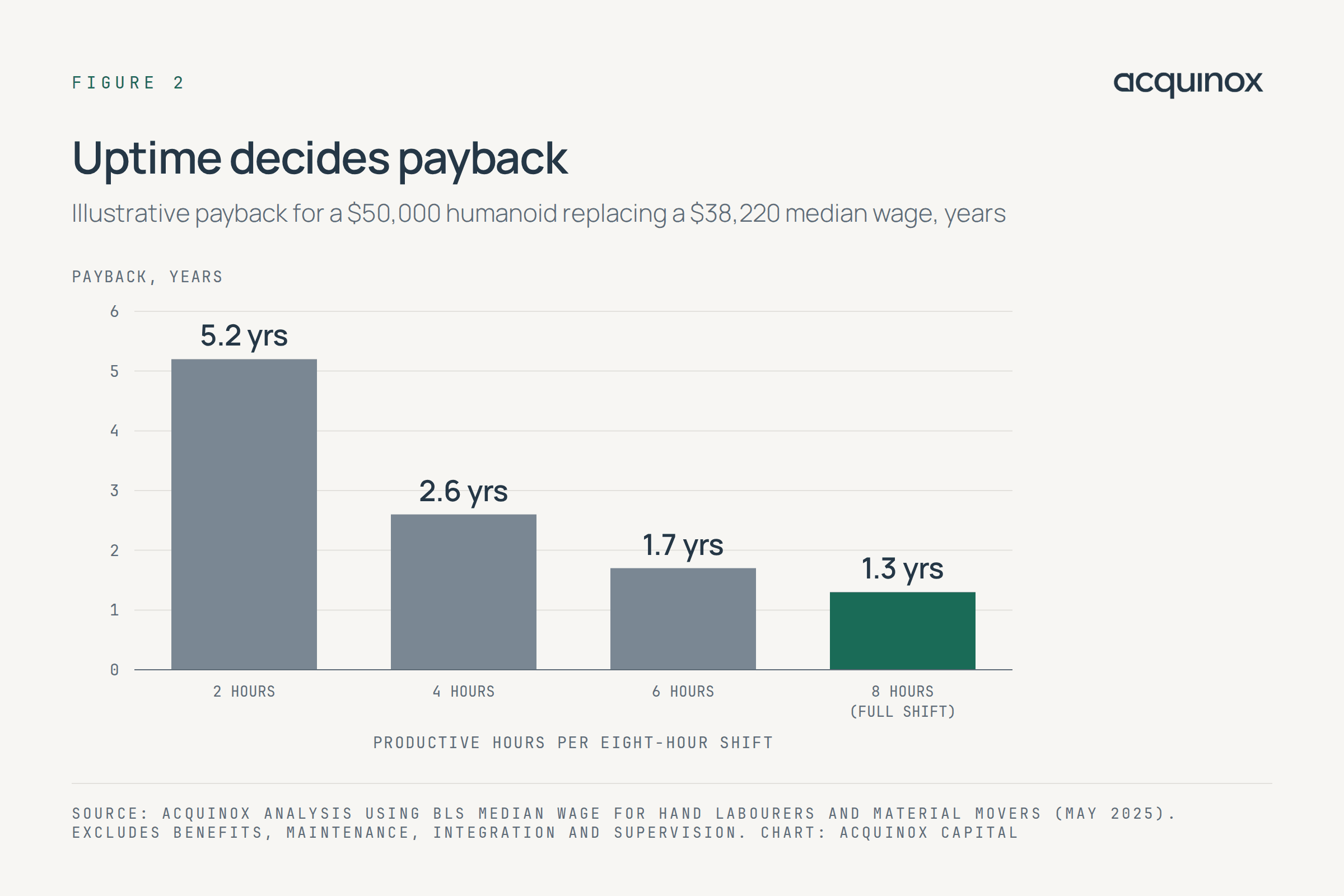
Figure 2. Illustrative payback for a $50,000 humanoid replacing a $38,220 median wage, by productive hours per eight-hour shift. Acquinox analysis; excludes benefits, maintenance, integration and supervision.
That makes uptime the main driver of return on investment. The IFR makes the same point: to compete with conventional automation, humanoids must match industrial requirements for cycle times, energy consumption and maintenance costs, and be certified to the relevant safety standards.
China: capital-market scrutiny and revenue quality
China is where the commercial test is most visible. Morgan Stanley raised its forecast for China's humanoid market in June to about 50,000 units shipped externally in 2026. Unitree raised about 6.1 billion yuan in its Shanghai IPO in August, and its shares rose more than fivefold on debut before falling 55% from their peak. Chinese regulators have since used informal "window guidance" to slow humanoid listings, Reuters reported, with one source describing them as effectively frozen and another saying there was no formal ban. According to sources cited by CNBC, applicants are expected to show sustainable revenue and commercial orders, narrowing losses and core technology, though meeting two of the three may suffice.
The underlying question is revenue quality. In the first nine months of 2025, about 9% of Unitree's revenue came from industrial sales and 73.6% from research and education customers, according to its review materials filed with the Shanghai Stock Exchange. Regulators are examining revenue from local-government-backed data-collection centres and joint ventures, in which local authorities can provide 80% to 90% of the initial investment. Mech-Mind Robotics chief executive Shao Tianlan has questioned companies relying on "data collection centres, related-party deals and other unsustainable arrangements". One person close to humanoid investors told Reuters that some valuations could fall 60% to 70% if data-collection revenue were excluded, a single anonymous estimate. Our analysis of the US–China robotics race sets out the wider competition.
The investor scorecard
| Metric | Why it matters | Evidence to ask for |
|---|---|---|
| Productive hours per shift | Drives payback more than hardware cost | Shift-equivalent uptime at customer sites, including charging and faults |
| Task success and intervention rate | Separates repeatable work from demonstrations | Success rates with confidence intervals over thousands of cycles |
| Safety certification | Fenceless operation unlocks real factory floors | Certification to ISO safety standards for work alongside people |
| Total cost of deployment | Bill of materials is only part of the cost | Integration, maintenance, supervision and energy per shift |
| Order quality | Pilots and letters of intent are not revenue | Share of firm, paid orders versus non-binding expressions of interest |
| Revenue sources | State-linked and related-party revenue may not recur | Share of revenue from research, data-collection centres and related parties |
Source: Acquinox analysis, drawing on IFR, Bank of America and company disclosures.
In our view, the next benchmark for humanoid robotics will not be another spectacular demonstration but boring, repeatable reliability that supports profitable deployment. That shift separates pilots from production and viable businesses from research projects, and it moves value towards companies that can document uptime, safety and paying customers. Our earlier analyses of Project Prometheus and why AI still struggles in the physical world look at the technology behind that test.
The risks that matter
Forecasts built on different definitions
Shipment forecasts and the IFR count measure different things. Growth rates calculated across them can overstate or understate momentum, and valuations anchored to the most ambitious forecasts carry the most risk.
Revenue quality
Revenue from research buyers, government-backed data-collection centres and related parties may not recur. China's regulators are now testing exactly this, and private-market investors should apply the same test.
Unproven unit economics
Payback depends on uptime, maintenance and integration costs that few companies disclose. Until fleets run full shifts at customer sites, return on investment remains an estimate.
Safety and certification
Humanoids working alongside people need safety certification that is still being developed. Delays would keep deployments behind fences or in pilots.
A cooling IPO window
Unitree's volatile debut and China's window guidance show how quickly listing routes can narrow. Companies counting on IPOs for growth capital may face longer private funding cycles.
What to monitor next
Five indicators will show whether humanoids are moving from proof of concept to proof of economics: the IFR's 2026 count against bank forecasts of 50,000 to 90,000 units; shift-equivalent uptime disclosed by deployed fleets; independent safety certifications for fenceless operation; the share of firm orders in company backlogs; and whether China's IPO criteria change the revenue mix of listed humanoid makers.
The industry has shown that humanoids can generalise across environments. The harder test is whether they can do so reliably and safely enough to justify deployment at scale, and that will be settled by operating metrics over thousands of cycles, the structure of customer contracts and the quality of revenue, not by the next demonstration video.
This article is for informational purposes only and does not constitute investment advice or an offer to buy or sell any security. It reflects publicly available information and estimates as of the publication date, which may change. Private market investments involve substantial risks, including illiquidity and potential loss of capital. Readers should conduct their own due diligence and consult qualified advisors before making investment decisions.