
Key takeaways
- CoreWeave, Nscale and Crusoe raised over $11 billion in September 2026 and report over $340 billion of contracts, yet only $2.6 billion of Nscale's $103.4 billion was active at the end of August.
- Lenders increasingly underwrite the customer, not the neocloud: CoreWeave's contract-backed facility is rated investment grade, while its own bonds yielded close to 15% in October.
- Main risks: customer concentration, financing contingencies, power and construction delays, GPU residual values, and capital markets that tightened sharply in October.
In September 2026, the three best-known independent AI cloud providers, or neoclouds, raised more than $11 billion between them: CoreWeave sold $4.2 billion of convertible notes, Nscale raised $3.36 billion of pre-IPO convertible notes and filed for a New York listing, and Crusoe closed a $3.9 billion Series F. Together they report more than $340 billion of contracted value. A month later, the gap between those numbers and what is actually funded and running became the story: Microsoft withdrew from an Nscale data centre in England, investors pushed back on Nscale's IPO valuation, and AI infrastructure stocks sold off. This article examines how neoclouds finance the build-out, and what investors should test before treating contract value as revenue.
From compute scarcity to project finance
Neoclouds rent out GPU capacity, mostly NVIDIA chips, to AI labs, hyperscalers and enterprises. When chips were scarce, access to hardware was the main competitive advantage. As the build-out has scaled, financing has become as important as supply: each new campus is a multi-billion-dollar project that needs contracted customers, power and debt before it earns revenue.
The same shift is visible across the industry. The Bank for International Settlements documented it in a January bulletin titled Financing the AI boom: from cash flows to debt, and its March Quarterly Review describes data-centre structures backed by assets and hyperscaler contracts as "shadow borrowing", obligations economically akin to debt that sit off balance sheet. Its 2026 Annual Economic Report adds the risk most relevant to neoclouds: if hyperscalers slow their capital spending, many borrowers across the supply chain could struggle to replace lost revenue and service their debt.
The three best-known neoclouds have answered the financing question in different ways.
| CoreWeave | Nscale | Crusoe | |
|---|---|---|---|
| Latest capital event | $4.2B 2.875% convertible notes due 2033 (closed 22 Sept 2026) | S-1 filed 18 Sept 2026 for NYSE listing; $3.36B pre-IPO convertible notes | $3.9B Series F initial close at $30.9B post-money (17 Sept 2026) |
| Reported contract value | ~$104B revenue backlog at 30 June, excluding >$25B added early in Q3 | $103.4B total contract value; ~85% Microsoft and Anthropic | >$140B total contract value; 6GW+ gross contracted capacity |
| What is producing revenue | Q2 revenue $2.58B; 1.5GW active power | $2.6B of contract value active at end of August; H1 revenue $140.6M | 1GW operational; revenue not disclosed |
| Key financing feature | $35.6B of debt at 30 June, including $13.6B of project loans backed by GPUs and contracts | Largest contract conditional on Nscale securing financing | Vertical integration from power generation to cloud |
Sources: CoreWeave Q2 2026 results and filings; Nscale Form S-1 (18 September 2026) as reported by Bloomberg, CNBC and TechCrunch; Crusoe (17 September 2026). Backlog and total contract value are defined differently by each company and are not directly comparable.
CoreWeave: cheaper money while the equity cooperates
CoreWeave is the most established of the three and carries the most debt. It priced its September convertible at $3.7 billion and closed at $4.2 billion once the initial purchasers took up their option, at a 2.875% coupon. Its existing straight bonds carry coupons of around 9.6% to 9.75%, so a convertible is far cheaper in cash interest, as long as investors value the right to convert into shares.
That condition is now being tested. CoreWeave carried $35.6 billion of debt at the end of June, of which $10.6 billion falls due by the end of 2027. In the second quarter, net interest expense rose to $640 million from $267 million a year earlier and turned a near-breakeven operating result into a $626 million net loss, according to its Q2 results. Markets have since repriced that risk. On 14 October, CoreWeave's shares fell 15.5% in a day and Nebius's 10%, and the yield on CoreWeave's 9.625% notes due 2032 reached about 14.8%, CNBC reported. Chief executive Mike Intrator told staff that difficulties at Firmus, AirTrunk, Lambda and Nscale were "bleeding into the narrative", according to the Financial Times, while NVIDIA's Jensen Huang told Bloomberg he did not expect CoreWeave to need a backstop. With the shares trading well below the $97.85 conversion price, the next convertible will be harder to sell at the same coupon.
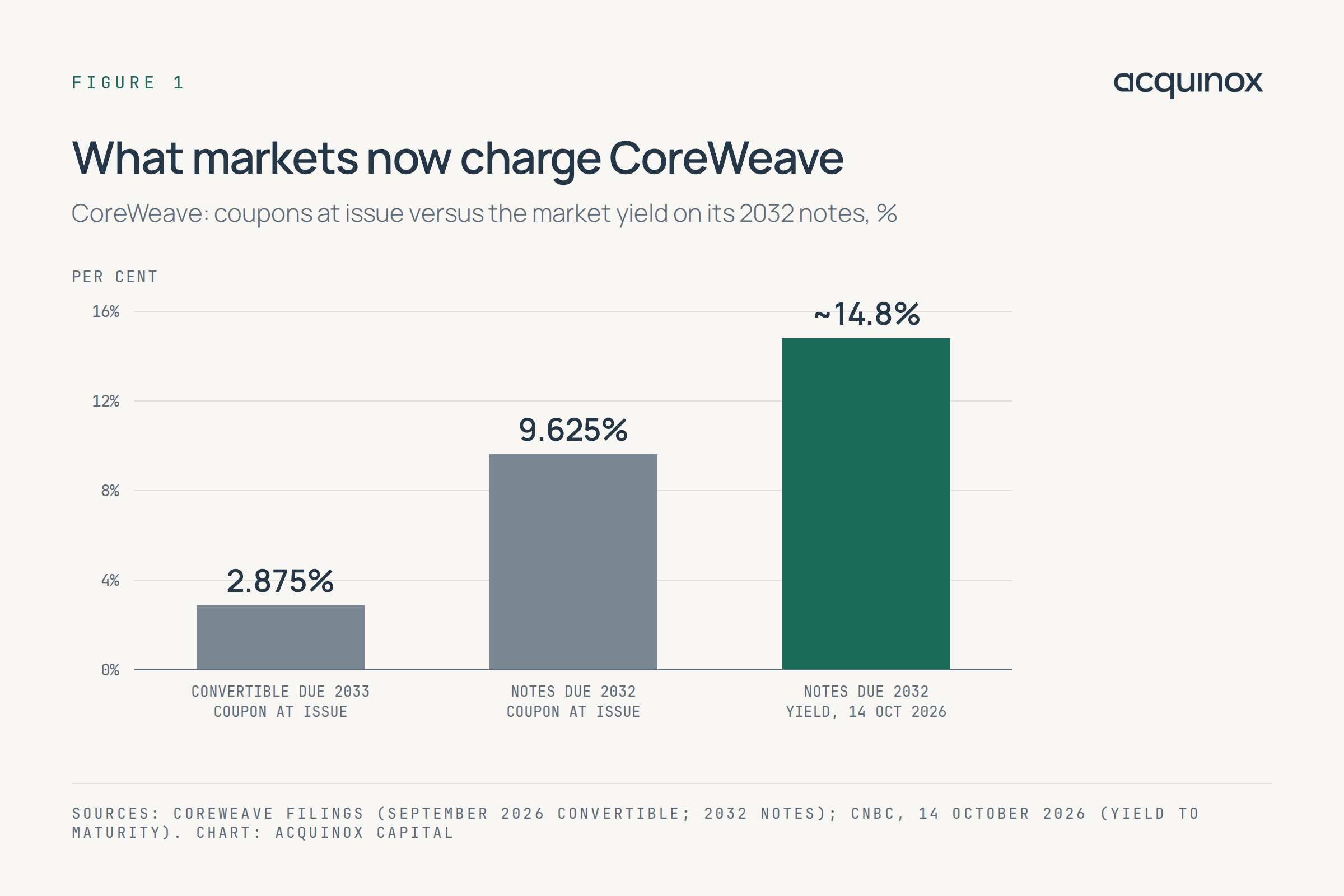
Figure 1. CoreWeave’s 2033 convertible carries a 2.875% coupon and its 2032 notes 9.625%, but the 2032 notes yielded about 14.8% on 14 October 2026. Its separately rated, contract-backed facility (A3) is not shown.
Nscale: $103 billion of contracts, $2.6 billion active
Nscale's IPO filing shows the gap between contracted and bankable revenue most clearly. The London-based company reported $103.4 billion of total contract value, with Microsoft (up to $43.8 billion through 2033) and Anthropic (up to $44.6 billion) accounting for about 85%. Only $2.6 billion of that value was active at the end of August, against first-half revenue of $140.6 million. The Anthropic agreement, for capacity at a planned campus in West Virginia, is contingent on Nscale obtaining financing, and the customer can walk away if milestones the filing describes as "stringent" are missed.
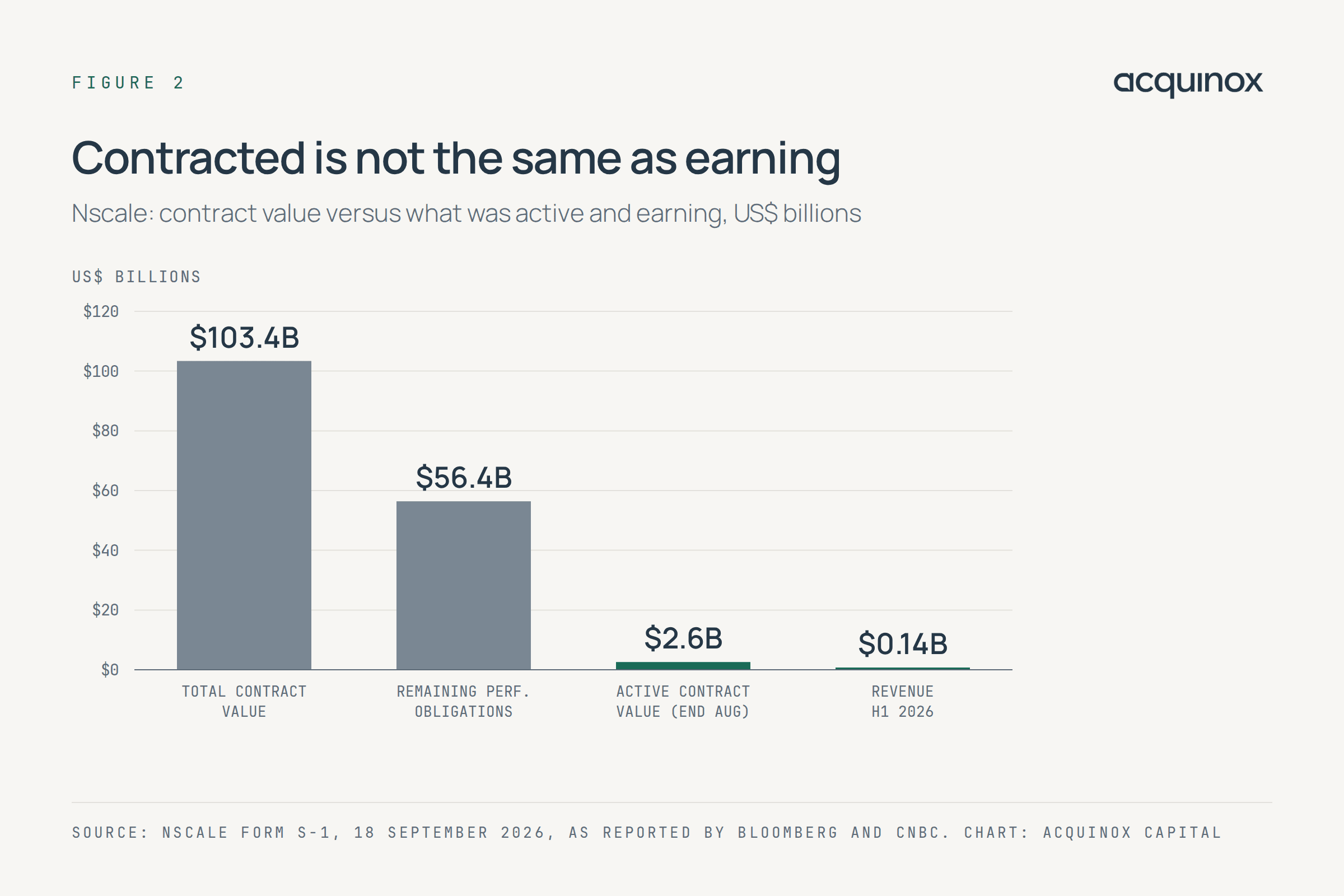
Figure 2. Nscale’s $103.4B of total contract value against $56.4B of remaining performance obligations, $2.6B active at the end of August, and $140.6M of first-half revenue.
Execution is now testing that backlog. In October, Microsoft withdrew as anchor tenant of a planned Nscale site in Loughton, England, after power constraints delayed the project, and Nscale's flagship site in Norway was reported to be about six months behind schedule. Some investors have argued for an IPO valuation of $16 billion to $19 billion rather than the roughly $30 billion the company is seeking, pointing in part to Australian operator Firmus abandoning its own IPO. Firmus withdrew its planned $5 billion listing on 9 October after investors questioned its debt, its lack of a track record in building AI data centres and a partner's exit from a A$73 billion development deal, Reuters reported. "The market has spoken," said one of its investors. Our earlier analysis of Nscale's sovereign AI ambitions set out the strategy; the filing shows what it takes to finance it.
Crusoe: vertical integration as a financing strategy
Crusoe, based in Denver, is the only one of the three still fully private. Its Series F, co-led by Atreides Management, Mubadala Capital and Valor Equity Partners, valued it at three times its $10 billion valuation of October 2025. The company reports more than $140 billion of total contracted value and over 6GW of gross contracted capacity, of which 1GW is delivered and operating. Its largest disclosed single contract is a five-year, $13 billion cloud agreement with trading firm Jane Street.
Crusoe's distinctive feature is that it develops power as well as data centres and cloud services. The investment case is that controlling energy supply shortens the path from contract to revenue, the step where Nscale has stumbled. The valuation rests on that execution: revenue and margins are undisclosed, and five-sixths of contracted capacity has yet to be built. We examined the model in more detail in our Crusoe investor insights.
Where the debt sits: the credit is the customer
The most important change in neocloud financing is where lenders look for repayment. In March, CoreWeave closed an $8.5 billion facility rated A3 by Moody's and A (low) by DBRS, the first investment-grade financing secured by GPU infrastructure and a customer contract, anchored by Blackstone Credit & Insurance. CoreWeave's own investor materials describe the model: debt held in project vehicles is secured by long-term take-or-pay contracts and the related GPUs, amortises as customers pay so that it is repaid by the time the contract expires, and earns investment-grade ratings when the underlying customers are investment grade. A further $3.1 billion facility in May, rated Ba2 by Moody's and BB+ by Fitch, was the first of its kind to be publicly syndicated.
The contrast with CoreWeave's corporate credit is stark: S&P rates the company B+, and its unsecured bonds now yield close to 15%. Lenders are underwriting the customer and the contract, not the neocloud. Peers are adopting the same approach. Nebius raised its first secured debt in July, $775 million backed by GPU infrastructure and contracted cash flows, alongside more than $40 billion of contracted revenue from customers including Microsoft and Meta. Hyperscalers also lend their own credit: Google has backstopped more than $5 billion of Fluidstack's lease obligations to former bitcoin miners, but law firm Quinn Emanuel notes that the backstop applies only once construction is complete, leaving bondholders exposed to execution risk during the build.
The competitive advantage among neoclouds is therefore shifting from access to GPUs towards access to cheap structured capital, and that depends on who the customers are.
Private credit and the wider system
Neocloud financing is part of a larger shift in how AI infrastructure is funded. The BIS reports that direct lending funds have quadrupled their lending to AI and IT companies over five years, to about 15% of their portfolios, on terms broadly similar to other sectors despite larger loan sizes. The Financial Stability Board's May 2026 report on private credit finds that AI-related firms accounted for 34% of private credit deals in 2025, against an average of 17% over the previous five years, and cites estimates that private credit could supply around $800 billion of AI infrastructure financing over 2025–28. It warns that a sharp correction, triggered for example by electricity shortfalls that delay projects or by data-centre overcapacity, could lead to sizeable credit losses for private credit investors.
The revenue side is under scrutiny too. Gartner estimates that AI data-centre owners would need $8.5 trillion of cumulative revenue through 2030 to cover announced capital spending, financing costs and a 12% return, against no more than $3.6 trillion of AI revenue attributable to those data centres, and expects more than 80% of neoclouds to cease independent operations by 2030. When one sector absorbs that much new credit across bonds, convertibles and private loans at once, stress in it can travel through channels regulators are still mapping.
What investors should test
In our view, contract value is a claim on future revenue, not revenue, and a neocloud's cost of capital is increasingly borrowed from the credit of its customers. The test for any neocloud is how much of its backlog is active, funded, powered and owed by counterparties able to pay, and what the capital structure looks like if any of those conditions slips. Four questions do most of the work:
| Question | What to look for |
|---|---|
| How much of the contract value is active? | Share of contract value generating revenue today, and the schedule for the rest |
| Who owes the money? | Customer concentration and each anchor customer's own funding position |
| Is the capacity funded and powered? | Binding financing and grid connections for each site, not just signed contracts |
| What does the capital cost? | Coupons, maturities and covenants across project loans, bonds and convertibles, and realistic access to refinancing |
Source: Acquinox analysis.
Power procurement has moved from a secondary diligence item to a primary revenue risk: Nscale's Loughton site lost its anchor tenant over power, not demand. For late-stage investors, the balance-sheet test separates infrastructure businesses with funded, contracted and connected capacity from leveraged bets on future financing. Our analysis of how data infrastructure became investable covers the wider market.
The risks that matter
Customer concentration
Two customers account for about 85% of Nscale's contract value. Any renegotiation, delay penalty or cancellation by an anchor customer changes the investment case.
Financing contingencies
Contracts conditional on the provider raising capital can lapse if markets close. Firmus's withdrawn IPO and the pushback on Nscale's valuation show that access to capital cannot be assumed.
Power and construction delays
Grid connections and construction schedules decide when contracted capacity starts earning. Delays extend the period in which debt accrues before revenue arrives.
GPU residual values
Project loans are secured on hardware whose value depends on rental rates across chip generations. Falling rates would weaken both earnings and collateral at the same time.
Market access and refinancing
Low-coupon convertibles depend on rising share prices. October showed how quickly that can reverse: when equity weakens, refinancing shifts towards high-yield debt and private credit at higher cost, unless the debt can be secured on investment-grade customers.
What to monitor next
Five indicators will show which neoclouds pass the test: the share of contract value that becomes active each quarter; Nscale's IPO pricing and any change to its Microsoft and Anthropic commitments; CoreWeave's cost of new debt relative to its 2.875% convertible; site-level power connections and delivery dates; and private-credit terms for GPU-backed loans.
The neocloud build-out has moved from a hardware race to a financing test. Contract value will keep growing, but the companies that compound value will be those that turn it into funded, powered and paying capacity without depending on capital markets staying open on every step of the way.
This article is for informational purposes only and does not constitute investment advice or an offer to buy or sell any security. It reflects publicly available information and estimates as of the publication date, which may change. Private market investments involve substantial risks, including illiquidity and potential loss of capital. Readers should conduct their own due diligence and consult qualified advisors before making investment decisions.