In a Shenzhen factory, robots are working the night shift without breaks. UBTech's humanoid robots lift boxes, assemble battery packs, and conduct quality inspections. Now, the company unveiled something more remarkable: a robot that autonomously swaps its own battery, enabling uninterrupted twenty-four-hour operation.
While the AI race dominates headlines, amid media speculation about a potential future IPO that could target a trillion-dollar valuation for OpenAI, a parallel contest is unfolding with potentially greater economic consequences. The robotics race between the United States and China will determine which nation controls the physical infrastructure of the AI economy, and by extension, the manufacturing capacity that underpins 21st-century power.
The strategic divide: Brains vs. bodies
The United States is leading decisively on intelligence, the brains in the robot body. Skild AI recently saw its valuation exceed $14 billion, building universal robot operating systems. Firms focusing on ‘brains’ develop Vision-Language-Action models that allow robots to understand vague human commands rather than requiring explicit programming.
China is leading in manufacturing. To reference a few examples, Beijing-based Galbot completed a $300 million funding round in December 2025, reaching a $3 billion valuation with thousands of units deployed across CATL, Bosch, Toyota, and Hyundai facilities. Chinese manufacturer Unitree launched its R1 humanoid at $5,900 in July, a price point thought impossible before 2030.
The scale differential is stark. In 2024, China is estimated to have accounted for over half of all global industrial robot installations, a volume nearly ten times that of the United States.
Manufacturing as a competitive moat
China's advantage isn't just volume but vertical integration. Modern humanoid robots contain thousands of precision components: harmonic reducers for joints, torque sensors, high-resolution encoders, brushless motors, and vision processors. Chinese firms now supply "practically the entire robot" within local industrial clusters.
This integration enables iteration speed Western competitors cannot match. In Shenzhen and Shanghai, manufacturing hubs allow toolmakers, robot integrators, and end-users to co-locate, rapidly testing and refining automation.
Galbot's autonomous warehouse solutions demonstrate stable twenty-four-hour operations for over a year. The company secured orders for thousands of units in real manufacturing environments, not pilot programs.
The American response remains largely conceptual. Tesla aims to deploy thousands of Optimus robots internally by year-end 2025, ramping toward one million units annually by late 2026 or early 2027. These are projections, not demonstrated capacity.
The valuation paradox
American companies command extraordinary valuations despite minimal revenue. Figure AI's $39 billion valuation represents a bet on future technological superiority. The company has shipped limited units with deployments measured in dozens, not thousands.
Chinese firms are valued on demonstrated production. Galbot's $3 billion valuation followed commercial deployments and multi-year contracts. The valuation gap with Figure AI at thirteen times Galbot reflects different investor frameworks. Silicon Valley prices potential. Asia prices execution.
But the execution gap is narrowing faster than the technology gap. Goldman Sachs reported manufacturing costs for humanoid robots declined 40% year-over-year in 2024, versus earlier projections of 15-20%. As costs collapse, the AI advantage American firms possess may matter less if Chinese robots achieve acceptable performance at one-tenth the price.
This mirrors the electric vehicle trajectory. Tesla pioneered the technology and commanded premium valuations. Chinese manufacturers now produce EVs at price points Tesla cannot match while maintaining acceptable quality. BYD surpassed Tesla in global EV sales, achieved with a product line that includes hybrids alongside pure electrics because of manufacturing scale, not just technological elegance.
Where the opportunities actually are
The robotics race presents asymmetric opportunities across both markets, but requires recalibrated frameworks. Three dynamics are reshaping how value compounds:
The AI premium versus manufacturing scale trade-off
Investing in U.S. robotics leaders like Figure AI represents a wager that superior AI will matter more than manufacturing cost. The thesis holds if robots require sophisticated reasoning for unstructured environments like healthcare, household assistance, and adaptive manufacturing. If the "brain" creates a defensible moat, American valuations may prove justified.
The risk: history suggests that manufacturing commoditises technology over time. If humanoid robots commoditise like smartphones and PCs, early technological leads matter less than sustained manufacturing advantage.
Access and liquidity constraints in Chinese markets
Investing in Chinese robotics manufacturers offers exposure to demonstrated scaling capability and falling cost curves. China's robotics sector saw 610 investment deals totaling $7 billion in the first nine months of 2025, a 250% increase year-over-year. Companies like Galbot, Unitree, and UBTECH are manufacturing operations with paying customers, not research projects.
The challenge: Chinese robotics firms increasingly list in Hong Kong or Shanghai, limiting participation for Western investors. Secondary markets and structured vehicles provide entry points, though liquidity remains constrained compared to U.S. venture rounds.
The sovereign infrastructure premium
The geopolitical dimension creates structural demand independent of economic cycles. European and Asian governments are building domestic robotics capacity to reduce dependence on any single supplier. This creates opportunities in regional champions that may not achieve global scale but capture protected domestic markets with government backing.
Market projections and reality
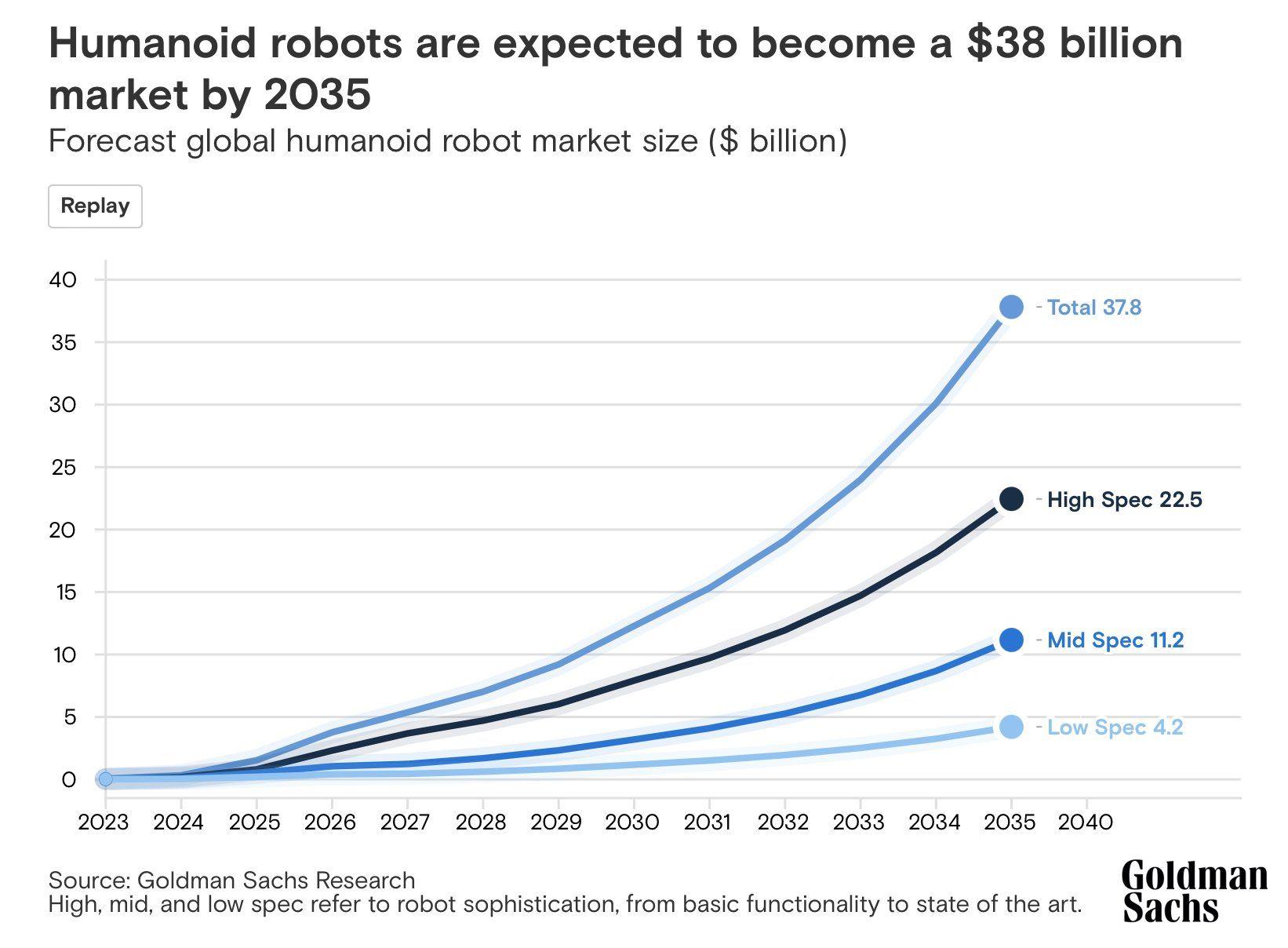
The global humanoid robot market is projected to grow rapidly, and projections vary decisively, with Goldman Sachs projecting a market size of up to $37.8bn in 2035. Morgan Stanley projects the market reaching $5 trillion by 2050.
But here's what the trillion-dollar projections miss: the smartest money isn't betting on who builds the smartest robots. It's identifying which business models capture value as the industry scales.
The nation that can produce capable robots at an acceptable cost will set global prices, just as China did with solar panels and electric vehicles. The alternative, where AI sophistication creates durable advantages, requires robot tasks to remain complex enough to justify premium pricing. History suggests that's unlikely for industrial applications where "good enough" at low cost wins.
This article draws on data and publicly available information from Figure AI, Galbot, Tesla, UBTech, and market research, industry data, and reporting from Financial Times, Bloomberg amongst others. All data is current as of December 2025.
Published by Samuel Hieber