

Key takeaways
- SpaceX reportedly targeted a mid-June 2026 IPO raising up to $50 billion; potential mega-listings would test public-market capacity.
- Anthropic’s estimated 80% enterprise revenue mix and Databricks’ positive free cash flow distinguish their investment cases from consumer-led AI growth.
- Smaller IPO floats could ease capital absorption but constrain liquidity and price discovery, while ambitious valuations leave room for compression.
Welcome to 2026, the year when technology companies have grown so large in private markets that a single IPO can shift capital allocation across entire continents.
For the past three years, the IPO market was relatively muted compared to the SPAC boom in 2020 and 2021 and mainly established companies decided to list. That drought looks to be ending. According to EY Global IPO Trends, the US IPO market saw 216 deals completed in 2025, raising $47.4 billion in total proceeds, significantly higher than prior years.
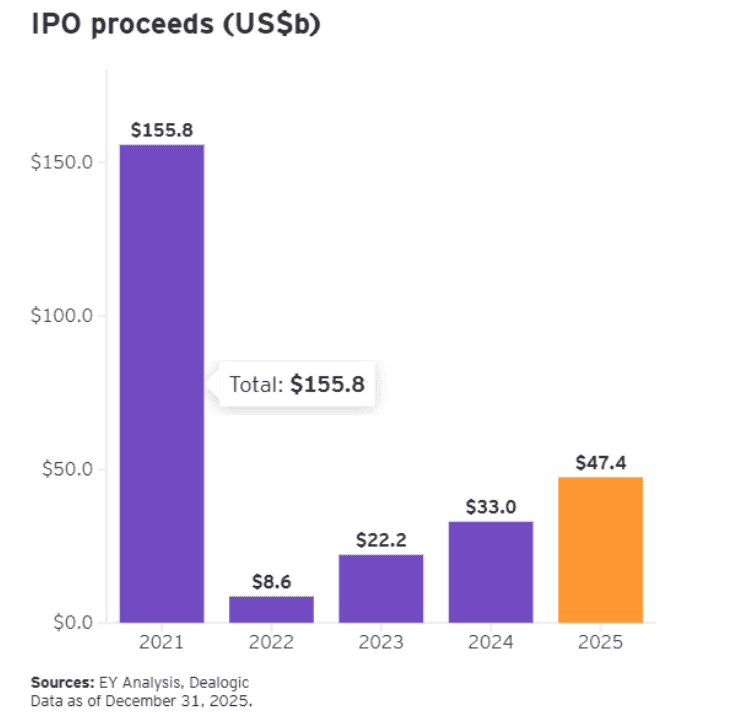
Source: EY
Now, 2026 is shaping up as something entirely different: the year when companies valued at a trillions could simultaneously test public markets.
The trillion-dollar question
SpaceX is reportedly targeting a mid-June 2026 IPO at a $1.5 trillion valuation, , with some recent reports suggesting valuations approaching $1.75 trillion, aiming to raise up to $50 billion, which would beat Saudi Aramco's 2019 record. OpenAI is laying groundwork for a Q4 2026 listing that could value it near $1 trillion, according to Reuters reports. AndAnthropic closed a $30 billion funding round in February 2026 at a $380 billion valuation, positioning itself as the enterprise-focused alternative to OpenAI's consumer dominance.
The scale defies conventional IPO mathematics. A few companies alone could attempt to absorb an unprecedented amount of capital in a single year. Standard IPO floats of 15-25% would require raising hundreds of billions from public markets. It's not just unprecedented, it's structurally impossible without dramatically smaller floats.
Company | Reported valuation target / latest funding valuation | Timeline | What matters |
SpaceX | $1.5–1.75 trillion (reported target valuation) | June 2026 | Starlink cash flow ($8B EBITDA on ~$16B revenue); xAI integration under discussion |
OpenAI | $1 trillion (reported target valuation) | Possibly Q4 2026 | ~$25B estimated revenue run-rate but $14B projected losses in 2026; infrastructure costs ballooning |
Anthropic | $380 billion (latest funding round) | Late 2026 possible | 80% enterprise revenue mix; $19B annualised revenue with strong margin profile (Sacra estimates) |
Databricks | $134 billion (latest funding round) | H2 2026 possible | $5.4B revenue growing 65% YoY with positive free cash flow |
What's actually driving this wave
Three structural factors distinguish 2026 from previous IPO cycles:
Private capital exhaustion: Even the largest venture funds cannot indefinitely fund companies burning billions quarterly. OpenAI is targeting approximately $600 billion in infrastructure spending through 2030 and needs a path to public capital that doesn't dilute existing shareholders to oblivion. As companies like Anduril Industries demonstrate in the defence sector, scaling capital-intensive technology requires either government contracts or public market access.
AI infrastructure arms race: The cost of training frontier AI models has exploded. What cost hundreds of millions in 2023 now requires tens of billions. Anthropic's $30 billion raise, initially targeted at just $10 billion, signals institutional conviction that AI infrastructure is the new oil and gas.
Demonstration effects from 2025 listings: CoreWeave, the AI data centre company, went public in March 2025 at a $23 billion valuation and has more than tripled at peak. Figma and Klarna provided additional proof points that public markets would reward quality growth companies with clear paths to profitability.
The enterprise versus consumer divide
The most important valuation question isn't size, it's revenue mix.
Anthropic derives an estimated 80% of revenue from enterprises, with its Claude Code AI coding tool and other enterprise targeted applications. Public markets traditionally assign higher multiples to enterprise revenue because it's stickier, more predictable, and demonstrates pricing power.
OpenAI, by contrast, has more than 800 million weekly active users and an estimated $25 billion in annualised revenue, but also faces $14 billion in projected losses for 2026. Its consumer-first model delivers scale and virality but at infrastructure costs that make even patient investors uneasy. The company's targeted $1 trillion valuation assumes it can successfully monetise through advertising, enterprise expansion, and eventually, autonomous AI agents. That's a lot of assumptions.
Databricks closed $7 billion in combined equity and debt financing at a $134 billion valuation and disclosed $5.4 billion in revenue growing 65% year-over-year with positive free cash flow. Among mega-IPO candidates, it represents a “smaller” deal size, but with proven enterprise traction, diversified customer base, and unit economics that may seem sustainable. The broader market for AI investments in private equity has shifted decisively toward companies demonstrating these characteristics.
Beyond the mega-IPOs: The next tier of 2026 candidates
While SpaceX, OpenAI and Anthropic dominate headlines, a substantial cohort of companies valued between $2 billion and $25 billion are also preparing for public markets. These represent more digestible deal sizes for institutional investors and may offer clearer valuation frameworks.
AI infrastructure challengers
Cerebras Systems is positioning itself as a credible alternative to Nvidia in the AI chip market. The company, which pioneered wafer-scale computing with the largest AI chip ever built, filed for a U.S. IPO after withdrawing an earlier filing. The company's valuation has surged dramatically to $23.1 billion in February 2026 after raising $1 billion led by Tiger Global. Cerebras claims 10x faster training time-to-solution compared to GPU-based alternatives, and counts OpenAI among its customers for low-latency inference workloads.
Lambda, the Nvidia-backed cloud computing platform, is reportedly in talks 2026 IPO that could happen as early as H1 2026. The company raised $1.5 billion in November 2025. Lambda's "Superintelligence Cloud" provides on-demand GPU access for AI training and inference, with cloud GPU rentals nearly doubling year-over-year in 2025 and now constituting the majority of revenue.
Nscale, another Nvidia-backed AI infrastructure play, raised $2 billion at a $14.6 billion valuation in March 2026 and is reportedly eying an IPO with Goldman Sachs and JPMorgan as underwriters. Founded in 2024, the UK-based company owns and operates its own data centres, GPUs, and software stack. Its customer roster includes Microsoft and OpenAI, a notable validation of its infrastructure capabilities.
Consumer and social platforms
Discord confidentially filed for a U.S. IPO in January 2026, though deliberations remain ongoing and the company could still decide not to proceed. Founded in 2015, Discord has evolved far beyond its gaming roots. The platform now serves over 200 million monthly active users, with 54% representing non-gaming communities spanning education, cryptocurrency projects, and developer ecosystems. Valued at approximately $15 billion in 2021, the platform's community-centric model and sticky user engagement could command premium multiples if it demonstrates a clear path to profitability.
Strava, the fitness tracking platform that combines workout monitoring with social networking, confidentially filed for an IPO in January 2026 with a potential listing as soon as spring 2026. The company was last valued at $2.2 billion in a May 2025 funding round led by Sequoia Capital. The platform's popularity surged during the pandemic thanks to features like giving "kudos" and comparing results with others, and it has maintained momentum as fitness tracking becomes increasingly mainstream.
Energy infrastructure
X-Energy, the nuclear reactor developer, publicly filed its S-1 in March 2026, planning to list on Nasdaq under the ticker "XE". The company is developing more than 11 gigawatts of new nuclear capacity through commercial partnerships in the U.S. and UK, with small modular reactors designed to run on HALEU (high-assay low-enriched uranium). The timing is strategic: the U.S. nuclear industry is experiencing a renaissance driven by surging power demand from AI computing infrastructure.
Valuation reality versus private market pricing
Yet, public markets tend to consistently value technology companies more conservatively than late-stage venture capitalists. If that pattern holds, there may be compression to those desired valuations.
Consider the revenue multiples: SpaceX at $1.5 trillion on ~$16 billion revenue implies a sales multiple close to 100x. OpenAI at $1 trillion on ~$25 billion revenue is still 40x. Compare that to Snowflake's post-IPO valuation of around 80x or traditional SaaS leaders trading at 8-12x. These valuations embed growth assumptions that border on heroic.
Anthropic's $380 last round valuation on $19 billion revenue, a 20x multiple, looks almost reasonable by comparison, especially given its enterprise customer concentration and the way it's positioned itself around AI safety. Similar to specialised AI chip investments, infrastructure plays command premium valuations when they demonstrate technical moats.
The absorption problem
Can public markets actually digest this much new supply? The answer depends on float structure. If SpaceX, OpenAI, and others debut with single digits floats rather than standard 15-25%, they avoid overwhelming available capital. But tiny floats create different problems: constrained price discovery, limited liquidity, and volatile trading.
For strategic investors, this dynamic may present an opportunity. Companies completing pre-IPO preparations often offer secondary market access through structured vehicles. Pre-IPO investment opportunities in unlisted growth equities allow positioning ahead of public market repricing, though you're accepting illiquidity and concentration risk.
What separates winners from wishful thinking
Not all mega-IPOs will succeed. Three criteria separate compelling opportunities from valuation mirages:
Path to profitability matters more than growth: Public investors tolerate losses when there's a credible roadmap to positive unit economics. Databricks has already crossed that threshold.
Enterprise revenue commands premium multiples: Consumer platforms can achieve massive scale but face monetisation challenges and regulatory scrutiny. Enterprise infrastructure, especially when embedded in mission-critical workflows, generates stickier revenue and demonstrates pricing power. The defence technology sector exemplifies this, where companies like Anduril build durable moats through deep customer integration.
Capital efficiency separates platforms from black holes: SpaceX reportedly generates $8 billion in EBITDA on $16 billion in revenue. That operating profitability funds R&D and expansion without constant capital calls. Compare that to companies requiring billions quarterly just to maintain operations. At $1.5 trillion, SpaceX's valuation embeds optimism, but the business model has proven it works.
Positioning for the inevitable
For investors evaluating 2026's IPO pipeline, three strategic considerations emerge:
Timing risk is significant but directional thesis is robust. Whether these IPOs happen in June, October, or slip to 2027 matters less than understanding that AI infrastructure, space communications, and enterprise data platforms represent multi-decade growth trajectories. Similar to the mobile gaming sector's evolution, what starts as hype often consolidates into genuine value creation.
Sector selection trumps brand recognition. SpaceX has Elon Musk's celebrity, and Databricks solid unit economics. Anthropic lacks the massive brand and name recognition of OpenAI but delivers enterprise characteristics. As with xAI's rapid ascent, what matters is sustainable competitive advantage, not headlines.
Pre-IPO access windows are narrowing, and the numbers show why it matters. Early investors in pre-IPO rounds historically capture the most significant valuation upside. At IPO, secondary market premiums typically compress, often dramatically: late-stage pre-IPO holders in high-profile listings have seen first-day pops ranging from 20% to over 100%, while post-IPO lock-up expirations frequently introduce volatility that erodes those gains. Entering earlier, like around Series D or E, usually means lower cost basis, perhaps a potentially greater upside potential, and more control over exit timing.
The bottom line for the 2026 IPO year
2026 won't just be another strong IPO year, it represents a structural reset in how technology innovation is financed. Companies have grown so large in private markets that their public debuts will reshape indices, redirect capital flows, and establish new benchmarks for what constitutes scale.
The real question is portfolio construction: balancing the proven (Databricks), the probable (Anthropic's enterprise moat, OpenAI’s consumer dominance), and the outlandish (SpaceX's interplanetary vision). The next tier—Cerebras, Lambda, Nscale, Discord, Strava, and X-Energy—offers diversification across AI infrastructure, consumer platforms, and energy, with more conventional valuation frameworks and potentially better liquidity.
2026 will mark the moment when technology companies that defined the private market era finally come to public markets, and test whether traditional valuation frameworks still apply.
The giants are coming. For sophisticated investors, the question is whether portfolio positioning reflects this shift, with appropriate consideration of the real risks involved.
This article is for informational purposes only and does not constitute investment advice. Past performance is not indicative of future results. Private market investments involve substantial risks including illiquidity and potential loss of capital. Readers should conduct their own due diligence and consult with qualified advisors before making investment decisions.