

Key takeaways
- Defence tech funding approached $50 billion in 2025, with autonomous systems attracting roughly $12 billion as military procurement increasingly values software.
- Manufacturing-focused defence investment reached $4.7 billion across 39 deals in 2025, shifting investor attention from prototypes toward repeatable production.
- Government demand supports the sector, but supply-chain constraints and demanding valuations make conversion of venture funding into manufacturing output the critical test.
Defence Tech Investing: Why Autonomous Systems Are Reshaping Private Markets
The meeting room overlooks the Pacific, and the founder presenting has paused mid-sentence. On the screen behind him, drone footage from eastern Ukraine shows what conventional warfare has become: not tanks in formation but swarms of autonomous systems, coordinated by algorithms, operating in airspace where GPS fails and communications are jammed. No human pilots. No ground control stations five thousand miles away. Just software making life-and-death decisions in milliseconds.
Five years ago, this would have been the moment when polite venture partners check their watches. The "strategic alignment" line, followed by nothing. Today, it's the moment capital leans forward. Because in those five years, three things converged: warfare moved faster than doctrine could contain it, geopolitics fragmented along lines Silicon Valley can no longer ignore, and private markets decided the future of conflict isn't platforms. It's intelligence.
Defence tech funding hit a record of close to $50 billion in 2025, nearly doubling from $27.2 billion the year before. Autonomous systems alone took roughly $12 billion. That's not growth. That's a market repricing itself.
Whether investors actually understand what changed, and where returns get captured next, is another question.
Ukraine situation has triggered investment glut
Ukraine demonstrated at scale that drones, autonomous platforms, and AI-enabled systems work. Cheap, rapidly produced systems paired with faster decision-making proved just as useful as traditional high-end platforms. What started as improvisation in Donbas became validation for an entirely new category of warfare.
But the real driver runs deeper than one war. Tech companies are competing for a share of the roughly $850 billion U.S. defence budget, but that budget is itself expanding in response to what the Pentagon now treats as inevitable: contested environments where traditional command structures fail, where electromagnetic warfare disrupts communications, and where speed of adaptation matters more than mass of steel.
Incumbents like Lockheed Martin, Raytheon and Boeing still dominate procurement, but their development cycles were built for another era. A six-year development timeline makes sense when you're building an F-35. It makes less sense when battlefield conditions change every few weeks. Ukraine's battlefield improvisations, China's rapid investment in autonomous systems, and the rising demand for flexible countermeasures have all exposed the gap. Venture capital noticed.
What is actually different: Incumbents vs. challengers
Back to that conference room for a moment. The investor across the table isn't asking about TAM or CAC. He's asking about production timelines, electromagnetic spectrum resilience, and whether the autonomy stack can operate when every satellite is offline. These are not SaaS questions. They're questions rooted in a market where the customer base is governments, the product is dual-use technology, and the validation comes from actual deployment.
What makes 2025 different from 2018, or even 2022, is that the venture model and the defence procurement model have begun to converge in ways that were previously unknown. Three reasons:
The technology matured. While aerial drones remain a core focus, autonomy is rapidly expanding into maritime and ground systems, alongside AI-enabled sensing, command-and-control, and collaborative combat platforms. The software that guides a $500 commercial drone now powers million-dollar military systems. The computer vision algorithms trained on consumer data now operate in GPS-denied combat zones. This dual-use convergence means development costs spread across commercial and defence revenue, changing the economics entirely.
Capital efficiency improved. Manufacturing-focused defence investment rose to $4.7 billion across 39 deals in 2025, nearly doubling year over year. Manufacturing, once an afterthought in venture-backed defence companies, is now where the competition actually is. Companies that can convert facilities into repeatable output are capturing both capital and contract velocity.
The ethical barrier shifted. Artificial intelligence opened the door to both pure defence and dual-use investment, helping mainstream venture firms move past long-held ethical reservations. These days, defence investment gets framed as supporting democratic values rather than fuelling conflict. Point72 has launched defence-specific funds. Y Combinator is actively seeking defence startups. A new founder community has taken shape in El Segundo, where entrepreneurs describe themselves as building for national security rather than for general-purpose software markets. The shift is cultural as much as economic.
The private market landscape: who's capturing value
Anduril Industries, the nine-year-old Costa Mesa company founded by Oculus creator Palmer Luckey, is the obvious example. In June 2025, Anduril raised $2.5 billion at a $30.5 billion valuation, with Founders Fund contributing $1 billion, the firm's largest cheque ever. Now, the company is in talks to raise billions more at a valuation approaching $60 billion, roughly doubling again within a year.
These aren't speculative numbers. Anduril reported approximately $1 billion in revenue in 2024, nearly doubling from the prior year, and secured defence contracts totalling around $1.5 billion. The company is building Arsenal-1, a 5-million-square-foot autonomous weapons manufacturing facility in Ohio.
Shield AI offers a parallel narrative with a different emphasis: not hardware dominance, but software ubiquity. Shield AI landed a $5.6 billion valuation in 2025, and is currently reportedly in talks to raise another round at up to $12 billion valuation.
Shield AI's core technology, Hivemind, is an AI pilot software that enables aircraft and drones to operate in areas where there is no communication or GPS. After an eight-month iteration period in 2024, Shield AI's V-BAT cleared rigorous Ukrainian jamming tests.
Palantir ties the whole thing together. Palantir's market capitalisation has grown to approximately $350 billion, with its share price more than doubling over 2025. The company partnered with Shield AI to integrate Hivemind with Palantir's operating system, enabling other defence contractors to produce arms faster.
That's the playbook: software platforms that enable production at scale, data networks that create defensibility, and integration layers that make switching too painful to bother with.
Company | Latest Valuation | Recent Funding | Core Focus | Key Metric |
Anduril | ~$30.5B (seeking raise at $60B) | $2.5B Series G (Jun 2025) | Autonomous systems, manufacturing scale | ~$1B revenue (2024), |
Shield AI | ~$5.6B (seeking raise at $12B) | $540M (2025) | AI autonomy software (Hivemind) | $300M revenue (FY Mar 2025), |
Palantir | ~$350B (public) | N/A (public company) | Data integration, AI platform | $1.4B quarterly revenue (Q4 2025) |
The investment thesis: increasing military spending vs. manufacturing challenges
The bullish argument is straightforward. Few industries rivals defence tech's record-setting funding surge. Actually, they're converging. Companies like Helsing, Chaos and True Anomaly operate more like AI labs than traditional military vendors. They are rewriting what modern defence systems look like.
Military spending is rising globally, with some of the biggest budget increases in Europe. Global military expenditure reached $2.7 trillion in 2024, increasing 9.4%, the steepest year-on-year rise in more than 30 years. American defence-tech startups attracted the lion's share of funding in 2025, with U.S. equity investment nearly tripling to $14.2 billion, compared to $2.48 billion in Europe. The addressable market is not shrinking. It's getting bigger, and the barriers to entry are structurally lower than they've been in decades.
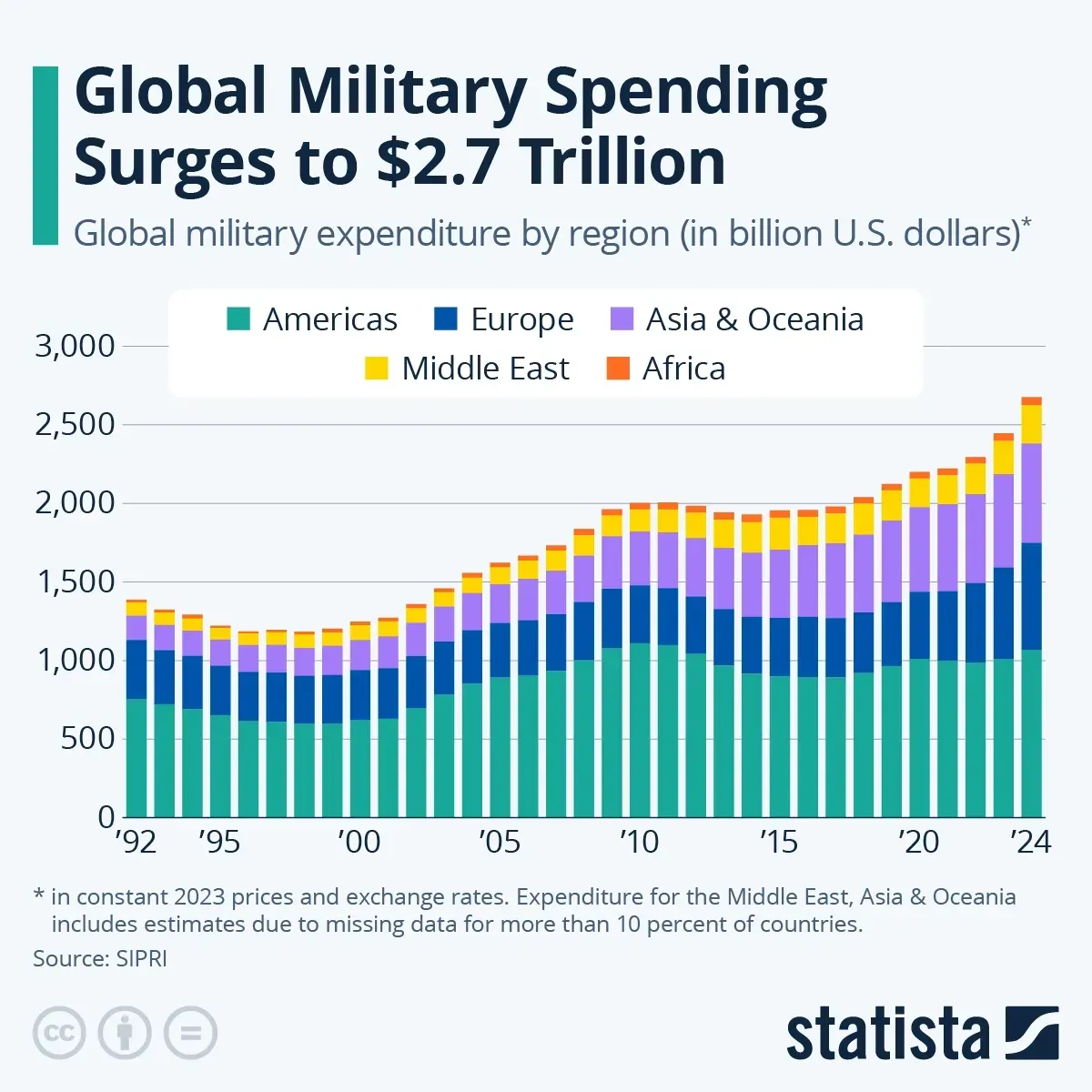
Global military spending; source: Statsta
But the bearish argument deserves equal weight. Growth will depend on whether these startups can solve the harder problem: translating venture capital into large-scale manufacturing capacity and navigating supply-chain constraints that have kept most from reaching battlefield scale. Defence-tech startups will have to prove to investors they can turn funding into actual production at scale, with manufacturing now the test that matters.
The honest question for capital allocators isn't whether defence tech is real. It's whether current valuations assume outcomes that can't actually happen, and whether the path from prototype to production is as smooth as the pitch decks claim.
What this means for private market investors
For sophisticated investors allocating capital to unlisted growth equities, defence tech presents a category that checks boxes few other sectors can match in 2026:
Demand that isn't going away. Defence tech companies with proven systems face procurement pipelines measured in years, backed by government budgets that are expanding, not contracting.
Margins that actually exist. Anduril's estimated gross margin of 40-45% significantly exceeds traditional defence primes, who typically operate in the 8-10% range. Late-stage investors who've watched too many unicorns flame out on the path to IPO will notice that immediately.
Exit pathways that are open. Industry reports suggest venture capital exits from defence-tech investments have increased. Liquidity is available.
Pre-IPO access matters here more than most sectors. Shield AI's trajectory from $2.8 billion to $5.6 billion in under two years shows that step-ups can happen quickly once operational traction is proven. For growth equity investors, positioning before those public market re-ratings is where asymmetric returns are captured.
The framework here isn't consumer tech. It's infrastructure. These are companies building the operating system for national security in the 21st century. The returns won't come from viral growth loops. They'll come from embedding so deeply into defence architectures that switching gets prohibitively expensive.
Is now the right time to get involved in defence tech?
The next decade of military innovation will not be led by the companies that defined the last century. It will be shaped by software-first defence startups built for a world where conflict evolves weekly.
The question isn't whether autonomous systems matter. The nearly $50 billion that flowed into defence tech in 2025 already answered that. The question is whether current entrants can execute at scale, and whether late arrivals can still find value in a market that's consolidating faster than it's fragmenting.
This article has been prepared using sources from Defence News, Bloomberg, Techcrunch, Pitchbook and other sources as linked.
This content is for informational purposes only and does not constitute investment advice or a recommendation to invest in any specific company. Defence technology investments carry significant risks including regulatory uncertainty, long sales cycles, contract concentration, and geopolitical volatility. Forward-looking statements are based on current expectations and assumptions; actual results may differ materially. Past performance is not indicative of future results. References to pre-IPO investment opportunities are intended for accredited investors only and subject to legal restrictions.