

Key takeaways
- GitHub research reports approximately 55% faster task completion with Copilot, although productivity gains should not be treated as universal automation.
- Consultants using AI performed better within its capability frontier but worse on unsuitable tasks, preserving the importance of expert judgment.
- AI may pressure billable-hour economics and junior hiring across professional services, while creating unresolved challenges for apprenticeship and future talent development.
Two laptops side by side. On the left, a coder ships three new features before lunch. On the right, a strategy consultant is finalising client feedback on slide 47. Both are using AI. The productivity gains look different, but both may face transformation.
That's one view of the reality playing out across professional services in 2026. According to the World Economic Forum's projections, 170 million new jobs could be created by 2030, while 92 million may vanish as artificial intelligence reshapes how knowledge work gets done. The question isn't necessarily whether AI will transform consulting and software development; it's how quickly and to what extent each industry adapts.
Coding is getting automated right now
Many software developers may have thought they were safe. Complex problem-solving, creativity, years of training. Then came AI pair programmers that can write, debug, and optimise code faster than most humans in certain contexts. Developers using GitHub Copilot complete tasks approximately 55% faster than those working without AI assistance, according to GitHub's research.
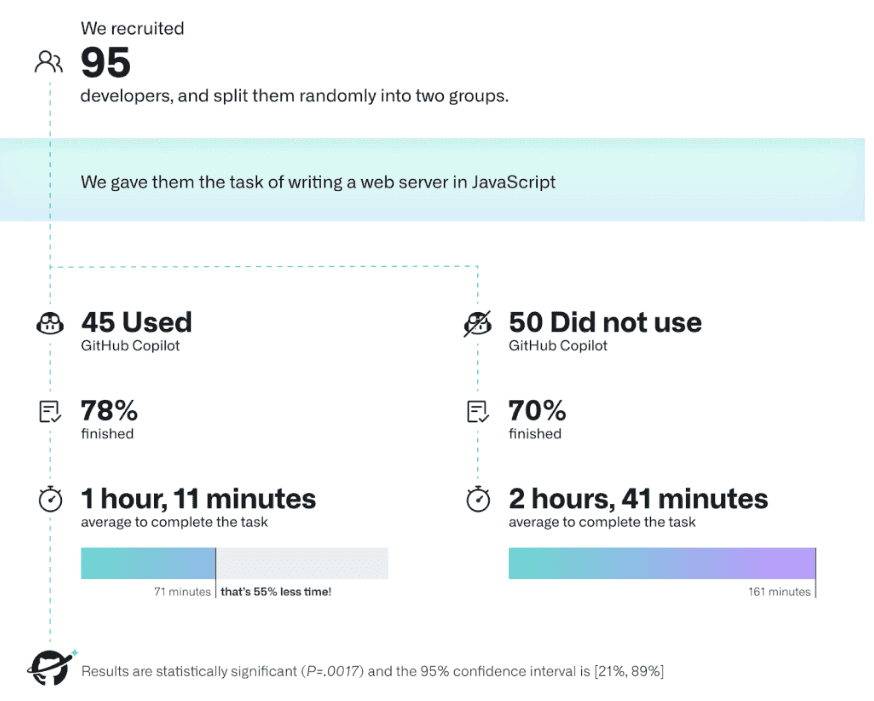
Source: Github
But speed is only part of the story. What may matter more is what's being automated versus augmented. When you look at how developers actually use AI coding tools, the data suggests a notable pattern. A significant portion of AI coding conversations appear to involve the AI directly performing tasks rather than just helping humans work faster. This suggests we may be seeing genuine task substitution, not just productivity boosts.
The junior developer problem
Employment for software developers aged 22-25 has declined nearly 20% from its peak in late 2022, according toStanford Digital Economy Lab research. That timing is notable. ChatGPT launched in November 2022. Within 18 months, entry-level developer hiring contracted sharply, though the precise causal relationship remains subject to analysis.
Recent surveys also suggest that a substantial proportion of hiring managers believe AI can handle tasks traditionally assigned to interns and recent graduates, though the extent of this sentiment varies across industries. If this sentiment is widespread, the talent pipeline could face significant challenges.
Startups have been quick to recognise the opportunity. A founding team that once needed five engineers may now find they need fewer engineers when leveraging Claude or Copilot. The competitive advantage appears measurable and the savings can be immediate. For investors evaluating AI infrastructure opportunities, such as those explored in Acquinox Capital's insights, this shift could have profound implications for talent-intensive business models.
Consulting's transformation may run deeper
Strategy consultants aren't necessarily pulling all-nighters less frequently thanks to AI. Many report working harder than ever. The difference may be what they're doing.
Junior consultants used to build financial models, conduct market research, and format presentations. AI can now handle much of that type of work, but the business model still typically requires armies of associates.
Research with Boston Consulting Group consultants revealed AI's limitations. 41% of employers expect to reduce their workforce where AI can automate tasks, according to the World Economic Forum's Future of Jobs Report 2025, but consulting presents unique challenges.
On tasks within AI's capability frontier, consultants using AI completed around 12% more tasks, 25% more quickly resulting in higher quality of work, according to the Harvard Business School study.
However, on unsuitable tasks, consultants using AI performed 19 percentage points worse than those working without it.
That's the "jagged frontier" problem identified by researchers. AI appears to excel at some consulting work while failing unpredictably at others. The challenge is knowing which is which, and that judgment arguably still requires significant human expertise.
The Big Four's gamble
The Big Four consulting firms and top strategy houses have collectively poured over $10 billion into AI initiatives since 2023, according to industry analysts.
Yet the fundamental business model has not fundamentally changed to date. These firms still largely bill hours. When AI collapses research time from days to hours, that model could face pressure. It becomes challenging to charge clients for 40 billable hours when AI completed the analysis in four, even if a senior consultant spent an hour verifying the output.
EY reported a 30% rise in AI-related revenues in FY25, driven by enterprise transformations and AI governance frameworks, but this largely appears to mean selling AI strategy to clients, rather than transforming their own operations. The industry may be caught between needing fewer junior staff and maintaining the pyramid structure that produces future partners.
Why coders may face faster disruption
Coding may be getting disrupted faster than consulting because the work is often discrete, outputs are more readily verifiable, and training data is abundant. Billions of lines of open-source code taught AI how to program. The tools appear to work and seem to be getting better quickly.
Factor | Software development | Consulting |
|---|---|---|
Measurable productivity gain | Approximately 55% faster with AI (per GitHub research) | More variable, context-dependent |
Entry-level employment | Down ~20% since 2022 (per Stanford data) | Gradual restructuring reported |
Task automation | Potentially high: code either works or doesn't | Potentially lower: value includes relationship and judgement |
Tool maturity | Widely deployed, improving rapidly | Reportedly experimental, uneven adoption |
Consulting work may resist automation because value often lives in ambiguity. One could argue that a market analysis delivered by AI may have less impact than one delivered by a trusted advisor who spent six months embedded with the executive team. That relationship and credibility are difficult to replicate through automation, but they also may not justify the old pricing model when AI does the analytical grunt work.
What both industries share: a talent crisis
Junior developers who never write boilerplate code from scratch could struggle to understand systems more deeply when relying on AI. Junior consultants who never build financial models manually may lack the intuition to spot when AI output is wrong.
Both industries have traditionally built expertise through apprenticeship. When apprentice-level work gets automated, how do you develop mastery? Neither field appears to have fully solved this yet, and it could matter enormously for long-term competitiveness.
The software industry may be ahead in one dimension: AI-native developers are already entering the workforce. They learned to code alongside ChatGPT and Copilot. They tend to think in terms of prompting and verification rather than pure implementation. Whether that produces better or worse engineers in ten years remains to be seen.
The investor perspective
From a capital allocation standpoint, these disruption patterns could create different risk-return profiles. For investors exploring opportunities in transformative technologies and their regulatory environment, understanding these dynamics appears increasingly relevant.
Software services firms that capture productivity gains and pass savings to clients through competitive pricing may be well-positioned to win market share. Those that cling to legacy billing models could face headwinds. Evidence suggests the transition may already be underway.
Consulting firms face a harder choice. Radically restructure around AI-augmented senior talent, or try to preserve the pyramid. Firms that choose restructuring could emerge smaller, more profitable, and more selective. But they would likely need to address the talent development problem first, because building a firm entirely of senior people presents significant challenges.
For investors evaluating opportunities in AI-driven transformation or secondary market transactions in emerging technology, the key insight may be this: disruption appears to be happening at different speeds but could reach similar depths. Investors may wish to position accordingly.
This article has been prepared using sources from the World Economic Forum Future of Jobs Report 2025, Harvard Business School, GitHub, EY and others as cited.