In 1811, Luddites smashed textile machinery in Nottingham, convinced that automation would end work. Two centuries later, Britain had about five times the population and record-low unemployment. The textile workers were right about their jobs but dead wrong about work itself. The AI employment debate is likely making the same category error.
For investors trying to separate signal from noise in the AI employment debate, this paradox is the starting point. The question dominating boardrooms and policy circles isn't whether AI destroys jobs. It often enhances employee productivity, likely leading to subsequent job losses. The question is what economic model emerges when task automation and labour scarcity collide, and which companies capture value in that transition.
Hype or reality? Both, simultaneously
The headlines scream replacement. The data tells a more complex story.
The IMF estimates 60% of jobs in advanced economies are exposed to AI. But exposure doesn't mean elimination. Roughly half of those roles are more likely to benefit through higher productivity and wages than to disappear entirely.
AI is the core driver of business transformation: according to employers surveyed by the World Economic Forum, 86% cite AI and IT as the technology likely to drive business transformation.
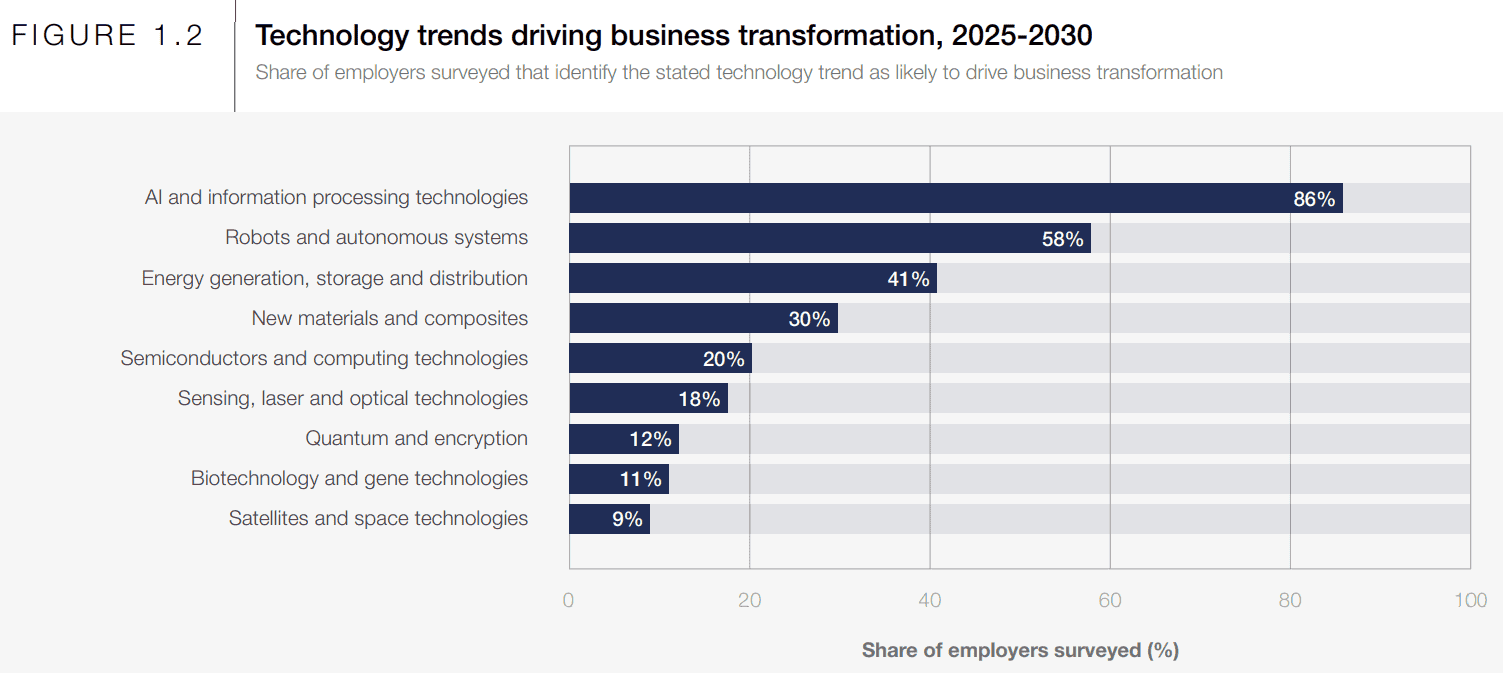
The WEF also projects AI and related technologies will create around 170 million new roles globally by 2030, while displacing 92 million. That's a net gain of 78 million jobs, however, with brutal sectoral and skill reallocation along the way.
To give an example of how AI is shaping employment dynamics right now: At a law firm, a junior associate who once spent 40 hours reviewing merger documents for compliance may now spend four by employing AI as an assistant. An AI agent can scan contracts, flag issues, and draft summaries. The junior lawyer could then review, edit, and advise clients. Her billable hours won’t drop, but her output tripled.
The story is a fictitious example, but similar dynamics happen all around the globe in various clerical jobs and industries. The difference lies in task exposure and adaptation speed.
Tasks are being automated, not work
The pattern is becoming clear across industries. AI automates tasks, not entire occupations.
Routine, predictable work such as data entry, basic admin, call-centre scripts, and simple accounting faces the highest automation or job replacement risk. But even in exposed professions, jobs are morphing into AI-augmented roles rather than vanishing outright. Less grunt work. More oversight, judgment, and client interaction.
The World Economic Forum found 40% of employers expect to reduce headcount where AI can automate tasks. But a majority plan to upskill existing staff to work with AI rather than simply replace them. The OECD confirmed that higher AI exposure correlates with more job vacancies overall, not fewer. Yet, massive shifts in the mix of skills and occupations are demanded.
The divide isn't humans versus machines. It's AI-complementary humans versus AI-substitutable routines.
Productivity: the hidden engine
Major institutions like the IMF, OECD, McKinsey converge on a critical insight often missing from the employment panic: AI's biggest macro effect is productivity growth, not pure headcount cuts, especially in advanced economies facing ageing populations and labour shortages.
Higher productivity at the firm and economy level tends, over time, to raise incomes and create new demand, which supports new jobs, even as specific tasks are automated away. This isn't theory. Historical evidence from previous automation waves shows no long-run collapse in aggregate employment, but painful transitions for certain regions, sectors, and skill groups, followed by reallocation into new categories of work.
The key variable is adaptation speed, not whether automation exists.
Winners and losers: adaptation, not automation
Real deployments show "centaur" models, humans using AI agents, outperforming both humans alone and AI alone on complex work. Coding, customer support, medical drafting, and financial analysis. The highest returns come when firms redesign jobs so AI handles patterned, repetitive, or summarisation work, while humans focus on ambiguity, relationships, ethics, and high-stakes decisions.
Workers who learn to use AI tools for coding, analysis, content creation, and decision support are seeing wage and employment resilience. Those whose routine tasks are automated without reskilling support face the largest downside. Employers cite skills shortages in 60-70% of cases as the constraint on AI deployment, not capital or technology.
That hybrid model, humans directing machines, is becoming the default work configuration, not a full replacement.
Where the opportunities actually are
For investors, the AI employment shift creates three distinct opportunity zones where business models align with structural demand rather than hype cycles.
AI infrastructure and tooling: Companies building the copilot layer, enabling workers to supervise AI rather than be replaced by it, are seeing explosive enterprise adoption. Platforms that integrate AI into existing workflows without requiring workers to become data scientists are capturing the largest addressable markets. This includes vertical AI solutions in legal, healthcare, finance, and operations, where regulatory complexity and high-stakes decision-making create durable moats.
Reskilling and talent infrastructure: As skill gaps emerge as the main barrier to productive AI adoption, the market for corporate reskilling, credentialing, and talent platforms is expanding rapidly. This isn't EdTech 2.0. It's essential infrastructure for companies navigating the largest workforce transition in a generation.
AI-native services in constrained sectors: Healthcare, elder care, education, and public services face structural labour shortages due to ageing demographics. AI that boosts productivity in these sectors, without replacing human judgment, unlocks latent demand rather than cutting headcount. The growth is in augmentation, not automation.
Geographic arbitrage also matters. Regions investing in active labour transition policies and AI literacy are seeing faster productivity gains and lower displacement, creating valuation gaps between otherwise comparable companies operating in different regulatory and talent environments.
The bottom line
AI is neither utopia nor apocalypse. It's a productivity engine that amplifies both capability and inequality. The macro effect is growth, not contraction, in particular in advanced economies facing labour shortages and ageing populations.
But here's what the hype-and-fear cycle misses: the smartest capital isn't betting on full automation or resisting it entirely. It's backing the companies enabling hybrid models where AI handles repetitive tasks, and humans handle judgment, ethics, and relationships.
McKinsey estimates hundreds of millions of roles could be displaced globally by 2030 if adoption is fast. The same forecasts point to net positive job creation in AI-intensive, green, health, and care sectors, provided that reskilling and policy keep pace. The transition gap is real. The opportunity lies in companies bridging it.
The future of work isn't humans versus machines. It's humans directing machines. The investment opportunity lies in identifying the platforms, tools, and services that make that partnership productive, scalable, and defensible.
For those willing to look past the headlines, the AI employment transition represents exactly what venture-backed infrastructure plays have always been: calculated bets on companies solving real problems, with proven business models, in markets shaped by structural demand rather than speculative narratives.
This article draws on research and data from the International Monetary Fund (IMF), World Economic Forum (WEF), McKinsey Global Institute, and publicly available information, as of December 2025.
Published by Samuel Hieber