

Key takeaways
- Several benchmarks of large, actively traded private tech companies recorded unusually strong gains in H1 2026, but capital and gains concentrated in a few companies, rounds and managers.
- Tender offers, direct secondaries, SPVs and co-investments give leading private companies routes to new capital and shareholder liquidity before an IPO; 2025 tender volume reached about $35 billion.
- Main risks: companies still priced off 2021–22 rounds, indicated interest shifting towards sellers, layered-vehicle costs, lock-up supply and heavy exposure of new deployment to AI.
The largest private technology companies can now raise capital at scale, give employees and early investors liquidity, establish market prices for their shares and syndicate ownership, all without first going public. In effect, they have access to a capital market of their own, built from tender offers, special purpose vehicles (SPVs), co-investments and a growing private secondary market. The first half of 2026 made that infrastructure unusually visible, and showed how concentrated it remains. This is not a broad venture recovery story. It is a story about the institutionalisation of the late-stage private technology market, and about how few companies and managers that development currently reaches.
In brief: the private secondary market. The private secondary market is where existing shares in private companies change hands before an IPO or acquisition. For late-stage companies it takes four main forms: company-run tender offers, direct transfers between holders, SPVs that pool investors into a single position, and forward contracts. It is distinct from the larger market for interests in private equity and venture funds, which Lazard tracks separately and which this article does not cover.
Strong private benchmarks, measured on a narrow group
Several private-market benchmarks, measured over different periods, recorded unusually strong gains this year. The Caplight Top 20 Index returned 37% in H1 2026, and the NPM Private Market Tracker of the 50 largest names in Nasdaq Private Market's data rose 47%, against roughly 20% for the Nasdaq 100 over the same six months. Measured over the 12 months to August, Forge's equal-weighted Forge Private Market Index rose 86.6%, against 26.3% for the Nasdaq 100 tracker.
These benchmarks use different universes, weightings and periods, none represents private markets as an asset class, and each tracks only companies traded often enough to be priced. Breadth was limited even within them: NPM's broader top-100 average rose 28%, well below its top 50, and NPM attributes much of the outperformance to a small number of companies that raised capital at sharply higher valuations.
| Benchmark | What it tracks | Period | Return | Nasdaq 100, same period |
|---|---|---|---|---|
| Caplight Top 20 Index | Largest late-stage, VC-backed companies with active secondary markets | H1 2026 | +37% | ~+20% |
| NPM Private Market Tracker | 50 largest names in NPM's data by enterprise value | H1 2026 | +47% | ~+20% |
| NPM top 100 | 100 largest names by enterprise value, average | H1 2026 | +28% | ~+20% |
| Forge Private Market Index | Actively traded private companies, equal-weighted | 12 months to 31 Aug 2026 | +86.6% | +26.3% (QQQ) |
Sources: Caplight 1H'26 Venture Market Update (July 2026); Nasdaq Private Market, Halftime 1H 2026 review; Forge Private Market Update (September 2026). Methodologies and periods differ; figures are not directly comparable with each other.
Capital is returning to venture, but concentrating at the top
Fundraising recovered, but narrowly. According to Caplight, US venture funds closed $72.4 billion across 405 funds in H1 2026, nearly matching all of 2025. Established managers, defined as firms that have raised four or more funds, took 89% of that capital, the highest share in a decade, and only 53 first-time funds closed, the fewest since 2016. Distribution yields to limited partners returned to their long-run average of 17.9% for the first time since 2022.
Deployment was more concentrated still. The PitchBook-NVCA Venture Monitor reports that rounds of $100 million or more captured 87.5% of the $412.7 billion invested in US startups in H1 2026, and that AI companies took 86% of all venture dollars. Four rounds accounted for $237 billion: OpenAI's $122 billion round, Anthropic's $30 billion Series G in February and $65 billion Series H in May, and xAI's $20 billion round.
Removing the largest transactions shows how much of the headline rests on a handful of deals.
| Measure | Headline | Excluding the largest transactions | What was excluded |
|---|---|---|---|
| US IPO proceeds | $128B | ~$42B | SpaceX IPO ($85.7B) |
| US VC-backed M&A value | $375B | ~$65B (~1,070 deals) | SpaceX's acquisitions of xAI ($250B) and Cursor ($60B) |
| US venture-growth deployment | $274B | ~$37B | Four largest rounds ($237B) |
Sources: Caplight 1H'26 Venture Market Update, using PitchBook and EY data; Forbes (June 2026) for SpaceX IPO proceeds including the over-allotment; PitchBook-NVCA Q2 2026 Venture Monitor. Acquinox analysis subtracts the named transactions from each headline total.
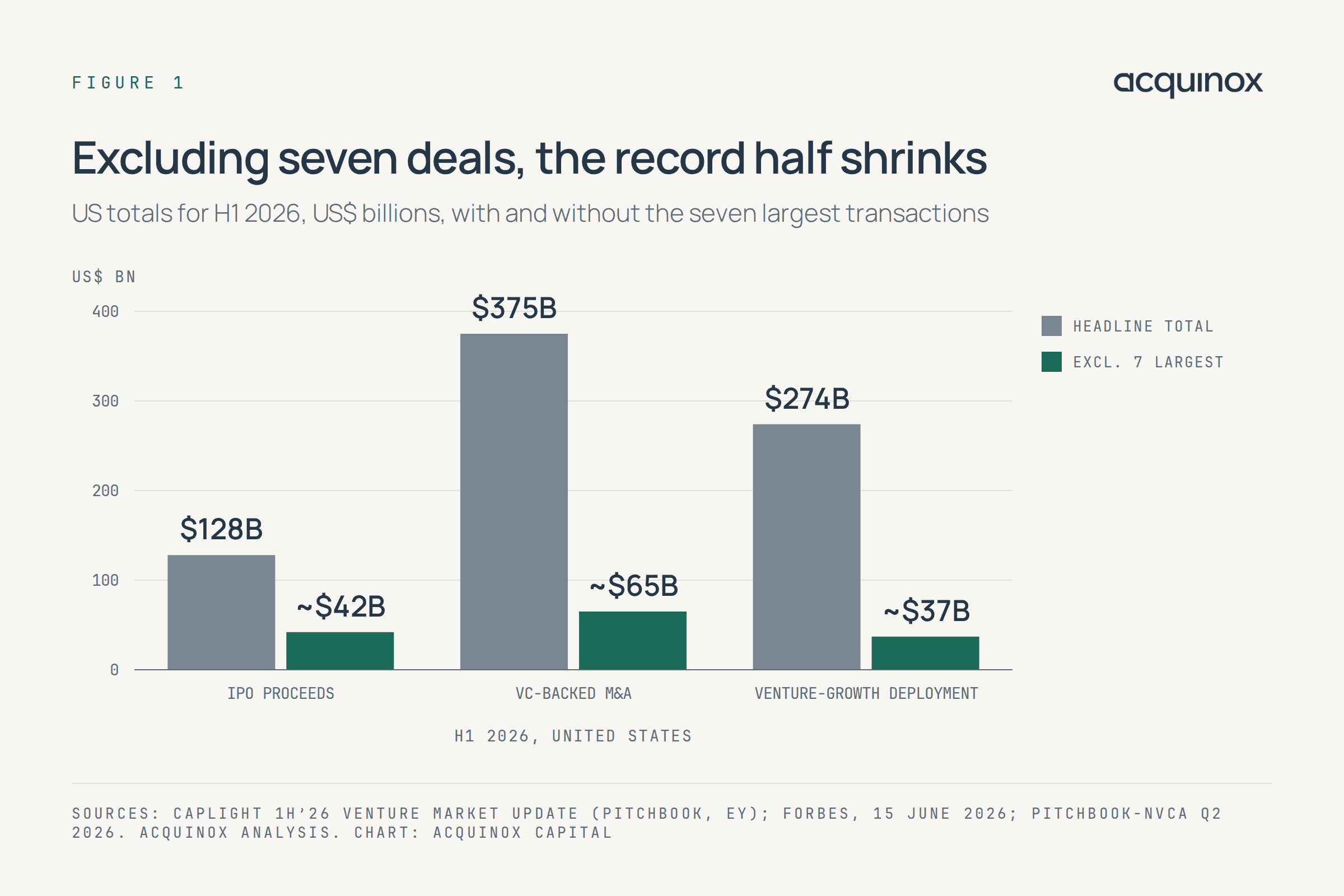
Figure 1. The seven transactions excluded are SpaceX’s IPO, its acquisitions of xAI and Cursor, and the four largest venture rounds. Acquinox analysis.
Capital has returned selectively, concentrating among established managers and a small number of very large companies and financing rounds. That concentration is one half of the story. The other is the infrastructure that has grown up around those companies.
The private secondary market is becoming routine infrastructure
Venture liquidity once meant waiting for an IPO or acquisition. For leading private companies, several mechanisms now provide it along the way.
Company-run tender offers have become an increasingly important source of liquidity. Nasdaq Private Market estimates tender volume at $35 billion in 2025; that reported figure was equivalent to roughly 78% of 2025 US IPO proceeds by value, which NPM puts at about $45 billion. Tenders have also become more frequent: on NPM's platform, the average interval between a company's tenders fell from 899 days in 2022 to 132 days in 2025.
Secondary trading has held near record levels. Closed transaction volume observed by Caplight totalled about $2.4 billion in H1 2026, around 39% above the first half of 2025 on our calculation from its quarterly data, with SPVs accounting for about 70% of that volume. Pricing has also converged with primary rounds. In June, the median secondary trade on Forge reached par with the company's last primary round for the first time since February 2022. The median discount was 7% in July and 3% in August, according to Forge's September update, against discounts approaching 50% in 2022 and 2023.
Two functions are often grouped together here. Primary rounds and GP-led co-investments are capital formation: they bring new money into the company. Tender offers, direct secondaries and SPVs that buy existing shares provide shareholder liquidity: they let employees and earlier investors sell. An IPO or a sale can provide both. What has changed is that mature private companies increasingly have private-market solutions for each.
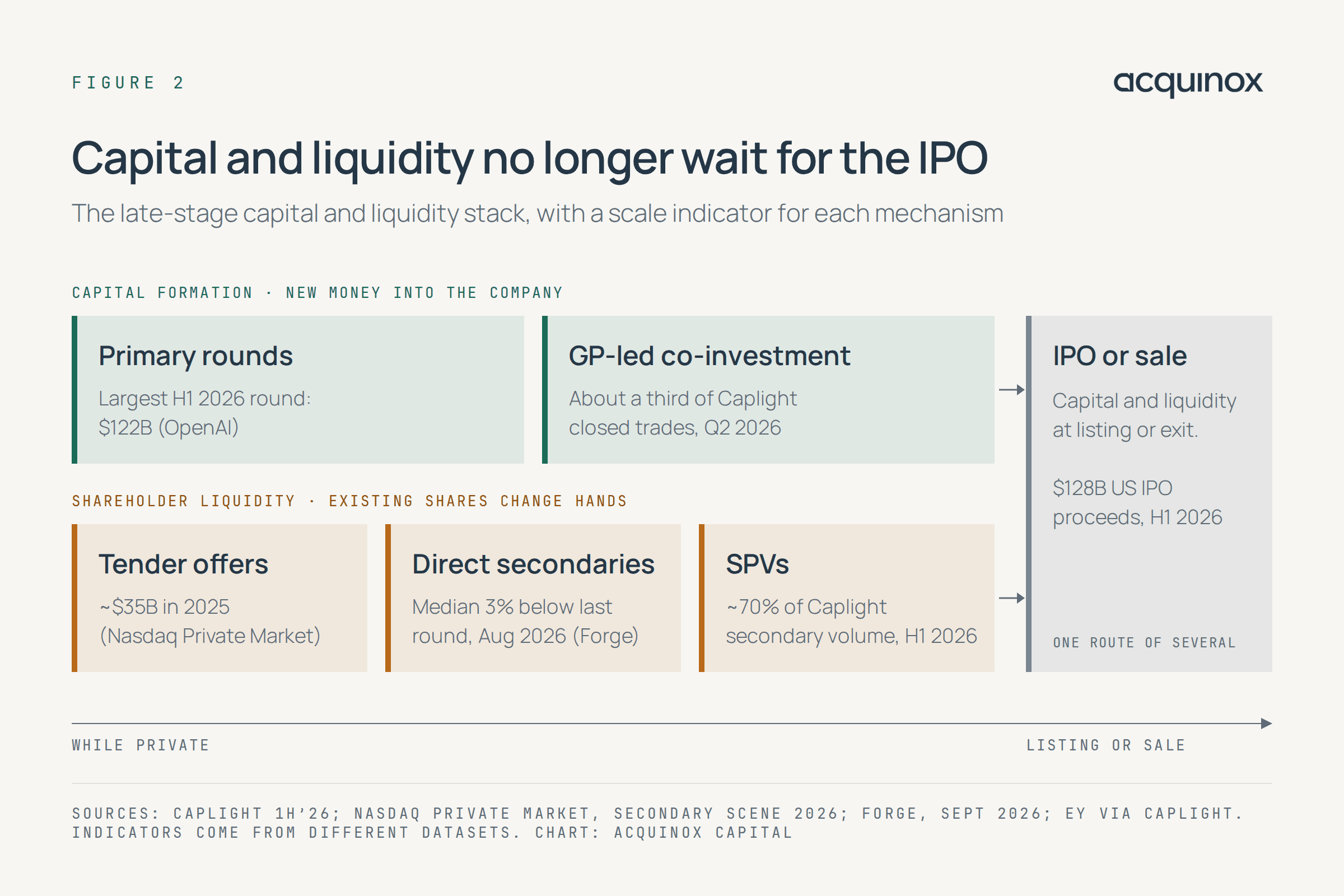
Figure 2. Capital formation brings new money into the company; shareholder liquidity lets existing holders sell. Leading private companies now have private-market routes to both.
Secondaries are evolving from an occasional workaround for illiquidity into part of the normal financing architecture of mature private companies. Routine use by companies, employees and funds creates more frequent market reference points, even though transparency and trading depth remain uneven.
For the strongest companies, staying private is increasingly a choice
Companies traditionally went public to raise growth capital, create acquisition currency, and give employees and investors liquidity. For a narrow group of well-capitalised, highly sought-after companies, private markets now provide much of this. Forge calculates that xAI reached a $100 billion valuation in 2.3 years and Anthropic in 4.5 years, against 19.6 years for SpaceX. Much of that capital came from sovereign wealth funds, corporations and crossover investors rather than venture funds.
This does not mean the largest companies are avoiding public markets. SpaceX listed in June in the largest IPO on record, raising $85.7 billion, and Anthropic has confidentially submitted a draft registration statement, as OpenAI reportedly has. What has changed is the timing. Large late-stage companies can now experience substantial valuation growth before listing. That makes the IPO one option within a broader capital stack, a liquidity milestone whose timing the company largely controls, rather than the only mechanism able to support a company at scale.
Mega-rounds have outgrown the traditional venture fund
Late-stage round sizes have grown much faster than the funds that write the cheques. According to PitchBook-NVCA data compiled by Caplight, the median US Series D+ round for AI companies rose from $100 million in 2023 to $235 million in 2026 so far, and for non-AI companies from $58 million to $150 million. Between 2023 and 2025, 60–64% of US venture funds raised each year were smaller than $50 million, and Caplight estimates that the median AI round is now nine times the size of the median venture fund.
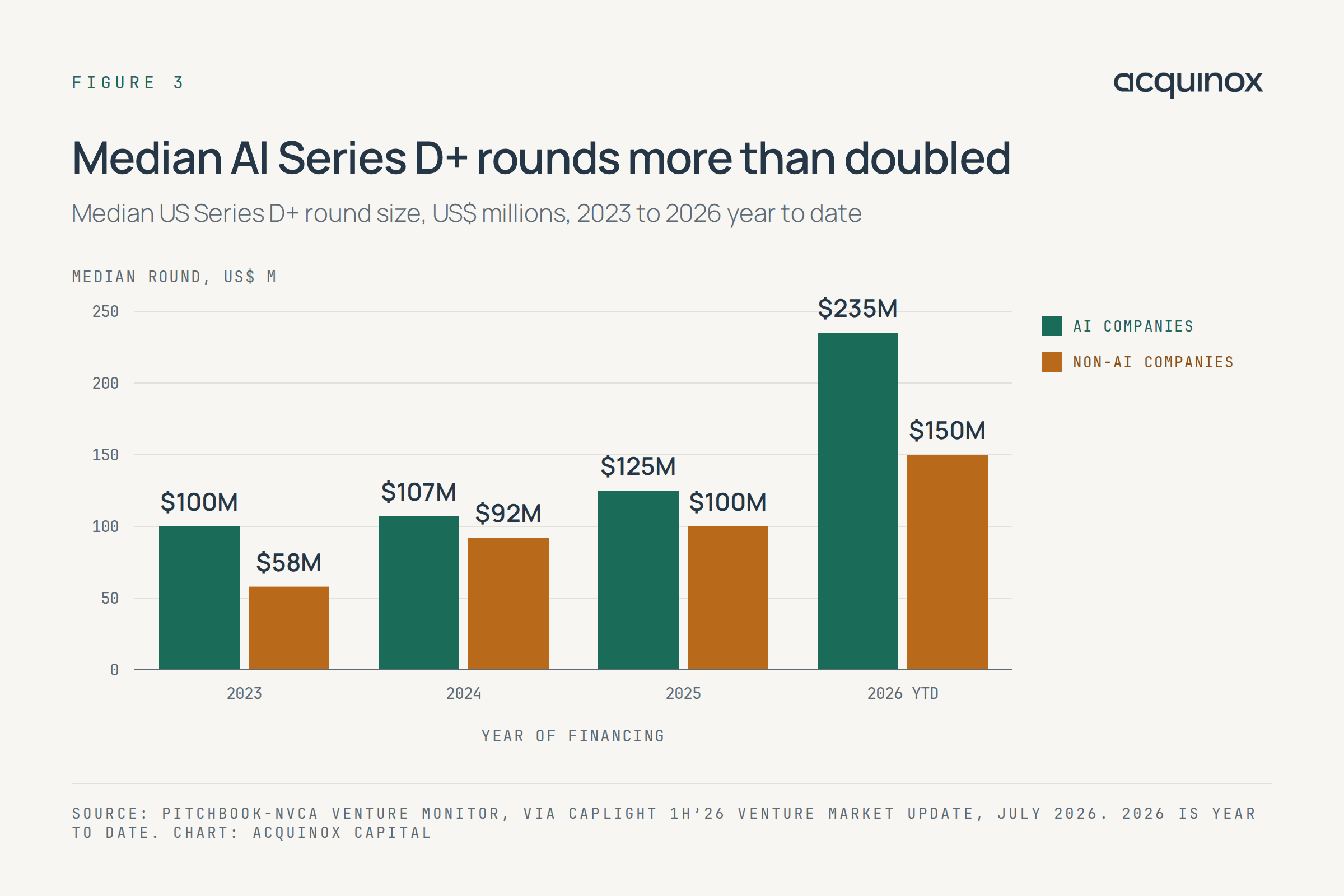
Figure 3. Median US Series D+ round size for AI and non-AI companies, 2023 to 2026 year to date.
A fund that leads or joins a round and wants to preserve its ownership increasingly faces an allocation larger than it can absorb within its concentration limits. The result is more syndication to limited partners and outside investors through co-investments and single-asset SPVs. On Caplight's platform, GP-led co-investments made up about a third of closed trades in Q2 2026 by count.
In our view, the growth of co-investment is not only a function of investor demand for direct exposure and lower-fee structures. It increasingly reflects the economics of late-stage financing itself: rounds have become too large for individual funds to absorb while maintaining concentration limits, so they have to be distributed, and the terms, rights and vehicle economics of that distribution become part of the investment outcome. Our earlier analyses of co-investment platforms and deal-by-deal investing examine the investor side of the same shift.
Frontier technology makes the private market heavier
The companies defining this cycle are more capital-intensive than the software companies that led the last one. Training clusters, data centres, power, robots, autonomous fleets and launch systems require billions of dollars of investment before reaching operating scale or public-market maturity: Waymo raised $16 billion in February and Prometheus $12 billion in June.
Secondary trading reflects this. Caplight reports that physical AI companies, spanning AI compute, defence, robotics and autonomy, accounted for about 40% of its closed-trade volume in H1 2026, with more than $1 billion of open buy interest across the category. This capital intensity also connects directly with our four investment pillars: Intelligence, Compute & Energy, Embodiment and Sovereign Demand. Each requires capital on a scale that has pushed the private market to build the infrastructure described above.
Deeper liquidity, sharper selection: the risks that matter
A deeper private secondary market does not lift every asset; better price discovery makes differences between companies easier to see.
A backlog of companies priced in a different market
Forge counts 497 private companies that last raised capital in 2021 or the first quarter of 2022. Of the 112 that have traded on its marketplace, the median indicative price sits 61% below the last round. Bending Spoons' acquisition of Airtable for $1.28 billion in cash, against an $11 billion valuation in 2021, implies a discount of about 88% on Forge's cash-price basis. For companies that have not raised since, the last round is a weak reference price.
Indicated interest has shifted towards sellers
Buy-side indications of interest on Forge fell from 57% of activity in June to 48% in July and 45% in August, the lowest share since late 2023, as more shareholders sought liquidity after the SpaceX listing. Median pricing held close to the last round, but a sustained shift in indicated interest towards sellers would test valuations, starting outside the most sought-after names.
Concentration is also correlation
With 86% of H1 venture dollars going to AI companies, new deployment has become highly exposed to a single theme. PitchBook's analysts warn that this leaves the market vulnerable to a broad correction if AI growth or returns disappoint.
Layered vehicles and access premiums
Access increasingly comes through vehicles. Caplight identifies seven retail-facing funds holding more than $4 billion of pre-IPO equity, most trading above their net asset value. Multi-layer SPVs can add fees, carried interest and counterparty risk, and investors may pay a premium to the underlying asset price for access.
Lock-up expiries and post-IPO supply
SpaceX lock-ups began expiring in August, according to Caplight. Expiries allow SPVs holding the shares to unwind or distribute them and may prompt some to do so, adding supply; later listings of large private companies could follow the same pattern.
Data limits
Much of the evidence comes from individual platforms, where indicative prices can rest on few trades or indications of interest. It should be read as a set of signals, not a single market statistic.
What to monitor as the private market matures
Six indicators will show whether this structure deepens or proves cyclical: the median secondary discount or premium to the last primary round; the balance of buyer and seller interest; tender-offer volumes; whether record exit value translates into higher distributions to limited partners; dispersion between the largest private names and the rest of the market; and whether deployment broadens beyond a handful of AI mega-rounds.
The boundary between public and private capital markets is becoming less rigid. Leading private technology companies now have many of the financing and liquidity tools once associated with listed companies, and investors have more ways to enter, price and exit before an IPO, as our analyses of pre-IPO M&A and the acquisition-or-IPO decision describe. Greater depth does not remove the need for underwriting. In a more liquid and more differentiated market, company selection, entry valuation, security structure, vehicle economics and exit optionality matter more. The defining question for late-stage investors is shifting from when a company will go public to how value compounds and liquidity emerges while it remains private.
This article is for informational purposes only and does not constitute investment advice or an offer to buy or sell any security. It reflects publicly available information and estimates as of the publication date, which may change. Private market investments involve substantial risks, including illiquidity and potential loss of capital. Readers should conduct their own due diligence and consult qualified advisors before making investment decisions.